
Science in the Mountains
Our monthly virtual lecture series features experts on weather and climate topics.

School Visits
In-classroom and after-school programming delivered by our science educators aligned with Next Generation Science Standards.

Weather Station Tours
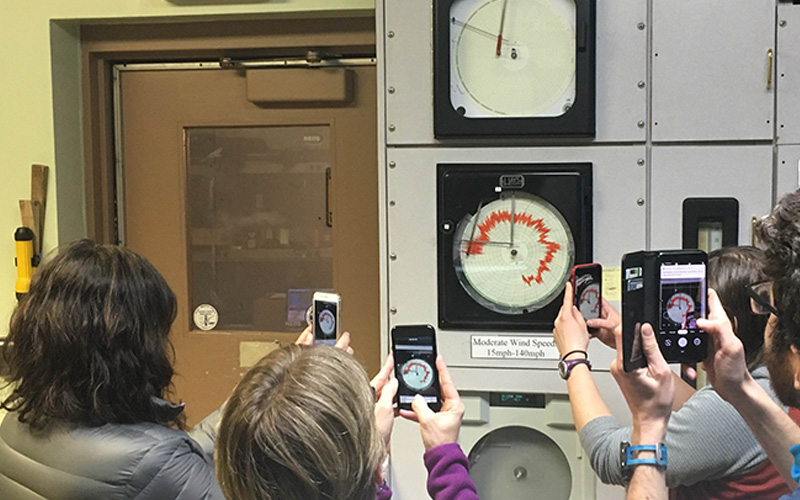
Tour the historic Mount Washington Observatory Weather Station as a member, or as part of a special group or event.

Field Trips
Bring your students to the “natural laboratory” that is Mount Washington Observatory’s summit weather station in partnership with the Mt. Washington Cog Railway.


Educational Resources
Curricular resources, lesson plans, media, data and links to other excellent materials.

Distance Learning for Adults
Connect your group live and learn with weather observers at Mount Washington Observatory’s summit weather station.

Professional Development
Professional learning opportunities for K-12 teachers in weather, climate and Earth science.
Overnight Edutrips
Educational overnight adventures on the summit of Mount Washington, led by Observatory staff and guest experts.
Education has been an integral part of the Observatory’s mission since our founding in 1932. Today, the spirit of exploration lives on, that quest for learning burns bright, and our passion for education is stronger than ever before.
We are proud to develop and offer a diverse, innovative offering of educational programs and resources, created by our experts in weather and climate. From virtual programs to custom presentations delivered onsite to your audience, summit adventures, weather station tours, professional development, and our Extreme Mount Washington museum, we are committed to increasing science literacy, helping our audiences better understand how weather and climate affect the natural world.


Program Support


National Science Foundation
The National Science Funded WeatherX curriculum promotes interest and skills in scientific data practices among middle school students in rural areas. With WeatherX, students use large-scale data to investigate typical and extreme weather in their rural communities and on New Hampshire’s Mount Washington, a place that has been called the “Home of the World’s Worst Weather.” Our multidisciplinary team is studying WeatherX learning experiences and is making resources available for science classrooms.
New Hampshire Charitable Foundation Neil and Louise Tillotson Fund
The vision of the Neil and Louise Tillotson Fund is “to serve as a resource for the people of Coös County and neighboring communities in New Hampshire, Maine, Vermont and southern Québec to forge their own pathways to well-being and cultivate a region that thrives.”


The Kendal C. and Anna Ham Charitable Foundation
Kendal and Anna Ham had long decided that their estates should support their charitable intentions. They had lived for many years in Conway, New Hampshire and had a lakeside summer cottage on Moose Pond in Bridgton, Maine. These communities were welcoming and important places to the Hams, and Anna decided that they should be the primary focus of their philanthropic efforts.
Meredith Village Savings Bank
Meredith Village Savings Bank (MVSB) is a mutual savings bank based in New Hampshire, founded in 1869, that serves individuals, businesses, municipalities, and nonprofits in the Lakes Region, Plymouth, and Seacoast areas of the state. MVSB is well known for its extensive charitable giving and community support. Through its dedicated philanthropic arm, the MVSB Fund — established in 1997 — the bank annually awards grants to a broad array of local nonprofit organizations working on environmental, educational, social, historic-preservation, and public-health projects.
The John D. McGonagle Foundation exists to support educational and mentoring opportunities for children and young adults, veterans, conservation, and other activities that contribute to a healthy community in the greater New England area.
The Agnes M. Lindsay Trust is a private foundation that provides financial grants to 501(c)(3) nonprofit organizations across Maine, Massachusetts, New Hampshire, and Vermont. Its mission focuses on relief of suffering, child welfare, and rural education by funding initiatives in health and welfare, dental care, summer camperships, food pantries, and homeless shelters. Over its nearly nine-decade history, the trust has awarded millions of dollars—primarily for capital projects, equipment, and targeted program support—to assist underserved communities in northern New England and Massachusetts.
We are the Greater Lakes Region Children’s Fund, supporting local kids and families in need through community fundraising efforts including the Children’s Auction, Pub Mania, Christmas in July, and the Sweepstakes Social. Together, these events make a lasting difference for our community all year long.
The Dorr Foundation
Since 1940, The Dorr Foundation has empowered visionary programs with seed funding and support – honoring a legacy of discovery, growth, and partnership.
The Air We Share is a national partnership between Sanofi and the Association of Science and Technology Centers (ASTC)’s Seeding Action, that helps communities understand how environmental factors like air pollution, wildfire smoke, and extreme heat affect respiratory health. By working with science centers and museums across the United States, the program brings trusted, science-based information directly to communities, providing them with practical ways families can protect their health and make informed everyday decisions.

TEAM II is Next Gen STEM’s congressionally authorized competitive award program that enables non-profit museums, planetariums, libraries, and youth-serving organizations to propose NASA mission-inspired STEM projects for K-12 students and their learning support systems of families and educators. TEAM II is designed to enhance the ability of informal education institutions and partners to deliver and participate in NASA-based activities, and to increase the capacity of institutions to utilize NASA resources and to provide students with the opportunity to contribute to NASA’s mission.