
Beyond the Classroom: STEM Learning Ecosystems and Community Partnerships
By MWOBS Staff
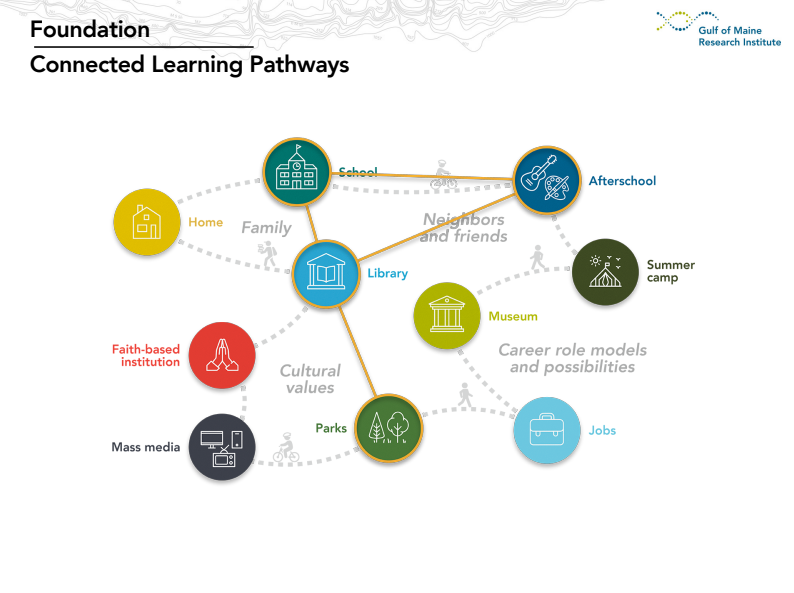
Connected Learning Pathways. Infographic by Gulf of Maine Research Institute.
Mount Washington Observatory (MWOBS) offers a wide range of educational programs for learners of all ages as well as teaching professionals. From digital programs like Science in the Mountains, to immersive in-person experiences like field trips for youth and EduTrips for adults, an overarching goal of the Observatory’s educational offerings is to provide accessible, enriching experiences to foster not only weather curricula engagement, but also a passion, connectedness and curiosity for the world around us and the discoveries to be had in our own backyard on New England’s highest mountaintop.
Perhaps a lesser known, but equally important educational tool the Observatory has been building over the past few years is its involvement in the White Mountains Connected Learning Ecosystem (CLE), which supports collaboration and resource sharing for formal and informal educators in our region working to build knowledge of climate and data literacy skills and resources.
Launched in 2023, this professional learning group is part of the NASA-sponsored Learning Ecosystem Northeast (LENE) network spanning New York, Vermont, Maine, and New Hampshire, bringing formal and informal educators together in support of student learning in and out of the classroom. Inspired by a simple observation, CLE educators not only learn and share together, but intentionally build connected learning opportunities in their communities so that every child has an opportunity to succeed in a context that appeals most to them. For example, one child may struggle in the classroom, but thrives in their 4-H club using math, or excels at a library’s STEM camp.
MWOBS’s education team became involved in the LENE network in early 2023 with an open invitation from lead institution Gulf of Maine Research Institute (GMRI). GMRI had previously grown a handful of CLEs across the State of Maine and were looking to expand the network across northern New England and New York by inviting science and technology centers to serve as anchor institutions in their communities to build and coordinate a CLE. In New Hampshire, MWOBS, Squam Lakes Natural Science Center, and Seacoast Science Center took the lead creating the first CLEs across the state of New Hampshire where each institution had strong mission alignment with expanding climate and data literacy knowledge.
As a core focus, the White Mountains CLE shares, develops, implements and evaluates weather, climate and data literacy learning experiences primarily for students in grades six through eight. Practically speaking, this group convenes once a month to build connections, share data and climate resources, and collaborate on projects that ultimately serve youth learning in our community. MWOBS is proud to serve as one of the science and technology centers in the Northeast convening these innovative groups that aim to share access to resources, facilitate communication and build community partnerships.
MWOBS STEM Programs Manager Jackie Bellefontaine and Whitefield Elementary teacher Amanda Garneau serve as the co-leads of the White Mountain CLE, while MWOBS Director of Education Brian Fitzgerald serves as the co-lead of the LENE community of practice that connects each science and technology center leading similar CLEs across the region to share out network-wide resources, including NASA Earth Science assets.
“Just as our educational programs were about to rapidly expand, the invitation to participate in the LENE network was so perfectly timed,” shares Fitzgerald. “MWOBS, along with so many fantastic educators in our region, have a lot on their plates, so collaboration sometimes takes a back seat. With a connected learning approach, we’re working toward a future where collaboration is the default, and all educators and youth stand to benefit.”
Last year, the White Mountains CLE took part in eight gatherings, including two in-person field trips to learn about the changing nature of our seasons on the summit of Mount Washington and at the Rocks Estate and tree farm in Bethlehem. In spring of 2025, the CLE launched its first connected learning project in partnership with the Mount Washington Valley Youth STEM Expo, Conway Public Library, White Mountain Science Inc. (WMSI), and Tin Mountain Conservation Center. A “climate exploration” track was added to the STEM Expo, encouraging students to conduct a science experiment or engineering project with a climate and Earth science focus. A free February break camp, hosted by Conway Public Library provided mentors for youth looking to build a science fair project. A first ever “climate exploration” track project was awarded a cash prize at the March STEM Expo by the White Mountain CLE.
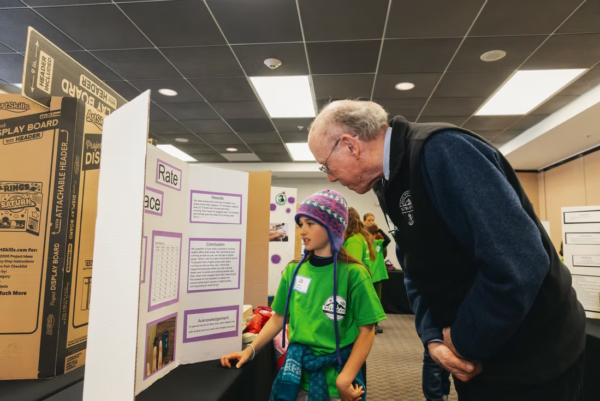
Dr. Peter Crane, MWOBS Curator, speaks with a participant as a volunteer judge at the 2025 MWV Youth STEM Expo. Photo by DVISION media.
More broadly, MWOBS participation in the network has expanded the reach of its programming and expertise. One anonymous educator shared their reflection in a recent LENE survey:
“I feel like now I see that [the CLE] is part of a bigger way of looking at things…Now all the little things are connected in a bigger network… I realized how many museums and other educational resources are involved. So if I want to do something with weather now I know that I could connect with the people at the Mount Washington Observatory… If we choose to pursue a connection, the groundwork is there and the support network is there.”
This past fall, Arizona State University hosted the STEM Learning Ecosystems and Community Partnership meeting in partnership with NASA’s Science Activation program and the National Informal STEM Education (NISE) Network, where Brian and additional White Mountains CLE partners collaborated with other STEM Learning Ecosystems from across the nation to learn about localized work to engage specific communities in STEM. Climate data and art, connecting educators in rural communities, and many connected learning project success stories were shared by educators taking part in truly inspiring work.
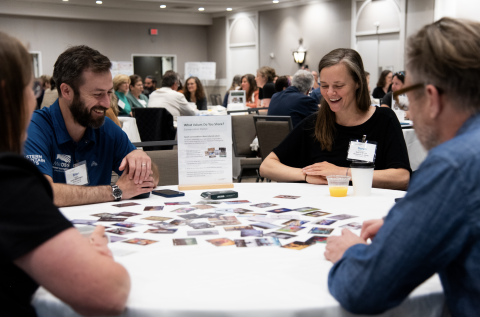
Brian Fitzgerald, MWOBS Director of Education (left), at this year’s STEM Learning Ecosystems and Community Partnership Meeting in Arizona. Photo by NISE.
For 2026, NASA funding appears murky; however the White Mountains CLE and the LENE network as a whole are just getting started. Connected learning mini-grants are allowing educators to carry out their own climate and data literacy projects, educators are purchasing weather stations for their students to investigate local weather data, and CLE in-person meet-ups will continue to give educators opportunities to connect, learn, and problem solve together. Stay tuned for more exciting work in this area.
To learn more about the STEM Learning Ecosystems project and its partners, visit https://www.learningecosystemsnortheast.org/about-lene.
If you believe these education programs are important, please consider giving a gift to Mount Washington Observatory during our Year-End Campaign.
From One Mountain to the Next
From One Mountain to the Next By Ellie Derry Hi everyone! My name is Ellie Derry and I am one of the fall 2026 interns at the Observatory. I’m super excited to be here
Mountains and Meteorology: What More Could a Girl Need?
Mountains and Meteorology: What More Could a Girl Need? By Emily Grainger Hi everyone! My name is Emily Grainger, and I am one of this fall’s Summit Interns atop Mount Washington! I’m from Orlando,
My Fear of Weather Became a Love of Meteorology
My Fear of Weather Became a Love of Meteorology By Kaitlin Farrell Hello! My name is Kaitlin Farrell. I am one of the fall summit interns here at Mount Washington Observatory. I recently graduated