
Geologist Climbs Rock Pile, Looks Up
By Bailey Nordin
Hello from the summit of Mount Washington!
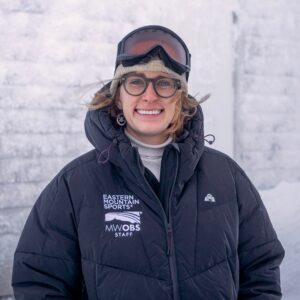 My name is Bailey Nordin, and I am the newest Weather Observer and Education Specialist joining the team up here at the Observatory! I’m coming to Mount Washington from the Upper Valley, where I spent the past several years both as a graduate student in the Earth Sciences department at Dartmouth College and also working as a long-term teaching assistant with Dartmouth’s off-campus field geology program this past fall. My time in the Upper Valley also cemented in me a passion for climate and natural science education through volunteer work at the Montshire Museum of Science in Norwich, VT. I am beyond thrilled to be making my meteorological debut at such a pioneering and historic center of alpine weather and climate!
My drive to understand our changing climate and work on problems in the regions it’s impacting the most has taken me to many cold places. Though I’m not a native New Englander, I’ve always found myself drawn to snowy mountains and cold weather wherever I can find it. After researching Antarctic subglacial erosion during my undergraduate degree in Earth Science at Columbia University, I become even more motivated to understand the impacts of earth’s warming temperatures on these sensitive and extreme environments in real time. I was thrilled, therefore, to get the opportunity to spend a year working with NOAA as an atmospheric science technician at the Amundsen-Scott South Pole Station, where I first began to experiment with types of science not involving rocks. (Situated at 9,300 feet above sea level and perched atop two miles of ice, there’s not a rock in sight at the South Pole.) My work in graduate school at Dartmouth also kept me close to frozen places, where I completed my master’s research on changing rates of permafrost erosion in the Northwest Territories of Arctic Canada, and worked as a teaching fellow for high school students in Greenland. Mount Washington is consequently not just the coldest place close to home for me, but also an impactful and uniquely dynamic location to better understand Earth’s weather, atmosphere, and climate.
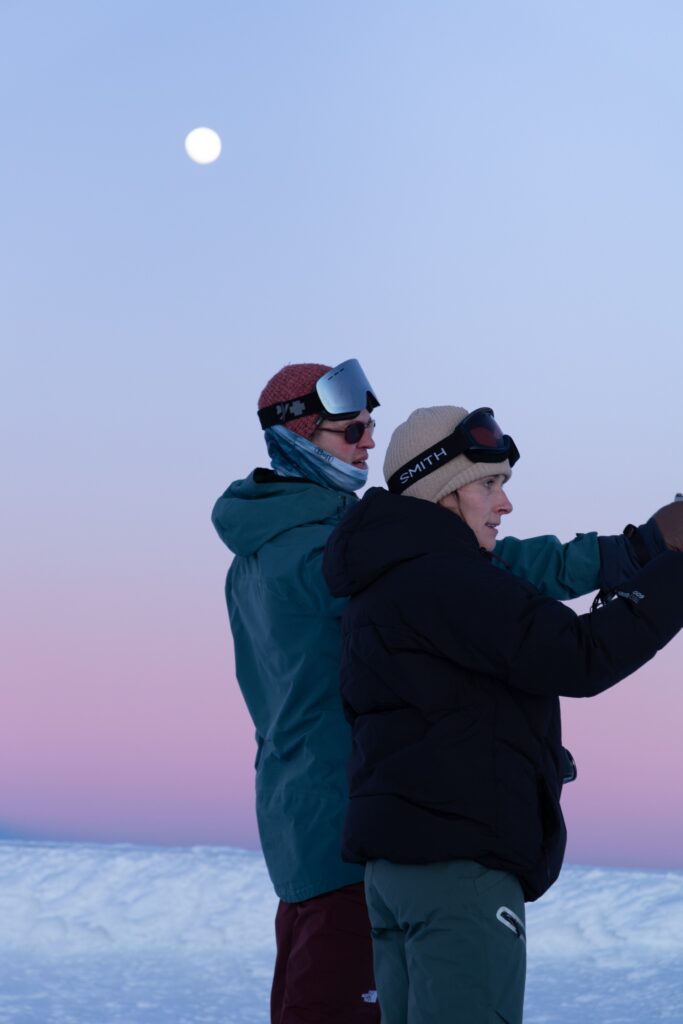
Learning my visibility markers under a rising gibbous moon from veteran Weather Observer Karl Philippoff. Photo credit: Ryan Steinke
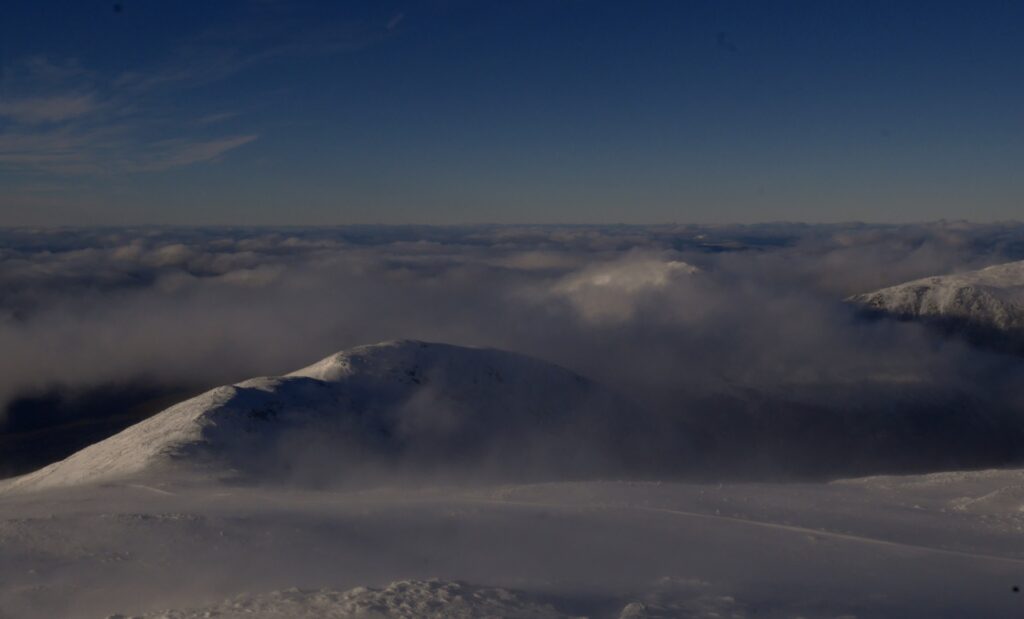
Low stratocumulus clouds blanket the peaks of the Northern Presidentials in mid-afternoon.
You might think that a year spent de-icing instrumentation and launching unwieldy ozone balloons in Antarctica would have prepared me for observations on the summit of Mount Washington, but the weather up here truly does feel like some of the worst in the world! It turns out troubleshooting an on-the-fritz anemometer at -10 °F with 80 mph winds is actually a lot more unpleasant than doing the same thing when it’s -80 °F and calm. Still, learning to forecast and code weather observations from the highest point in New England has its perks. As someone with a background in longer-term climatic and geologic processes, seeing how quickly weather conditions can change on the summit, and moreover understanding how these changes are brought on, has been both fascinating and immensely rewarding scientifically. In geology, scientists often group off based on the length of timescales they think over. Someone who studies plate tectonic cycles operating over billions of years may feel they have nothing to learn from someone studying climate changes over millions of years, who may feel they have nothing to learn from someone who studies glacial cycles over hundreds of thousands of years. Though I’ve tried my hardest to remember the interconnectedness of these processes, somehow nothing has been quite as grounding as nearly getting blown off the top of Mount Washington while closely observing the way our weather conditions and atmosphere are changing right now.
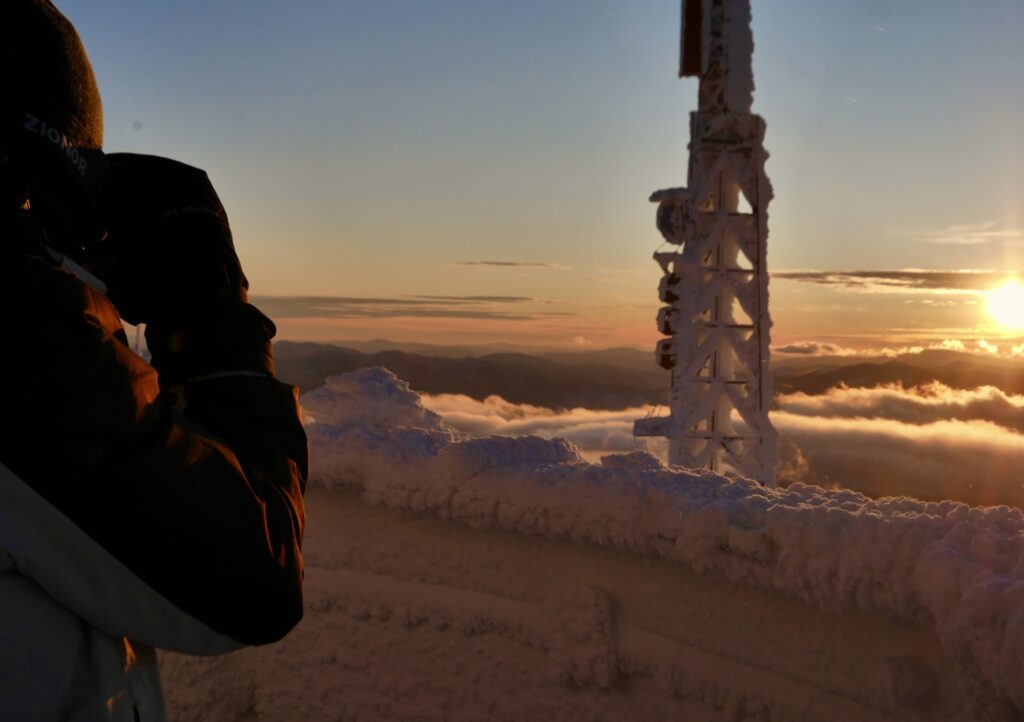
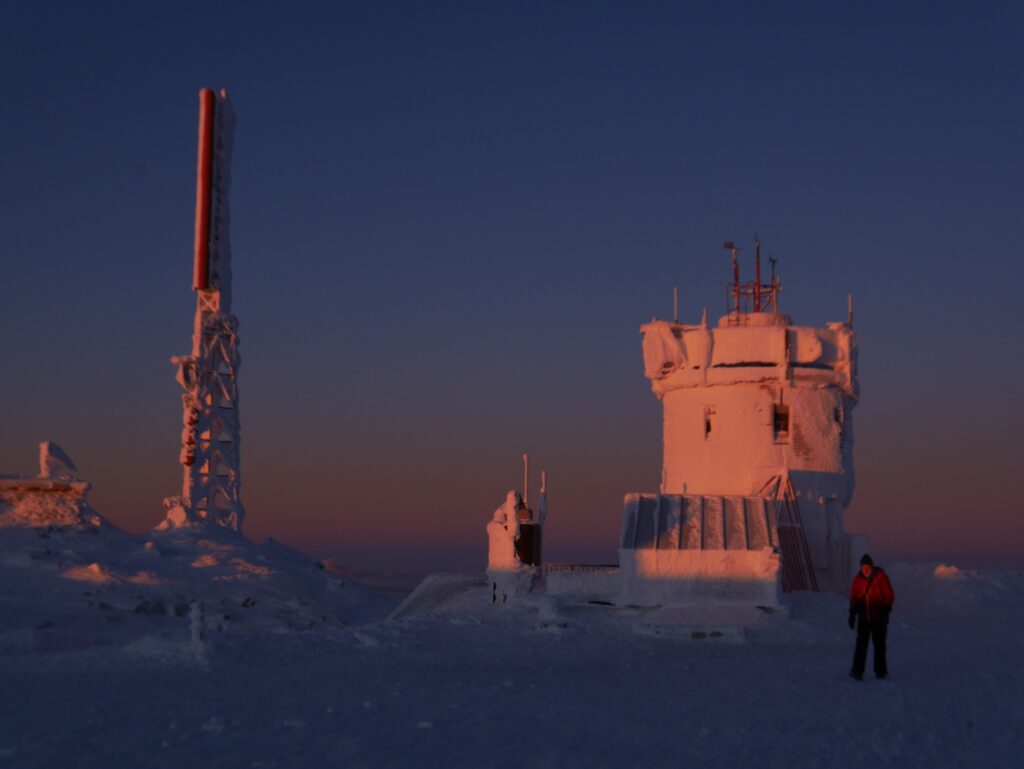
Visiting student Sam Morgan admires the sunset in 60 mph winds during the first clear afternoon of his week long visit.
My time on the summit so far has brought late nights and early mornings, with countless opportunities to reluctantly become a morning person as the first gray light of early morning gradually illuminates the weather room while we call in current conditions reports to the AMC huts and radio shows. I may already have seen more sunrises in my two and a half weeks on the rock pile than I had previously in my nearly three decades on earth! Working with a small and dedicated team of scientists to better understand and predict the extreme weather of the White Mountains has given me so much more to appreciate about a place that already felt like home to me. The Whites are truly unique, not only in their extremes but in the deep personal connections so many New Englanders have to this landscape. Contributing to our understanding of how they are evolving and changing, both in the long term but also in the day-to-day and moment-to-moment changes that impact the lives of those living and recreating up here, is more than enough of a reason to spend more time looking at the sky.
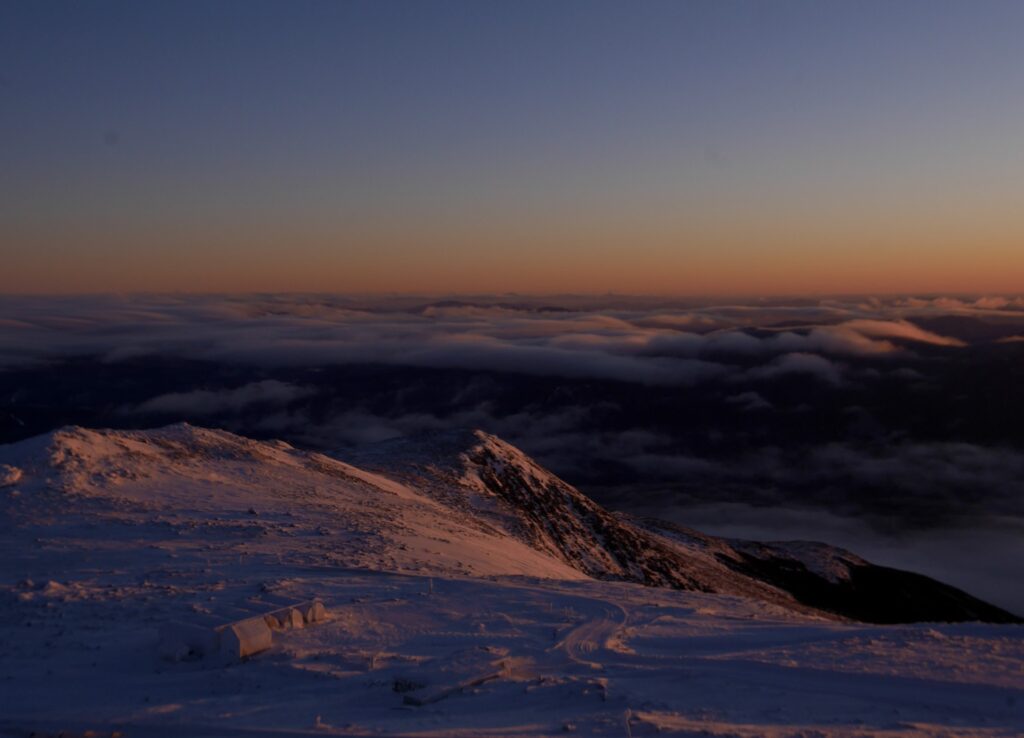
Sunrise in late January looking Northeast over Nelson Crag, and South towards the observation tower.
My Fear of Weather Became a Love of Meteorology
My Fear of Weather Became a Love of Meteorology By Kaitlin Farrell Hello! My name is Kaitlin Farrell. I am one of the fall summit interns here at Mount Washington Observatory. I recently graduated
Ascending with High Winds
Ascending with High Winds By Alonso Lopez Hi! I am Alonso Lopez, one of four interns at Mount Washington Observatory from August to December, 2026. I was born and raised in the Dallas-Fort Worth
26th Annual Seek the Peak Recap
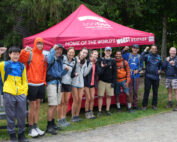
26th Annual Seek the Peak Recap By Drew Bush Members of the "Peak Potential" team gather at Pinkham Notch before hiking Mount Washington for the 26th Annual Seek the Peak. View more images. We’ve had