
A Unique Instrument for a Unique Place!
2018-11-03 14:17:33.000 – Chloe Boehm, Summit Intern
In anticipation of high winds tonight on the summit, it seemed appropriate to discuss how the observatory measures wind speeds in such an extreme environment. Since Mt. Washington experiences wind speeds that exceed 100 mph every three days in the winter as well as rime ice accretion up to 9 inches per hour, the observatory is forced to use an unusual instrument to measure winds. Typical anemometers such as a three-cup anemometer or a vane anemometer would not be able withstand such extreme conditions. With an average wind speed of 35 mph, such instruments would wear out very quickly from spinning so fast. Additionally, with the large accumulations of rime ice, the propellers or cups would get clogged very quickly and either break or not work properly. So instead we use a pitot tube.
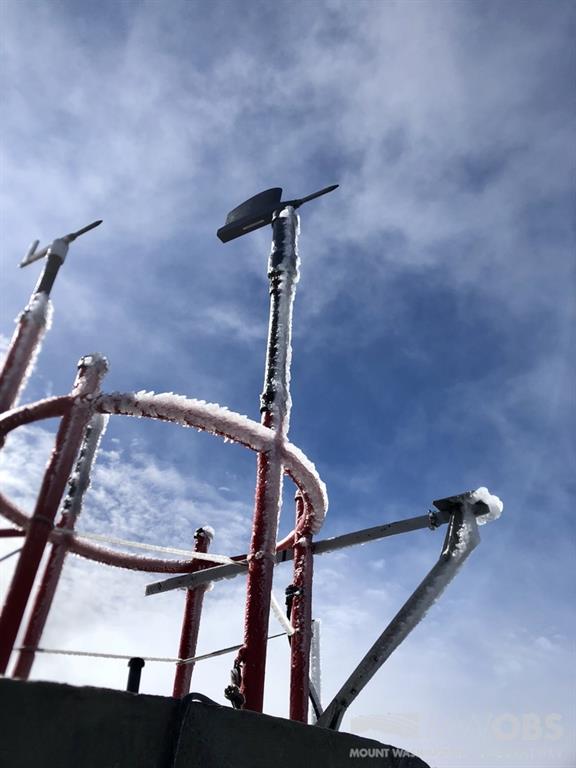
The pitot tube was initially invented by French engineer Henri Pitot in the early 18th century but it was later modified to its modern form in the mid-19th century by French scientist Henry Darcy. It is used to measure fluid flow velocity, most commonly used to determine the airspeed of aircrafts. The basic pitot tube consists of a metal tube pointing directly into the fluid flow. We use a pitot-static tube which is just a pitot tube with two ports, pitot and static ports. The pitot port measures the pressure of the air ramming into the tube known as the total pressure. The static port measures the static pressure of the air sliding along the tube using small holes along the side of the tube. The diagram below shows the placement of both ports.

The pitot tube is able to output air velocity using a fundamental principal called Bernoulli’s principle. Bernoulli’s equation states that the Total Pressure = Static pressure + Dynamic Pressure. Using the measured static and total pressure, one can thus calculate the dynamic pressure. Bernoulli’s principle also states that the dynamic pressure can be related to the velocity of the fluid. So calculating the pressure differential between the static and total pressure will give you the velocity of the airflow! Connecting a tail to the end of the tube makes sure that the tube always points into the direction of the wind meaning it can always accurately measure the wind speed regardless of direction.
This special anemometer has several perks. First, this instrument does not have any moving parts like a propeller. This means that it will not be jammed with ice as temperatures dip below freezing nor will it wear out from high wind speeds. It also has the huge advantage of being able to be heated which helps to combat the large quantities of rime ice that collect on every surface.

Chloe Boehm, Summit Intern

From One Mountain to the Next
From One Mountain to the Next By Ellie Derry Hi everyone! My name is Ellie Derry and I am one of the fall 2026 interns at the Observatory. I’m super excited to be here

Mountains and Meteorology: What More Could a Girl Need?
Mountains and Meteorology: What More Could a Girl Need? By Emily Grainger Hi everyone! My name is Emily Grainger, and I am one of this fall’s Summit Interns atop Mount Washington! I’m from Orlando,

My Fear of Weather Became a Love of Meteorology
My Fear of Weather Became a Love of Meteorology By Kaitlin Farrell Hello! My name is Kaitlin Farrell. I am one of the fall summit interns here at Mount Washington Observatory. I recently graduated