
Climate Comparisons
2016-12-11 10:29:54.000 – Tom Padham, Weather Observer/Meteorologist
While doing a bit of research for an upcoming education program I decided to do some comparisons with Mount Washington’s climate to our neighboring valleys. I wondered just how different our climate is from the surrounding terrain, and if I could find a populated area with a similar climate.
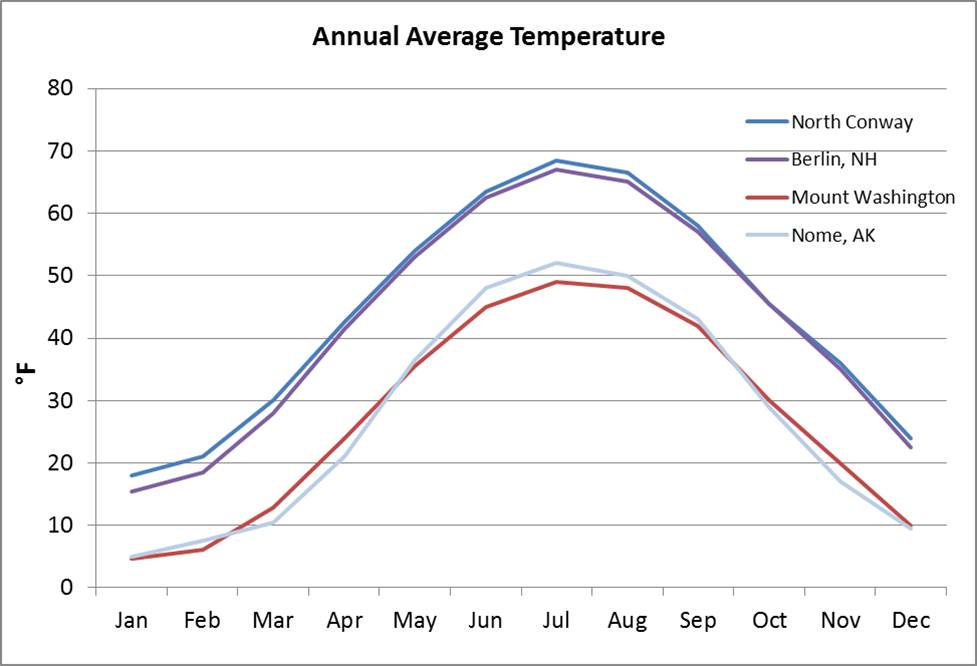
After graphing the average annual temperature for Mount Washington compared to Berlin (roughly 15 miles to our north) and North Conway (15 miles south) it’s pretty noticeable that the summit runs about 15-20°F colder than both locations through the year. Since North Conway and Berlin are only separated by about 30 miles and are at similar elevations, they have nearly identical climates. Although it is interesting that the largest separation occurs during mid-winter, when arctic air from Canada sometimes gets bottled up on the north side of the White Mountains.
For fun, I looked at several towns in the Canadian Arctic and Alaska, and settled on Nome, Alaska having a pretty close average annual temperature to that of Mount Washington. Nome is located at 64°N latitude, 20 degrees north of Mount Washington’s location. This far of a distance north would usually equate to a very large drop in temperature, but Nome’s location along the Bering Sea helps moderate its climate especially during the winter months when the interior of Alaska gets much colder.
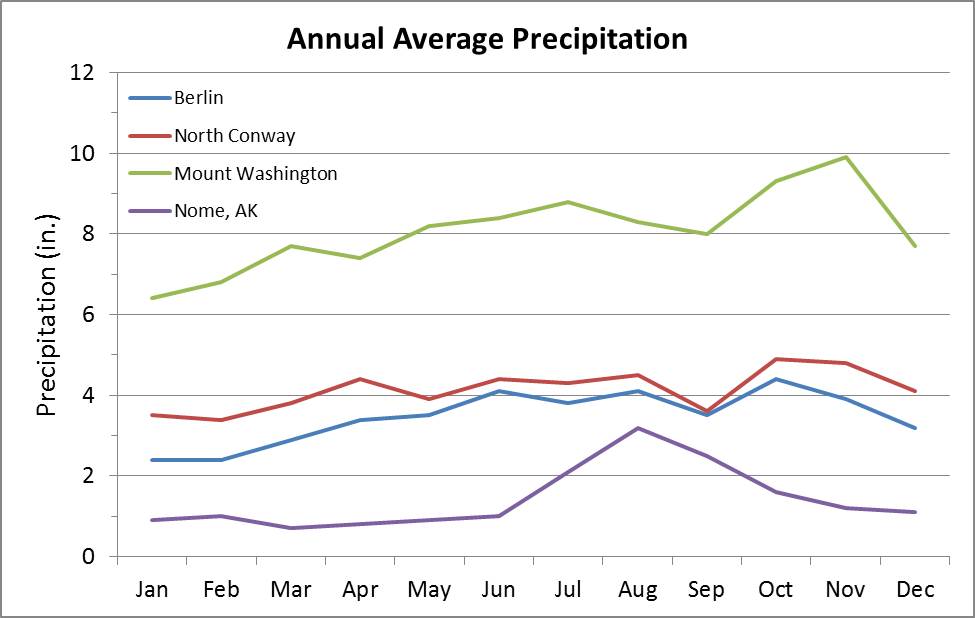
Looking at precipitation Mount Washington definitely stands above all of these locations. Nome receives very little precipitation over much of the year, which is true of much of the arctic and subarctic. During the summer months they see a spike in precipitation as storms briefly track far enough north before the jet stream begins to dive back south in the fall. As for locations closer to home, it is interesting seeing all three locations have a drop in precipitation in the month of September. My speculation is that during this month we tend to be in between the subtropical jet stream we see in the summer and the polar jet stream of the winter, resulting in fewer organized storms tracking through the area. Berlin averages less precipitation overall due to being slightly further from the coast and also occasionally sees a rain/snow shadow from Mount Washington. It’s always interesting to see how we stack up to other parts of the world and our surroundings, I’m looking forward to learning more!
Tom Padham, Weather Observer/Meteorologist
My Fear of Weather Became a Love of Meteorology
My Fear of Weather Became a Love of Meteorology By Kaitlin Farrell Hello! My name is Kaitlin Farrell. I am one of the fall summit interns here at Mount Washington Observatory. I recently graduated
Ascending with High Winds
Ascending with High Winds By Alonso Lopez Hi! I am Alonso Lopez, one of four interns at Mount Washington Observatory from August to December, 2026. I was born and raised in the Dallas-Fort Worth
26th Annual Seek the Peak Recap
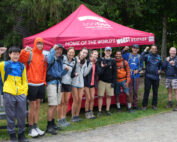
26th Annual Seek the Peak Recap By Drew Bush Members of the "Peak Potential" team gather at Pinkham Notch before hiking Mount Washington for the 26th Annual Seek the Peak. View more images. We’ve had