
The Science Behind Sunsets
2016-08-04 17:42:05.000 – Tim Greene, Intern

Why are sunsets so colorful, anyway?
To understand the science behind colorful sunsets, it is important to first understand color. Contrary to how most are accustomed to seeing the world, an object’s color is based off the ratio of how much light it absorbs and how much it reflects. For instance, a golf ball appears white only because the paint on its surface reflects all the colors in the visible spectrum (a small fraction of the entire electromagnetic spectrum) which collectively make up what we see as the color white. Similarly, a hockey puck appears black because it absorbs all the colors in the visible spectrum. This same concept is what makes the sky blue; the atmosphere, which is comprised mostly of nitrogen and oxygen, preferentially scatters (the technical term for reflect/deflect) violet and blue. The reason the afternoon sky looks blue and not violet is actually because the human eye is more sensitive to blue and green hues. That said, some animals look up to see a purple sky.
When the sun reaches its highest point in the sky (which is not necessarily directly overhead) in reference to a fixed ground point, it is passing through the minimum amount of atmosphere in its daily cycle. This relatively short distance of atmosphere light passes through yields a blue sky (especially on days when there is low humidity, otherwise the sky can have a milky, hazy appearance). As the sun sinks lower, its light must pass through a greater depth of the atmosphere (approaching its maximum, at sunset) in order to reach the surface. With a greater depth of the atmosphere blues and violets are better scattered, which serves to redden the atmosphere. In other words, the National Weather Service says, “sunsets are red because the daytime sky is blue.” The abridged version of this explanation is essentially: the greater the distance light must pass through, the more “colorful” it can appear.
Clouds add an interesting dynamic to sunsets because they each capture rays of varying length on a white canvas-like backdrop. Without them, sunsets would be far less impressive (especially just after the sun disappears below the horizon) as there would be no way to see some of the most impressive colors the visible spectrum has to offer!

Why is the sunset always so colorful from the summit of Mount Washington?
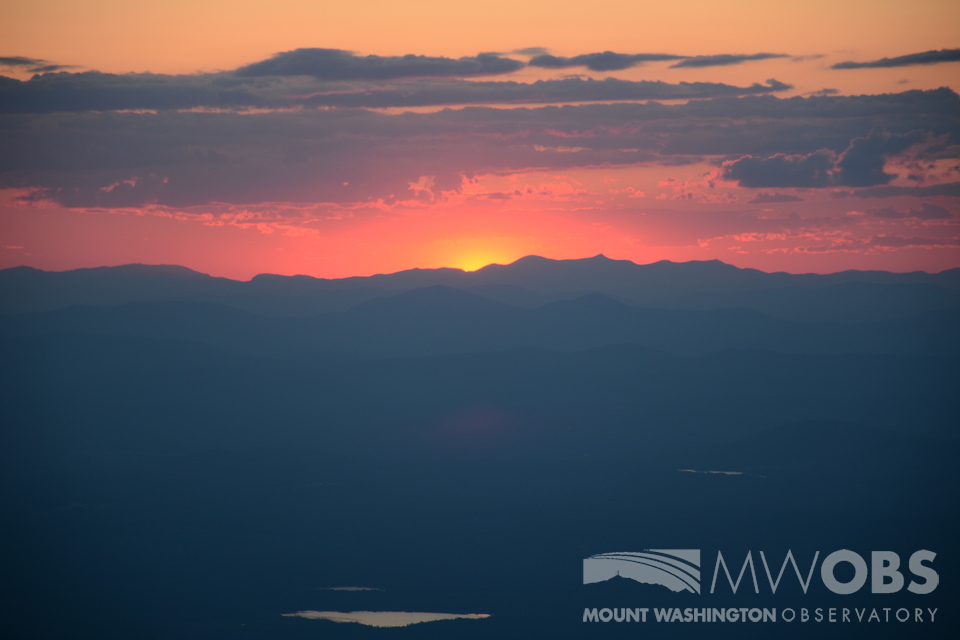
On the somewhat rare occasion we at the Observatory are able to see the sunset, it is always rich with deep red, fluorescent-looking hues. The reason for this stems from our unique vantage point; at 6,288 feet above sea level, our horizon is more distant than at lower elevations. This equates to more atmosphere the sun’s rays must pass through before they reach our eyes at the summit and a stunning red most are not in a position to be able to see.
Tim Greene, Intern

26th Annual Seek the Peak Recap
26th Annual Seek the Peak Recap By Drew Bush Members of the "Peak Potential" team gather at Pinkham Notch before hiking Mount Washington for the 26th Annual Seek the Peak. View more images. We’ve had

Seek the Peak Spotlight: The Cloud Chasers
Seek the Peak Spotlight: The Cloud Chasers By MWOBS Staff Mike Bergeron and Desiree Bolton have been participating and volunteering for Seek the Peak for three years now. Together, they comprise Team Cloud Chasers
Celebrating 250 Years: The Declaration’s Legacy in the White Mountains
Celebrating 250 Years: The Declaration's Legacy in the White Mountains By Peter Crane We are now approaching July Fourth, Independence Day, the day when we celebrate the adoption of the Declaration of Independence in