
The Science Behind Kelvin Helmholtz Wave Clouds
2015-12-14 09:35:25.000 – Andrew Henry, Summit Intern
While we did not receive any #MWOMetMonday questions this week, one of our Facebook followers posted the following picture of some unusual clouds, wondering what they were.
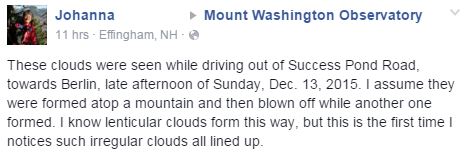

The clouds Johanna snapped a picture of late yesterday afternoon appear to be Kelvin Helmholtz clouds, also called billows. These clouds resemble breaking ocean waves, with rolling eddies seen at the top of the cloud layer. Kelvin Helmholtz clouds are named after two scientists, Lord Kelvin and Hermann Von Helmholtz, who studied the physics that lead to these wave-like cloud formations. Kelvin Helmholtz clouds form on windy days, when two different layers of air in the atmosphere move at different speeds. The winds in the upper layer of air move at higher speeds and cause cloud tops to roll over like a breaking wave. The atmosphere is split into layers when air densities change with height, for example, during temperature inversions.
The presence of Kelvin Helmholtz clouds are good indicators of instability and turbulence for aircraft pilots. However the rolling cloud motions seen in Kelvin Helmholtz clouds are often masked by a large amount of cloud cover. Other times, there are no clouds around to demonstrate the wave pattern.
Do you have a weather question? Get it answered by the meteorologists here on the summit every Monday. Simply tag your question on social media with #MWOMetMonday!
Andrew Henry, Summit Intern
From One Mountain to the Next
From One Mountain to the Next By Ellie Derry Hi everyone! My name is Ellie Derry and I am one of the fall 2026 interns at the Observatory. I’m super excited to be here
Mountains and Meteorology: What More Could a Girl Need?
Mountains and Meteorology: What More Could a Girl Need? By Emily Grainger Hi everyone! My name is Emily Grainger, and I am one of this fall’s Summit Interns atop Mount Washington! I’m from Orlando,
My Fear of Weather Became a Love of Meteorology
My Fear of Weather Became a Love of Meteorology By Kaitlin Farrell Hello! My name is Kaitlin Farrell. I am one of the fall summit interns here at Mount Washington Observatory. I recently graduated