
Lightning Can Hit the Same Place Twice!!
2013-09-12 16:42:03.000 – Pratik Patel, Summit Intern

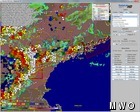
Mesoscale Activity Map
After a very hot and humid afternoon, the atmosphere was perfectly set up to bring severe weather throughout last night. Isolated thunderstorms were prominent on the summits bringing some heavy rain and strong winds. The night sky was lit up so bright at times from frequent lightning, that it felt as if someone was turning the lights on and off in a pitch black room. By the morning the summits seemed quiet, but strong gusts did occur for very brief periods of time. Early this morning, we experienced a strong downburst which peaked around 75 mph. Downburst are very dangerous because it’s a cold pool of air plummeting towards the ground as it is denser than the surrounding air. This is created as precipitation falls and evaporates creating a cold pool of air. This cold pool air is denser and heavier than the air around it and sinks very rapidly towards the ground.
Last night, Observer Rebecca Scholand took a screenshot of the radar (shown in the thumbnail) that shows us the progression of lightning throughout the region. As you can see there are a lot of things occurring on the map, but the one thing that stands out the most is the lightning strikes indicated by the various squares of different colors. The white squares represent the most recent lightning strikes that occurred approximately 12 minutes before the stated time. Following all the colors, you can clearly get a better visualization of the movement of the thunderstorms. This is just many of the tools we use to determine the path of the storms that traverse through the region.
In addition, the weather on the summit will continue to be active for the next few days. As a cold front moves into the region, it will trigger some thunderstorms also bringing colder air into the New England region, leading to falling temperatures.
Pratik Patel, Summit Intern
From One Mountain to the Next
From One Mountain to the Next By Ellie Derry Hi everyone! My name is Ellie Derry and I am one of the fall 2026 interns at the Observatory. I’m super excited to be here
Mountains and Meteorology: What More Could a Girl Need?
Mountains and Meteorology: What More Could a Girl Need? By Emily Grainger Hi everyone! My name is Emily Grainger, and I am one of this fall’s Summit Interns atop Mount Washington! I’m from Orlando,
My Fear of Weather Became a Love of Meteorology
My Fear of Weather Became a Love of Meteorology By Kaitlin Farrell Hello! My name is Kaitlin Farrell. I am one of the fall summit interns here at Mount Washington Observatory. I recently graduated