
Ice
2010-10-19 21:36:27.000 – Erica Sandschulte, Summit Intern
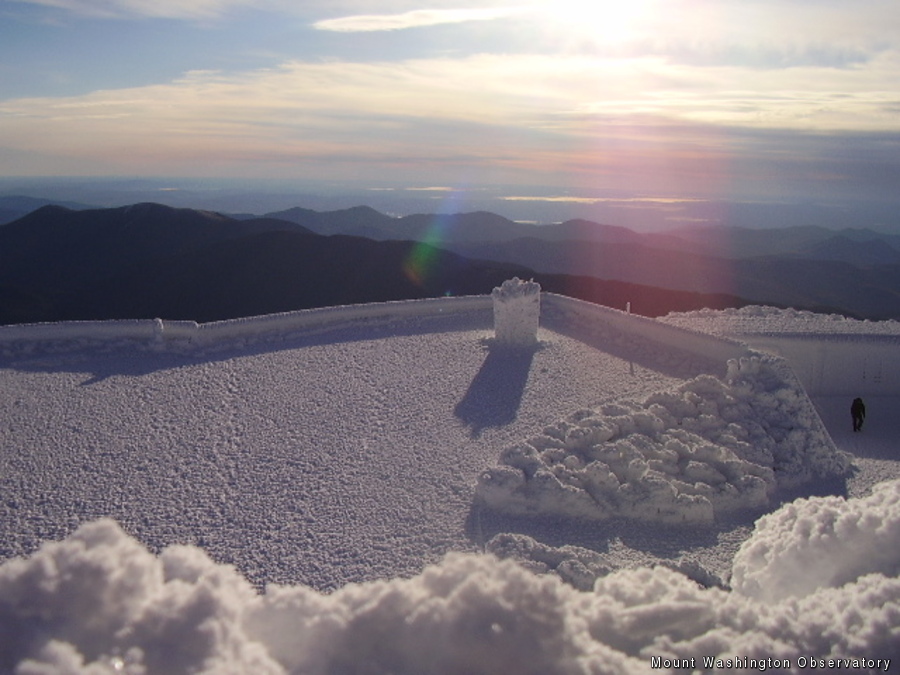
Rime Ice covering the Observation Deck
Like many of us up here on the summit, I have a great fascination with winter weather. Up here on the rockpile we see all kinds of weather and mixed precipitation. Now with the passing of the storm last week we were able to experience several different types. One unique form of ice that you will find here on the summits is rime ice-frozen fog. It is a beautiful feather like formation that will attach itself to anything and everything. With the storm that rolled in late last Thursday we observed freezing rain, snow, snow grain, and ice pellets. Rime ice has had its time in the spot light with past comments, so I will take this opportunity to talk about the differences between precipitation types that are easily mistaken from one another; ice pellets and snow grains. But before I reveal their definitions, can you name the dissimilarities?
Well, ice pellets are small translucent balls of ice smaller than hailstones. These form when there is a layer above-freezing air and another layer of sub-freezing air both above and below it. Initially they begin to fall as snowflakes but as they pass through the warm layer they melt and again re-freeze taking the form of a ball. They usually occur for brief periods of time not having large measurable amounts.
Snow grains take on similarities of ice pellets that they are very small opaque particles of ice of less than 1mm in diameter. So how to determine between the two you may ask? Well, snow grains don’t bounce when they fall like ice pellets do. Snow grains are more flat and elongated; this distinction is key when doing an observation. Most fall from stratus clouds or fog. They can range in structure from bundles of frozen fog (rime) to fine ice crystals.
Now that you know the difference between the two, imagine going outside doing an observation with winds gusting at hurricane force and visibility of no more than 20 feet in front of you. What we do here to identify the kind of precipitation that is falling, is with the use of a board covered in a black cloth. We go outside on the observation deck holding the board up facing the wind, then looking down at the white specks to analyze the differences. Pretty cool right? So, the next time you go outside do your own observation and see what ice particles are falling from overhead.
Erica Sandschulte, Summit Intern

From One Mountain to the Next
From One Mountain to the Next By Ellie Derry Hi everyone! My name is Ellie Derry and I am one of the fall 2026 interns at the Observatory. I’m super excited to be here

Mountains and Meteorology: What More Could a Girl Need?
Mountains and Meteorology: What More Could a Girl Need? By Emily Grainger Hi everyone! My name is Emily Grainger, and I am one of this fall’s Summit Interns atop Mount Washington! I’m from Orlando,

My Fear of Weather Became a Love of Meteorology
My Fear of Weather Became a Love of Meteorology By Kaitlin Farrell Hello! My name is Kaitlin Farrell. I am one of the fall summit interns here at Mount Washington Observatory. I recently graduated