
Night Shift
2008-04-26 21:25:15.000 – Steve Welsh, IT Observer
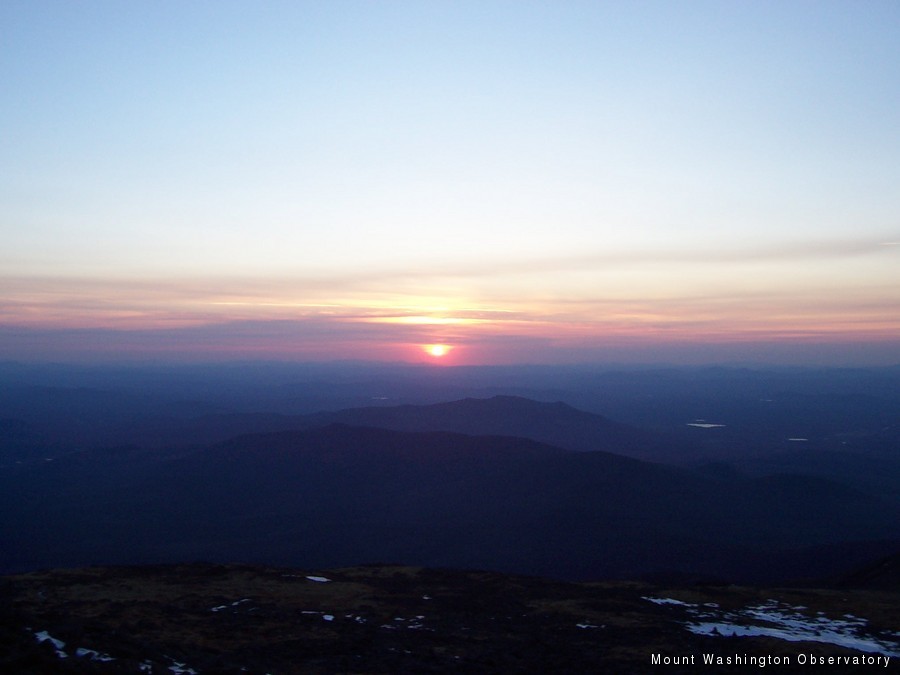
A recent sunset to start my day off
Last Wednesday’s shift change felt a little different for me. Not only did we take the truck half way up the auto road, before transferring to the Snow Tractor for the final stage, but I was also thinking about the upcoming week, when I’d be working nights, for the first time, at the observatory. It’s been 20 years since I’ve done a night shift; way back when I was working in Antarctica. So it was with a little trepidation that I began the week.
The night routine here is a little different to the day shift, especially with regard to collecting and summarizing the day’s weather data. There’s also several radios shows and weather phone recordings to be done. And of course its dark most of the time and your body gets that “jet lag” feeling since everything is shifted 12 hours. I have to admit that keeping track of time is confusing at best up here since weather observations are done on UTC (Zulu) time – some 4 hours ahead of Eastern Daylight Time (EDT) which is the time the rest of the Eastern US is currently running on, or as we refer to it “valley time”. The observatory itself works on Eastern Standard Time (EST) throughout the year since this makes recording daily weather statistics and climate data easier – so at the moment we are one hour behind “valley time”. Couple this with the fact that I start work as the sun sets and go to bed when it rises and you can, perhaps, understand why I’ve no idea what day it is at the moment.
To make things even more interesting on my first night the long spell of fine weather finally broke with a couple of thunderstorms. We also set a new record daily high temperature of 51 degrees Fahrenheit – so it was a busy time. Since then it’s been far quieter and I’ve really enjoyed watching the stars, meteors and moon when out doing observations. Another good thing about nights is that you get first pickings from any leftovers. Night shift definitely has its advantages.
Steve Welsh, IT Observer
From One Mountain to the Next
From One Mountain to the Next By Ellie Derry Hi everyone! My name is Ellie Derry and I am one of the fall 2026 interns at the Observatory. I’m super excited to be here
Mountains and Meteorology: What More Could a Girl Need?
Mountains and Meteorology: What More Could a Girl Need? By Emily Grainger Hi everyone! My name is Emily Grainger, and I am one of this fall’s Summit Interns atop Mount Washington! I’m from Orlando,
My Fear of Weather Became a Love of Meteorology
My Fear of Weather Became a Love of Meteorology By Kaitlin Farrell Hello! My name is Kaitlin Farrell. I am one of the fall summit interns here at Mount Washington Observatory. I recently graduated