
Relative Humidity
2008-03-17 14:20:49.000 – Steve Welsh, IT Observer

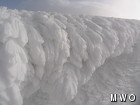
Rime Ice
One of the things you notice whilst living on the top of Mount Washington in winter is how dry the air is. Over the course of a week long shift up here your skin dries out and cracks. Typically the air inside the building, at this time of year, has a relative humidity of around 10% to 15%, which, is kind of strange considering we are in the fog most of the time with the humidity outside at 100%. So what’s going on? It turns out that warm air can hold far more moisture than cold air so the air outside the building can be totally saturated with moisture but the actually amount of water vapor it holds is really very low. Bring that air inside and warm it to 70 degrees and voila you have very dry air indeed.
One of the key components of the observations we make up here every hour is the dew point temperature. This is really a form of humidity measurement. The dew point temperature is defined as the temperature at which the air must be cooled, at constant pressure, before condensation (or dew) will form. Remember that colder air can’t hold as much water vapor as warm air, so if you cool the air, as often happens at night when the sun goes down, you’ll end up with dew forming on exposed surfaces such as grass. So the dew point temperature, as we report every hour in our observations, can be considered as the temperature you’d have to cool the air to form condensation. When the dew point temperature is equal to the air temperature you’re basically in the fog, however, if the dew point temperature is considerably lower that the air temperature then you’re in dry air.
For most people humidity levels from 35% to 45% are considered comfortable, much below 30% and it becomes too dry and above 60% it becomes oppressive – think of hot muggy summer days in New England.
The picture shows rime ice, which, is formed when super-cooled saturated air, in other words freezing fog, freezes on contact with surfaces. So 100% humidity can have its good side.
Steve Welsh, IT Observer

From One Mountain to the Next
From One Mountain to the Next By Ellie Derry Hi everyone! My name is Ellie Derry and I am one of the fall 2026 interns at the Observatory. I’m super excited to be here

Mountains and Meteorology: What More Could a Girl Need?
Mountains and Meteorology: What More Could a Girl Need? By Emily Grainger Hi everyone! My name is Emily Grainger, and I am one of this fall’s Summit Interns atop Mount Washington! I’m from Orlando,

My Fear of Weather Became a Love of Meteorology
My Fear of Weather Became a Love of Meteorology By Kaitlin Farrell Hello! My name is Kaitlin Farrell. I am one of the fall summit interns here at Mount Washington Observatory. I recently graduated