
A little about the Sling Psychrometer
2011-09-18 18:24:01.000 – Roger Pushor, Weather Observer/IT Specialist
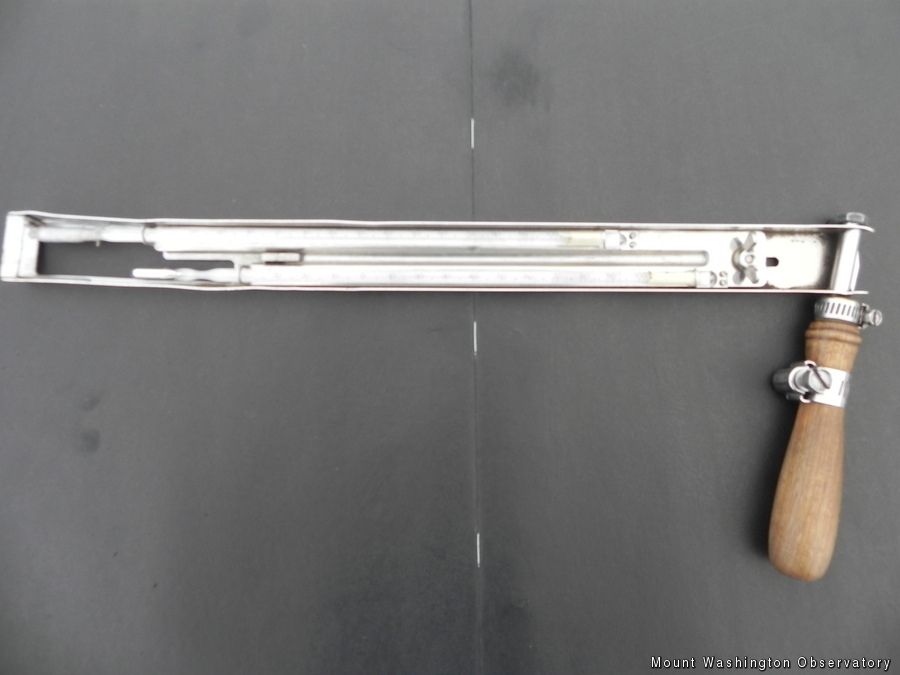
Sling Psychrometer
Invented in the late 1700s by James Hutton the Sling Psychrometer is used to measure the amount of water vapor or humidity in the air. The Sling Psychrometer has two thermometers. One thermometer is kept dry and is used to measure the ambient air temperature while the other thermometer is covered with a cotton wick which is wet with distilled water.
The instrument is “slung” in the air for several minutes so that air moves quickly over both thermometers causing the water to evaporate from the “wet bulb” thermometer thus lowering its temperature. This evaporative cooling is the same effect you feel when getting out of the shower. The lower the water content of the air the quicker the water evaporates from the “wet bulb” thus giving a lower temperature reading.
Once the dry bulb and wet bulb temperatures are known the dew point can be determined by looking it up on a chart. The Dew Point is the temperature at which water vapor starts to condense out of the air (the temperature at which air becomes completely saturated). Above this temperature the moisture will stay in the air. If the dew point temperature is close to the ambient air temperature the relative humidity is high however if the dew point is well below the ambient air temperature the relative humidity is low.
Roger Pushor, Weather Observer/IT Specialist

Seek the Peak 2026: New Adventures, Rooted in Tradition
Seek the Peak 2026: New Adventures, Rooted in Tradition By MWOBS Staff Seek the Peak is Mount Washington Observatory's largest annual fundraiser, and for 26 years it's brought together hikers, adventurers, and people who
What “Prepared” Really Means in the White Mountains
What “Prepared” Really Means in the White Mountains Early Spring in the Whites: The Most Honest Season By Andrew Harris, Burgeon Outdoor If you’ve spent any time in New Hampshire’s White Mountains in March,
March on Mount Washington
March on Mount Washington By Ryan Knapp Looking towards Mt. Madison at sunset on March 21, 2026. The calendar has spoken: Friday, 20 March 2026, marked the first day of astronomical spring.