
A Turbulent Weather Day
2016-07-19 14:15:45.000 – Mike Carmon, Senior Weather Observer & Education Specialist
Yesterday, we were all thrilled with the prospect of severe weather in northern New Hampshire. All signs pointed to an eventful afternoon for most of New Hampshire and Maine, with the summit of Mt. Washington smack in the middle of the action.
 Yesterday’s severe weather risk from the Storm Prediction Center
Forecasted values of CAPE (Convective Available Potential Energy) were exceptionally high (by New England standards), signifying a good deal of instability in the air. That’s ingredient number one.
Due to the income of a warm, moist air mass from the southwest, plentiful moisture was available, which is necessary for convection to occur. This is ingredient number two.
And finally, a strong cold front was approaching from the northwest. A frontal boundary such as this provides the third and final ingredient needed for convection: lift. A source of jump-starts the convection process, prompting air parcels at the surface to begin an ascent into the atmosphere.
With these three components in place, thunderstorms began to fire across northern New Hampshire around midday on Monday. It didn’t take long before Severe Thunderstorm Warnings were posted for these thunderstorms blossomed into supercells.
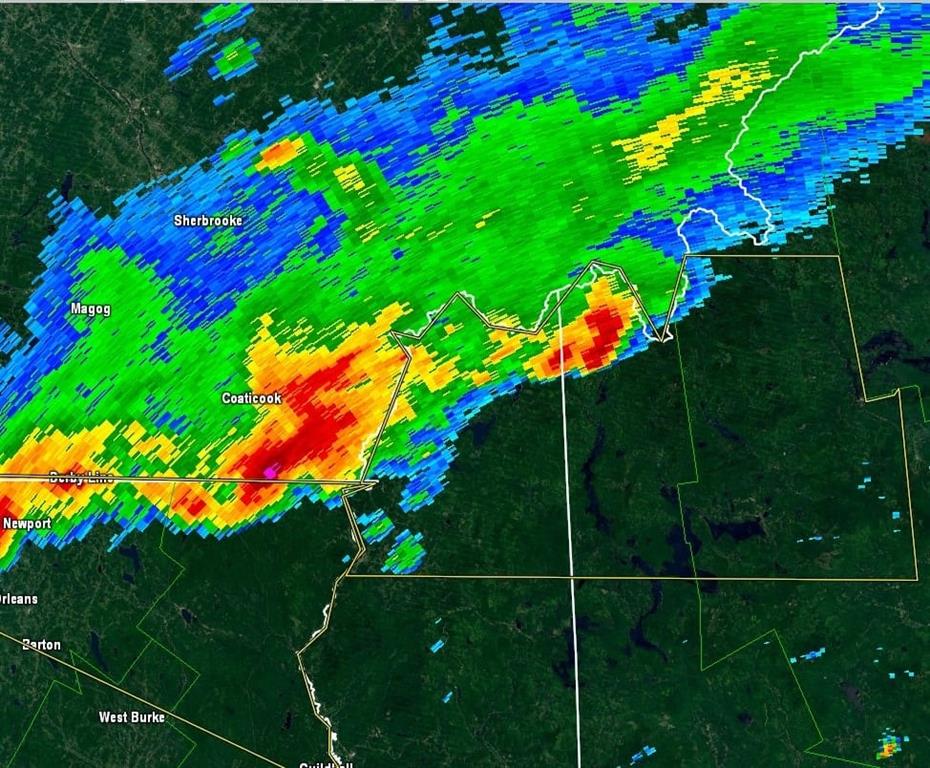
The first thunderstorms to fire yesterday afternoon.
 Structure of a supercell thunderstorm (Note the separation of the updraft & downdraft)
Lines of thunderstorms continued to form throughout the afternoon and evening, bringing several rounds of turbulent weather all across the region. In fact, several tornado warnings were issued for counties in northern New Hampshire and Maine, although no tornadoes have been confirmed as of yet.
Being stationed on the summit of a mountain, receiving a direct hit from a supercell thunderstorm is a rare occurrence for summit weather observers. Mountains disrupt wind flow and can present a literal physical barrier to developing thunderstorms. Unfortunately, passing thunderstorms succumbed to these effects yesterday, as any and all storm that formed either went around us to the north, to the south, or hit the summit and promptly weakened.
However, we were treated to a spectacular show yesterday afternoon around 4PM as a particularly intense supercell hit the Presidential Range and skirted around to the north. Simultaneously, the fog cleared from the summit, allowing us to witness this menacing storm as it passed to the north. Check out our Facebook Live video as we followed this storm while it passed us to the north yesterday.
Mike Carmon, Senior Weather Observer & Education Specialist

Seek the Peak 2026: New Adventures, Rooted in Tradition
Seek the Peak 2026: New Adventures, Rooted in Tradition By MWOBS Staff Seek the Peak is Mount Washington Observatory's largest annual fundraiser, and for 26 years it's brought together hikers, adventurers, and people who
What “Prepared” Really Means in the White Mountains
What “Prepared” Really Means in the White Mountains Early Spring in the Whites: The Most Honest Season By Andrew Harris, Burgeon Outdoor If you’ve spent any time in New Hampshire’s White Mountains in March,
March on Mount Washington
March on Mount Washington By Ryan Knapp Looking towards Mt. Madison at sunset on March 21, 2026. The calendar has spoken: Friday, 20 March 2026, marked the first day of astronomical spring.