
Bringing Polar Byrd I to Mount Washington
By Jackie Broccolo
In 1968, my grandfather joined the Polar Byrd I “Dustin Transpolar Flight”, which was the first commercial flight to carry civilians across both poles and touch down on all continents in just 26 days. This round-the-world flight was a tribute to renowned polar explorer and pioneer of aerial exploration, Admiral Richard E. Byrd. Admiral Byrd led several historic expeditions to Antarctica from 1928 to 1956, including establishing the first United States Antarctic base on the Ross Ice Shelf (Little America I) during his second mission in 1928, the first flight over the South Pole in 1929, mapping uncharted territories such as Marie Byrd land, and is also credited for laying the groundwork for international scientific cooperation in Antarctica. The Polar Byrd I transpolar expedition, also known as the “Dustin Transpolar Flight” was proposed by Commander Frederick G. Dustin, who was a fuel engineer on the second Byrd expedition to Antarctica, a veteran of six polar expeditions and a local to Vermont.
The purpose of this historic and ambitious civilian voyage was not only to memorialize Admiral Byrd’s extensive legacy but sought to raise funds to establish the Admiral Richard E. Byrd Polar Center in Boston, MA (now since dissolved ). Boston was chosen as the location for this center since Byrd raised his family and spent his final years in a brownstone on Brimmer Street. With personal ties to the city, he received a hero’s welcome and ceremony, with banners and cannons, upon his return to Boston after his second Antarctic expedition in 1935. At the time when Frederick G. Dustin first became to dream up Polar Byrd I in the late 1950s, my grandfather, Edgar Bellefontaine, was the Chief Librarian at Suffolk County Courthouse’s Social Law Library (Boston) and was a lover of history, and friend and former UMaine classmate of Frank Reed, who was assisting Dustin with planning the voyage. With his connections, my grandfather joined Commander Dustin, Reed, and a small planning board to organize the ambitious transpolar flight. One of these planning members was Edward C. Bursk (editor of Harvard Business Review and professor emeritus of marketing at Harvard, and friend of Edgar’s), who wrote and delivered a recruitment letter that targeted individuals with interest and means to embark on this journey, and join the founding board of the Byrd Polar Center. In the letter, he detailed how the reader will join a selective group of 60 participants, and 10 crew members, that will enter history by “taking part in a mission of great significance for the United States and the entire world. A mission, incidentally, which has never been attempted by man” and that they “will personally have the chance to help enrich mankind’s fund of knowledge about two of the last earthly frontiers, the polar regions”. The Dustin Transpolar Flight recruitment letter would later be studied in university business courses as a successful example of direct marketing.
Bursk’s letter successfully captured the interest of 60 entrepreneurs and titans of industry, all of whom paid the ticket price of $10,000 to join the historical flight. The highly priced ticket covered all travel expenses, accommodations, food and drink, excursions and gear. The remainder went into escrow to establish the Byrd Polar Center in Boston. Some names you might recognize from the passenger list included James Walgreen (Walgreens Pharmacy), and J.A. Germain Bombardier. Another notable member of the crew was Helen “Buttons” Dustin, wife of Commander Dustin. A photo from the journey shows Buttons exiting the Polar Byrd I with a note on the back describing her as the first woman passenger to circumnavigate the globe and touch down on all continents.
On November 8th, 1968, with the passenger list and exciting itinerary set, my grandfather joined fellow adventurers and flight crew members at Boston Logan Airport to board the Dustin Transpolar Flight. The plane that would ferry the group around the globe and become the first commercial jet to circumnavigate the world and land on all seven continents was a Convair 990A (Polar Byrd I) chartered by Modern Air Transport and piloted by former Airforce One pilot, Harold Neff. At 10:00 AM, “the powerful engines roar(ed) their speed to the northerly skies of Thule (Greenland)” and the historic flight was off. The 26-day itinerary was packed with receptions, cultural immersion, and meetings with foreign dignitaries as the Polar Byrd I crossed the globe. While in Japan, my grandfather and fellow passengers had the opportunity to meet with Emperor Hirohito, then in Rome, a private audience Pope Paul VI at the Vatican. As impressive as these meetings were, the standout leg of his itinerary was the Dustin Transpolar Flight’s arrival at McMurdo Station, Antarctica.
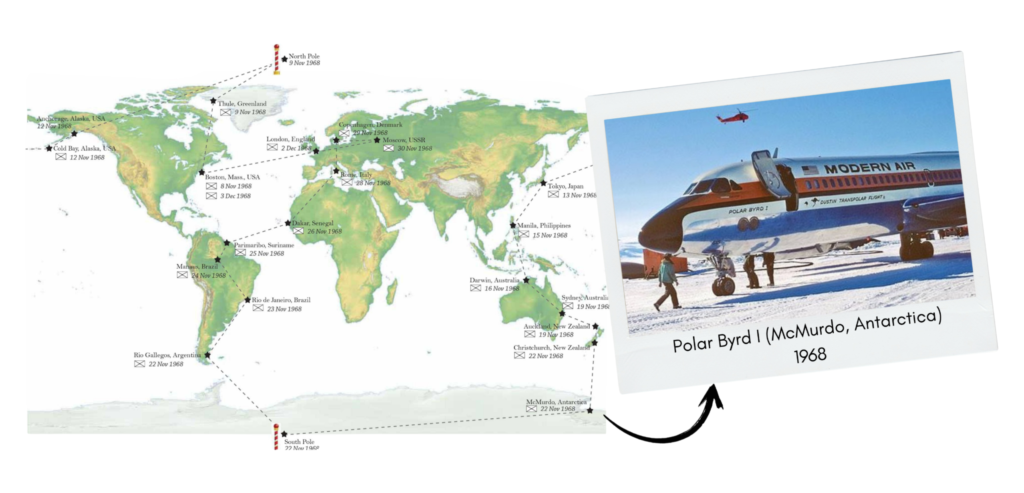
Map of the Dustin Transpolar Flight’s round-the-world path (left) alongside a picture taken of Polar Byrd I on the runaway at McMurdo, Antarctica (right).
The landing of Polar Byrd I at McMurdo Station made history by becoming the first commercial jet carrying paying passengers to land on the icy 10,000 ft runway. Once landed, my grandfather, his colleagues and flight crew dawned their bright red ReFrigiWear suit customized to include a “Byrd Polar Center” patch on the chest and exited the aircraft to experience Earth’s icy, last frontier. During their time on the ice, the group was given tours of McMurdo Station, Scott’s Discovery Hut and Scotts Base before settling in for a lecture delivered by an NSF representative. However, the highlight of their time in Antarctica was a brief ceremony held at the Richard E. Byrd memorial which was then located next to the Chapel of the Snows. During the ceremony, Buttons placed a bouquet of roses at the base of the Byrd memorial bust. After a packed day, the Polar Byrd I refueled and took off from the polar continent to continue their journey around the world. After landing in other countries including Brazil, Senegal, Russia, Denmark and England, the Dustin Transpolar Flight finally returned home to Boston 26 days later. The stories from around the world, carried on the Polar Byrd I almost 60 years ago, are still a source of excitement among aviation enthusiasts, historians, and the families of the participants.
So, how does Mount Washington fit into the story of the Dustin Transpolar Flight? Growing up in Boston, I was surrounded by stories of Admiral Byrd, and my grandfather’s trip around the world to commemorate Byrd’s legacy. Out of all the grand audiences with foreign dignitaries, lavish dinners, and exploration of exotic locations, his experience in Antarctica captivated me the most. So much so that as a child, I vowed to be the next Bellefontaine to reach Antarctica. This personal motivation, combined with my interest in polar related sciences, has driven me throughout my career. It led me to the University of Maine to study Earth Sciences, to the Juneau Icefield Research Program, and to Mount Washington’s winter internship in 2021. My grandfather passed in 2010, and much of his memorabilia from Polar Byrd I was distributed amongst family. The item that was referenced the most by family was his red ReFrigiWear suit that dawned the Byrd Polar Center patch. In early 2025, when my grandmother’s, Greta Bellefontaine’s, health began to decline at the age of 93, I inquired about the whereabouts of the iconic red suit. Come to find out, my father had the suit packed up in our attic, which he retrieved and officially passed down to me. Upon seeing the suit, I immediately began to envision myself bringing it with me on some future journey to Antarctica. However, given my grandmother’s health and no current plans to reach the remote icy continent, I decided that I would take it up with me to the summit of Mount Washington for her to see another Bellefontaine dawned in red at another, icy and legendary location.
With the help of my colleagues at MWOBS, I was able to bring the 60-year-old suit up to the summit via the Bombardier snowcat (as you may recall, Bombardier was a passenger on Polar Byrd I) on a blustery winter day. Once I reached the summit, I dawned the suit and headed for the summit sign. MWOBS Weather Observer/Staff Meteorologist/Resident Photographer, Ryan Knapp, took a photo of myself that, with the absence of the summit sign, looked like I was standing at the South Pole. Though I still haven’t accomplished my dream of reaching Antarctica, Mount Washington’s winter is an excellent polar-like environment that keeps my passion for cold, dynamic places alive. I also say with pride that the Bellefontaine’s adventurous spirit lives on, and that Mount Washington has been added to the Polar Byrd I, Dustin Transpolar Flight’s legacy.
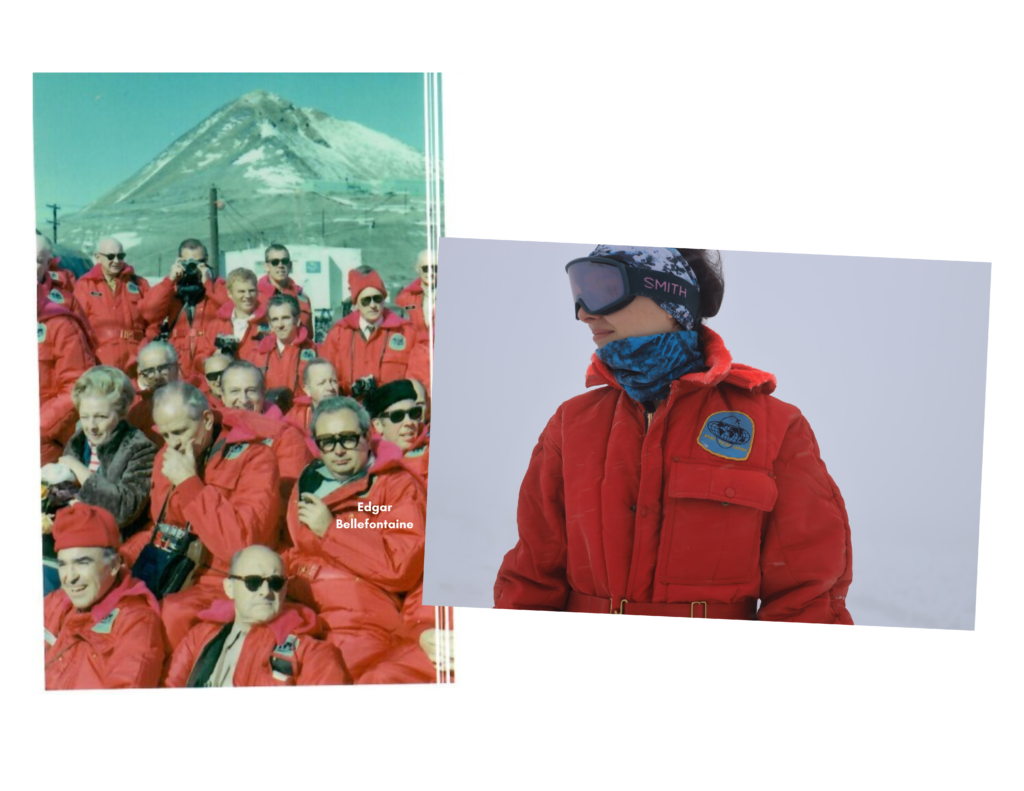
Edgar Bellefontaine with his polar suit and sporting his classic look, complete with thick rimmed glasses and a cigar in hand (1968, left). Jackie Bellefontaine, wearing the same suit on the summit of Mount Washington almost 60 years later (2025, right).
From One Mountain to the Next
From One Mountain to the Next By Ellie Derry Hi everyone! My name is Ellie Derry and I am one of the fall 2026 interns at the Observatory. I’m super excited to be here

Mountains and Meteorology: What More Could a Girl Need?
Mountains and Meteorology: What More Could a Girl Need? By Emily Grainger Hi everyone! My name is Emily Grainger, and I am one of this fall’s Summit Interns atop Mount Washington! I’m from Orlando,
My Fear of Weather Became a Love of Meteorology
My Fear of Weather Became a Love of Meteorology By Kaitlin Farrell Hello! My name is Kaitlin Farrell. I am one of the fall summit interns here at Mount Washington Observatory. I recently graduated