
Flux Tower Project III
2019-09-29 15:47:12.000 – Ben Charles, Summit Intern
Hello everyone, after an amazing experience being an intern here for the summer I am lucky enough to say I am staying for the fall internship. This summer I did a lot from forecasting, giving tours, and doing research.
My previous research project that I did this summer with intern Austin Patrick was called the Flux Tower Project. This consisted of comparing the accuracy and precision of handheld Kestrel instruments to the instruments on the Mount Washington Observatory deck and tower. Focusing on the variables of temperature, humidity, and wind speed. It was found that the kestrels had some strengths when measuring Temperature and high humidity events and a weakness recording all wind speeds and low humidity events.
The research I will be performing this fall will be a continuation of the Flux Tower Project from the summer. Since there was variability in the kestrels and they weren’t considered as accurate as the instruments on the Mount Washington Observatory deck kestrels will not be used this fall. The focus this fall will be to determine the thermal and moisture flux between the instruments on the Observatory Deck at the base of the tower, and the instruments on top of the Observatory tower.
The null hypothesis is that the spatial variability of measured air and dew point temperatures on the Mount Washington Observatory deck and tower do not impact the resulting computations of thermal and moisture fluxes. If the hypothesis proves true then there is little variation in the Bowen ratio and little to no thermal and moisture flux at such a distance. If false then there is large variation in the Bowen ratio and large thermal and moisture fluxes from the top of the tower and the observation deck, opening paths for further research. The Bowen ratio is an equation that allows us to explore the latent and sensible heat fluxes. I will begin this fall by gathering data calculating the ratio and producing plots to get a good visual sense of our results.
Ben Charles, Summit Intern
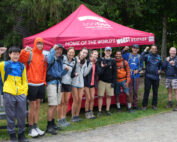
26th Annual Seek the Peak Recap
26th Annual Seek the Peak Recap By Drew Bush Members of the "Peak Potential" team gather at Pinkham Notch before hiking Mount Washington for the 26th Annual Seek the Peak. View more images. We’ve had
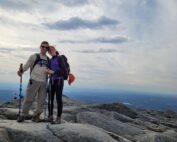
Seek the Peak Spotlight: The Cloud Chasers
Seek the Peak Spotlight: The Cloud Chasers By MWOBS Staff Mike Bergeron and Desiree Bolton have been participating and volunteering for Seek the Peak for three years now. Together, they comprise Team Cloud Chasers
Celebrating 250 Years: The Declaration’s Legacy in the White Mountains
Celebrating 250 Years: The Declaration's Legacy in the White Mountains By Peter Crane We are now approaching July Fourth, Independence Day, the day when we celebrate the adoption of the Declaration of Independence in