
It’s that TIME again…
2013-03-08 17:57:20.000 – Brian Fitzgerald, Weather Observer/Education Specialist
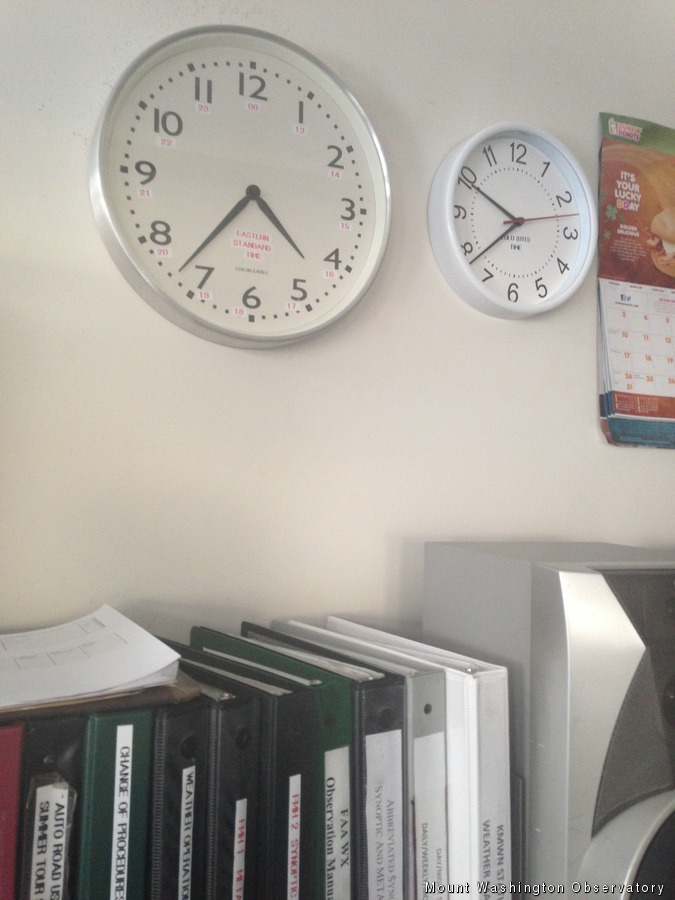

EST left, Zulu right.
Here on the rockpile, someone is always watching the clock. That ‘someone’ is usually the observer on duty who is responsible for starting each hourly observation no earlier than a quarter of the upcoming hour. Case in point, I just checked to see what time it is, and at 14:12 EST (or 2:12 PM eastern standard time) I know I have roughly a half hour before I need to get up, put on my gloves, hat, goggles and jacket, and head out the door for an observation which will be an evaluation of current conditions over a two minute span.
After recording all of our typical variables like wind speed and direction, temperature, sky condition, present weather, visibility and sky cover (just to name a few), I’ll record our data into a paper form and then send the observation out to our server and also the National Weather Service using something call UTC or Zulu time. UTC, or Coordinated Universal Time is a globally standardized time, which is based on GMT or Greenwich Mean Time. The reason why we use this time, along with every other meteorological reporting station in the world is to sync up all weather reports, especially for our a standard 6 hourly synoptic weather reports where we summarize weather over that time period and measure precipitation and a number of other variables. In the eastern time zone we need to add 5 hours to sync up with Zulu time, which would make 14:12 EST look like 1912Z in our METAR reports.
This Sunday we will be ‘springing’ ahead and changing most of our clocks one hour into the future; however, we will not be changing the clocks above our weather desk where one clock will still report Eastern Standard Time (instead of Daylight Savings Time) while the other shows Zulu time. It may be a bit confusing for a day or two, but generally speaking our operations will not change much, especially when it comes to what time we report. Talking to folks in the valley for the first few days may be a different story though…
Brian Fitzgerald, Weather Observer/Education Specialist

Seek the Peak 2026: New Adventures, Rooted in Tradition
Seek the Peak 2026: New Adventures, Rooted in Tradition By MWOBS Staff Seek the Peak is Mount Washington Observatory's largest annual fundraiser, and for 26 years it's brought together hikers, adventurers, and people who
What “Prepared” Really Means in the White Mountains
What “Prepared” Really Means in the White Mountains Early Spring in the Whites: The Most Honest Season By Andrew Harris, Burgeon Outdoor If you’ve spent any time in New Hampshire’s White Mountains in March,
March on Mount Washington
March on Mount Washington By Ryan Knapp Looking towards Mt. Madison at sunset on March 21, 2026. The calendar has spoken: Friday, 20 March 2026, marked the first day of astronomical spring.