
Meet MWOBS/MWAC Intern Ryan Tanski
By Ryan Tanski
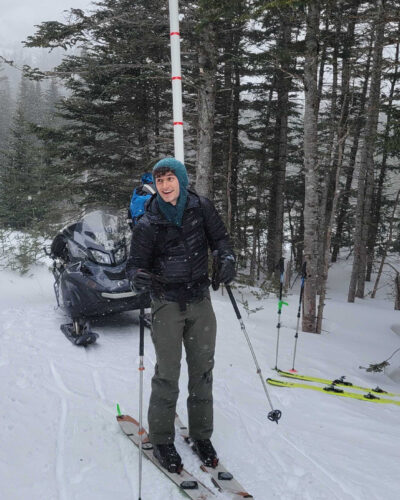 Hello! I’m Ryan Tanski and I’m the joint USFS Mount Washington Avalanche Center and Mount Washington Observatory Intern this winter. I’m thrilled to get to work with such talented and knowledgeable staff from both organizations and spend my winter in such a beautiful place.
Having lived in the Upper Valley since I was two, the mountains of New Hampshire are a familiar setting. Hikes up Cardigan, Kearsarge, and Moosilauke as a kid turned to peak bagging 4,000-footers at the crack of dawn once I could drive. Throughout my completionist exploration, checking the higher summits forecast was practically mandatory. It was an invaluable tool for picking fair weather days and telling my parents that the odds of me being blown off the side of the mountain are low. Of the mountains I’ve hiked in New England, the only time that I bailed due to weather was when I was attempting Katahdin. This affirmed the privilege of having smart people on Mount Washington writing relevant forecasts. Here at the Observatory, I get the opportunity to contribute to those forecasts and hopefully help others make safe decisions in the White Mountains.
Unable to escape the draw of New Hampshire, I went to Dartmouth and completed a degree in biomedical engineering this past fall. During college, I started climbing and splitboarding, both of which revealed places and communities in my home state that I had been oblivious to. As so many before, I felt the pull of Tuckerman Ravine. As I started to spend time in avalanche terrain, I came to appreciate snow science and the efforts that go into keeping backcountry recreators safe. Even in the depths of engineering coursework, I would check the avalanche forecast and observations after a storm in the hopes of interesting conditions. As with the observatory, it’s an honor to work with the MWAC team and appreciate both the rapidly changing conditions and amount of time spent in terrain that (I may be biased to say) makes the forecasting here so unique.
In my first few weeks, I’ve gotten to appreciate the range of weather that Mount Washington has to offer. From days entirely in the fog to glorious sunrises and sunsets, there’s usually something interesting to see out the weather room window. When I’m in the valley, I get to watch the ravines change as snow shifts and avalanche hazards ebb and flow.
As part of my internship, I’m conducting research on snowpack evolution with the aim to apply physics-based modeling software to the MWAC forecast area to enhance our understanding of weak layer formation. I can’t wait to continue developing my skills in forecasting both weather and avalanches and I will certainly enjoy the time I have left on Mount Washington.
Seek the Peak 2026: New Adventures, Rooted in Tradition
Seek the Peak 2026: New Adventures, Rooted in Tradition By MWOBS Staff Seek the Peak is Mount Washington Observatory's largest annual fundraiser, and for 26 years it's brought together hikers, adventurers, and people who
What “Prepared” Really Means in the White Mountains
What “Prepared” Really Means in the White Mountains Early Spring in the Whites: The Most Honest Season By Andrew Harris, Burgeon Outdoor If you’ve spent any time in New Hampshire’s White Mountains in March,
March on Mount Washington
March on Mount Washington By Ryan Knapp Looking towards Mt. Madison at sunset on March 21, 2026. The calendar has spoken: Friday, 20 March 2026, marked the first day of astronomical spring.