
Stability, Waves, and Wind
2007-01-30 09:33:33.000 – Neil Lareau, Observer

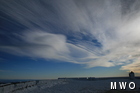
Wave Clouds
Winds this morning are higher than were expected; we’ve had a gust to 95 mph. This is significant in that it is about 20 below zero, and the wind does its best to instantly equalize the body’s heat with the surrounding atmosphere. Essentially this is what wind-chill values represent, the speed with which an exothermic body will lose heat. In trying to understand why our winds are so high we look to the temperature soundings for this morning (attained from balloon launches). It so happens that the vertical temperature profile of the atmosphere is actually very stable with an inversion layer from just below the summit to well above our elevation, the result of which is the impressive acceleration of otherwise moderate winds over the mountain (essentially the air is forced into an narrow accelerate slip just over the summit do to the unwillingness of the air above it to be displaced.) This scenario also allows for the vertical propagation of standing waves off of the entire range. At heights up to 22,000ft cirrocumulus and altocumulus lenticulars illustrate the oscillation of these waves. At lower elevations thin cap clouds mark the laminar flow of stable air over the summits and spindrift is visible in the turbulent eddies just down wind of some terrain features such as the rouche moutonneé of Mount Monroe.
Neil Lareau, Observer
From One Mountain to the Next
From One Mountain to the Next By Ellie Derry Hi everyone! My name is Ellie Derry and I am one of the fall 2026 interns at the Observatory. I’m super excited to be here
Mountains and Meteorology: What More Could a Girl Need?
Mountains and Meteorology: What More Could a Girl Need? By Emily Grainger Hi everyone! My name is Emily Grainger, and I am one of this fall’s Summit Interns atop Mount Washington! I’m from Orlando,
My Fear of Weather Became a Love of Meteorology
My Fear of Weather Became a Love of Meteorology By Kaitlin Farrell Hello! My name is Kaitlin Farrell. I am one of the fall summit interns here at Mount Washington Observatory. I recently graduated