
Summit Foliage Pyrotechnics
2011-09-25 18:04:15.000 – Rick Giard, Weather Observer / Education Specialist
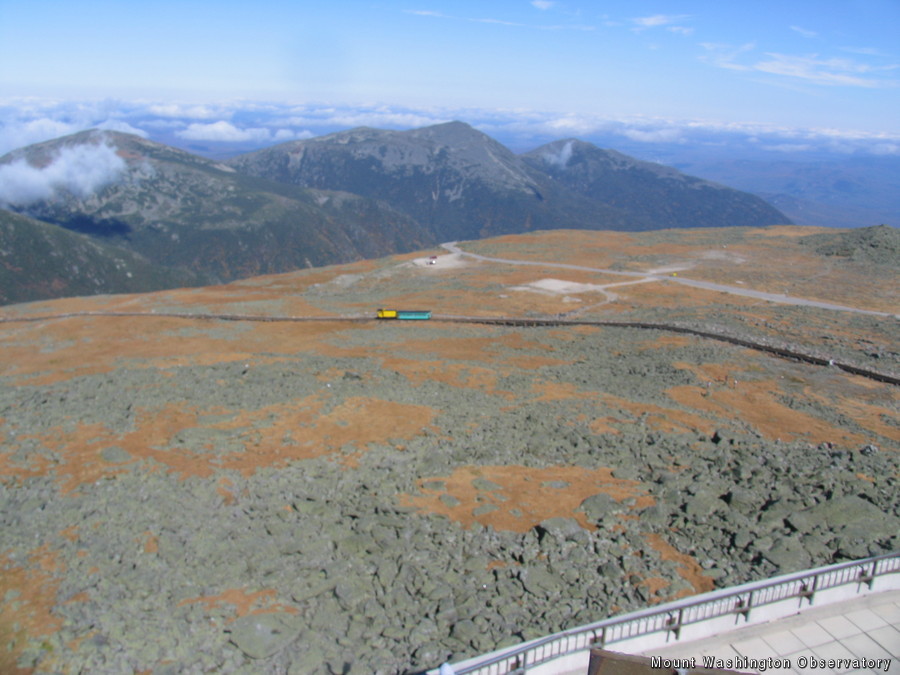
Summit Plant Life Ready for Winter
This past Friday, on the occasion of the Autumnal Equinox, I was interviewed on The Weather Channel live from the summit. The main topic of discussion was the state of fall foliage at Mount Washington and in the northern New Hampshire region. Does it seem a bit ironic that a meteorologist high atop a rocky, treeless peak engulfed in clouds could be interviewed about foliage?
With the nearest visible deciduous trees thousands of feet below, and fog/clouds obscuring the peaks to near-zero visibility 60% of the time, there are not many opportunities to truly admire foliage. Perhaps a good analogy is last July 4th, when I perched atop the instrument tower to view numerous, simultaneous fireworks displays. Although the faraway flashes and colors were observable, they were small, silent spectacles devoid of any real exhilaration. As with remote pyrotechnics, distant foliage seen from the summit is beautiful but lacking the boom.
Still, it was a thrill to be on TWC with Heather Tesch. We also had a chance to talk about a topic more relevant to the Rock Pile: October is frequently winter up here! During the incredible month of October 2005 we measured 79 inches of snowfall – over 6 1/2 feet. Monthly records were set for liquid (melted) precipitation [28.70 in.], total snowfall [78.9 in.], and 24-hour snowfall [25.7 in., 25th/26th]. On the 26th snow depth on the ground was 32 inches, and on the 27th the thermometer registered 11 degrees. As a far as we can determine, autumn weather lasts about two weeks on Mount Washington.
Last Wednesday as we made our way up the winding Auto Road to come on shift, a dramatic change in the plant life was evident. Compared with the previous week’s late-summer deep-greens, many plants had taken on a dull-green appearance, and quite a few trees along the way had begun to develop colors. Formerly green grasses and other small plants were taking on yellow and brown hues. Individual beeches and maples were turning yellow and red in dramatic fashion. Fallen leaves littered the forest floor and the road.
Just beyond tree line, above 4000 feet elevation, stunted krumholz trees rapidly transition to rusty, brown grasses. Nothing green seen. At that point it became apparent that the alpine zone plants are magnificently adapted to this rare environment. They know naturally what the lower-elevation life does not: atop the higher summits winter is nearly upon us.
Rick Giard, Weather Observer / Education Specialist
Seek the Peak 2026: New Adventures, Rooted in Tradition
Seek the Peak 2026: New Adventures, Rooted in Tradition By MWOBS Staff Seek the Peak is Mount Washington Observatory's largest annual fundraiser, and for 26 years it's brought together hikers, adventurers, and people who
What “Prepared” Really Means in the White Mountains
What “Prepared” Really Means in the White Mountains Early Spring in the Whites: The Most Honest Season By Andrew Harris, Burgeon Outdoor If you’ve spent any time in New Hampshire’s White Mountains in March,
March on Mount Washington
March on Mount Washington By Ryan Knapp Looking towards Mt. Madison at sunset on March 21, 2026. The calendar has spoken: Friday, 20 March 2026, marked the first day of astronomical spring.