
The Devil’s in the Details
2016-04-07 09:28:46.000 – Mike Carmon, Weather Observer/Education Specialist
One of the tasks that weather observers must tackle on a daily basis is checking of the various forms that we utilize to perform and submit hourly weather observations, as well as collect continuous daily weather data.
The first step of this process is to check each individual form on its own; we must ensure that all values observed on each of these individual forms are accurate and deemed reasonable by trained weather observers. Errors will inevitably be made, and the objective of daily check is to catch these errors in order to ensure our historical data set is of the highest quality, and nothing less.
After checking each individual form, these forms must then be checked against all other observation forms (that have also been previously checked). This can be a meticulous process depending on the weather events of the day, but it is a vital one to assure all forms and hourly observations (that will eventually land in our historical records) are of great quality.
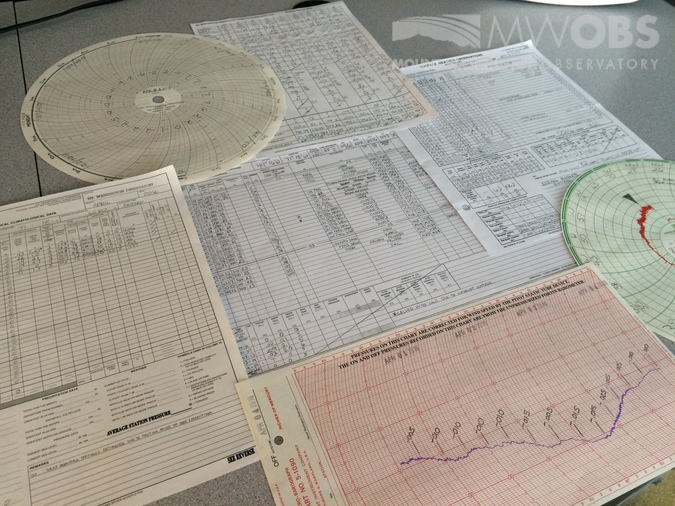
The summit staff’s goal with all of our meteorological data will always be sound quality. We must seek out any and all human errors, no matter how minute they may be, and be sure they are corrected as quickly and accurately as possible. All quality checks (which are subsequently repeated on a weekly and monthly basis) are a meticulous process, and the devil is surely in the details. It takes an individual with great attention to detail to perform these quality checks, and no form is checked any less than three times by at least two distinct weather observers. This methodology ensures the greatest chance of eliminating any lingering errors that may be hiding in unexpected places. Increased computer programming has given us additional tools to seek out these mistakes, but in the end, there’s no better tool than the watchful eye of a weather observer.
A common phrase amongst summit staff is that our data is our lifeblood, so although this quality check process may be tedious at times, it is one of the most important functions of summit weather observers.
Mike Carmon, Weather Observer/Education Specialist

Seek the Peak 2026: New Adventures, Rooted in Tradition
Seek the Peak 2026: New Adventures, Rooted in Tradition By MWOBS Staff Seek the Peak is Mount Washington Observatory's largest annual fundraiser, and for 26 years it's brought together hikers, adventurers, and people who
What “Prepared” Really Means in the White Mountains
What “Prepared” Really Means in the White Mountains Early Spring in the Whites: The Most Honest Season By Andrew Harris, Burgeon Outdoor If you’ve spent any time in New Hampshire’s White Mountains in March,
March on Mount Washington
March on Mount Washington By Ryan Knapp Looking towards Mt. Madison at sunset on March 21, 2026. The calendar has spoken: Friday, 20 March 2026, marked the first day of astronomical spring.