
Thoughts from the Newest Observer
2012-10-19 22:06:25.000 – Brian Fitzgerald, Weather Observer/Education Specialist

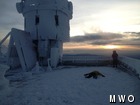
Sometimes snow angels on the deck are part of work
Life and work on top of Mount Washington can be as exhilarating as it is brutal. In the early days of the Observatory, observers would spend two three or four weeks at a time working around the clock to make sure a weather observation was made every hour of the day. In the 1930s observers were essentially unpaid volunteers to boot, but since the Great Depression had hit, staffers felt themselves more than lucky to have room and board (a luxury many people in the country could not afford). It was also typical for many years that only two observers were on each shift with one person working twelve hours during the day and the night observer working the twilight hours. As the decades moved forward weather observers were paid and had their work weeks decreased to shorter stints (still ten days or more at a time).
Fast forward to the past decade and observers on the Rockpile now work eight days on with 6 days off. During the daytime there are now two observers who split weather observations and specialize in either IT (due to all of our technical equipment and instruments) or Education, while the night observer works as the Staff Meteorologist. As you might imagine, taking time off, being sick or swapping personnel on shifts is not quite as straight forward at your typical nine-to-five. The most recent example of this happens to be the latter, where our Weather Observer/Education Specialist Rebecca Scholand is swapping shifts with myself. In order to accomplish this we devised a plan that required me to work eight days in a row with my now former shift and work straight through another couple days until Rebecca could come up and work straight through for ten days until she is synced up with the other shift’s schedule. Confused yet?
So here I am on day ten of my shift firmly in the groove of working on the summit and ready to see friends and family down in the valley again. It’s remarkable how many forms of weather you can see up here in ten days. During this time we’ve seen fog, freezing rain, snow, snow grains, blowing snow, rain showers, rain, near-calm winds, hurricane-force winds, visibilities of 130 miles and sometimes just the hand in front of your face. Did I mention we’ve seen a temperature spread between 47 and 7 degrees (7 being a new daily record low)? It’s been a long shift for sure, but in the grand scheme of things, I can only imagine what a month of isolation in the 1930s might have been like during winter.
Brian Fitzgerald, Weather Observer/Education Specialist
Seek the Peak 2026: New Adventures, Rooted in Tradition
Seek the Peak 2026: New Adventures, Rooted in Tradition By MWOBS Staff Seek the Peak is Mount Washington Observatory's largest annual fundraiser, and for 26 years it's brought together hikers, adventurers, and people who
What “Prepared” Really Means in the White Mountains
What “Prepared” Really Means in the White Mountains Early Spring in the Whites: The Most Honest Season By Andrew Harris, Burgeon Outdoor If you’ve spent any time in New Hampshire’s White Mountains in March,
March on Mount Washington
March on Mount Washington By Ryan Knapp Looking towards Mt. Madison at sunset on March 21, 2026. The calendar has spoken: Friday, 20 March 2026, marked the first day of astronomical spring.