
Upslope Snow “Orographic Lifting”
2016-10-28 19:02:00.000 – Taylor Regan, Summit Intern
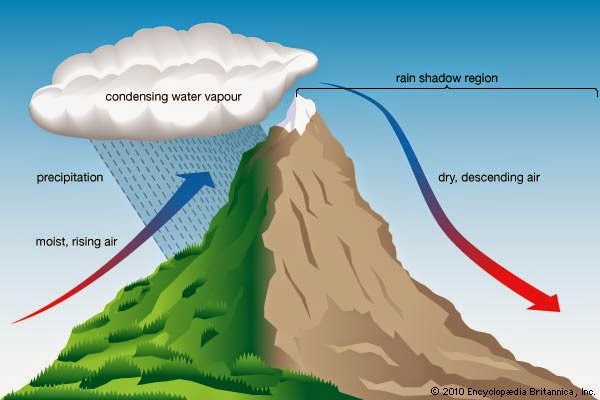
Imagine that you are hiking over the top of a mountain with a drinking cup that can change size. At the base of the mountain, the cup is maybe half full (or half empty, your call). As you climb the mountain, the cup shrinks, until the water completely fills the cup, but you still have further to go! Eventually, the cup has shrunk so much that some water spills out of the cup. If the cup were a parcel of air, this spillover would be upslope precipitation. As you descend the other side of the mountain, the cup gradually returns to its original size, but, because you lost some water on the way up, you are left with much less in the cup.
The White Mountains are uniquely situated perpendicular to the regional prevailing westerly winds, and with little in the way to break up the moving air mass, there are lots of opportunities to see upslope precipitation on the western slopes. However, upslope patterns (specifically upslope snow) are driven by three ingredients: moisture, low-level (surface) winds, and below freezing temps (for snow), and therefore, upslope patterns can develop on other faces of the mountains as well, as long as the “recipe” is met.
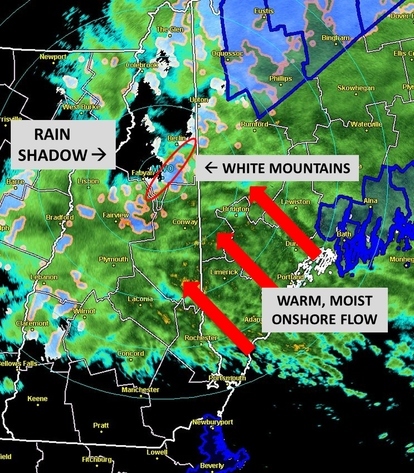
To the northwest of the Whites, as depicted in the above graphic, the precipitation is much lighter. The once moisture-rich air, having cooled and moved over the mountains, descends in a much drier state, as evidenced by the lack of precipitation being picked up on the radar. This “rain shadow” is a direct result of the forced upslope precipitation on the eastern edge of the Whites.
Taylor Regan, Summit Intern

Seek the Peak 2026: New Adventures, Rooted in Tradition
Seek the Peak 2026: New Adventures, Rooted in Tradition By MWOBS Staff Seek the Peak is Mount Washington Observatory's largest annual fundraiser, and for 26 years it's brought together hikers, adventurers, and people who
What “Prepared” Really Means in the White Mountains
What “Prepared” Really Means in the White Mountains Early Spring in the Whites: The Most Honest Season By Andrew Harris, Burgeon Outdoor If you’ve spent any time in New Hampshire’s White Mountains in March,
March on Mount Washington
March on Mount Washington By Ryan Knapp Looking towards Mt. Madison at sunset on March 21, 2026. The calendar has spoken: Friday, 20 March 2026, marked the first day of astronomical spring.