
Vernacular Confusion (The Sequel!)
2018-04-06 10:42:31.000 – Sarah Schulte, Summit Intern
“We’ll never survive!”
“Nonsense! You’re only saying that because no one ever has!”
Wesley and Buttercup, The Princess Bride
It’s time for more Vernacular Confusion! Don’t worry; it’s not going to be as scary as it sounds. Maybe I should have led with a different quote…
Vernacular Confusion is where I go over meteorological terms that might be misunderstood or misused. Part 1 of Vernacular Confusion had a definite winter vibe to it, so this time I’m going to go over some warmer terms. It is Spring, after all (whether or not it feels that way up here at the Rockpile is unimportant). Let’s get to it!
Pineapple Express/Atmospheric Rivers
Just to start things off, I want to clarify that Seth Rogen and James Franco have nothing to do with this. In meteorological terms, the Pineapple Express is an example of a strong atmospheric river. According to NOAA, atmospheric rivers are “narrow regions in the atmosphere that transport much of the moisture from the tropics to the northern latitudes”.
The Pineapple Express is an atmospheric river that transports moisture from the tropical Pacific (near Hawaii) to the West Coasts of Canada and the United States. The Pineapple Express can drop up to five inches of rain on California in a single day. Not all atmospheric rivers are strong, and their precipitation can prove beneficial to water supplies, but those with the strongest winds and largest moisture contents can cause severe flooding due to extreme rainfall.
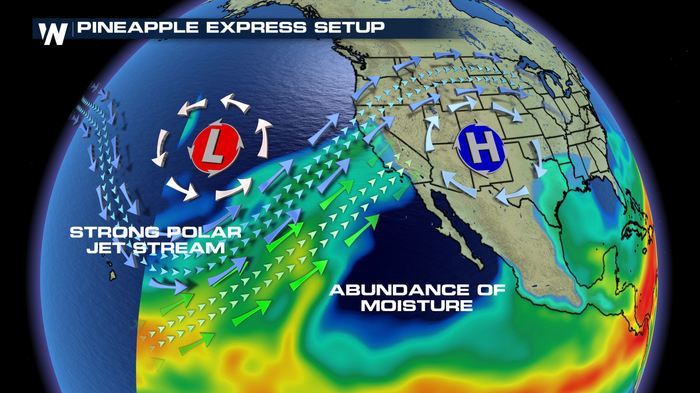
Diagram of the Pineapple Express from WeatherNation.
Gulf Stream
Let’s move to the East Coast and talk about the Gulf Stream. The Gulf Stream is a current of tropical water that starts in the Caribbean and flows up along the Atlantic Coast. It wraps around Florida and follows the coastline up to the North Carolina Outer Banks, where it takes a more eastward path farther out to sea.
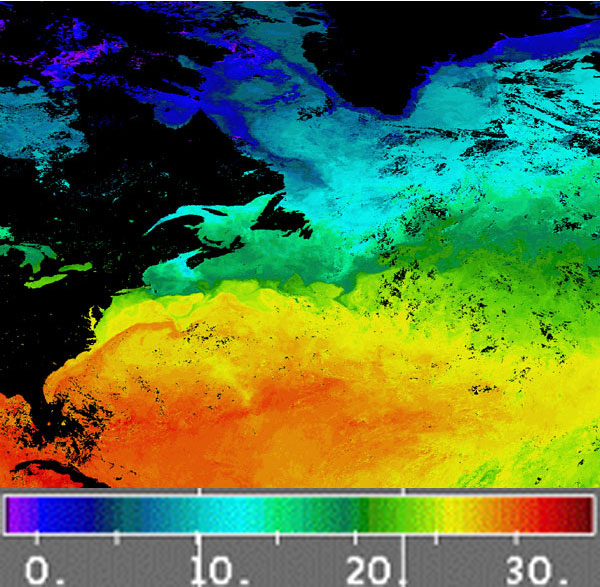
NASA image of Sea Surface Temperatures in the Atlantic Ocean. The Gulf Stream is the curl of warmer temperatures along the East Coast.
Ocean-air interactions are a vital area of the study of weather. As stated by LiveScience, “the Gulf Stream affects the climate of the areas closest to the current by transferring tropical heat towards the northern latitudes”. Just as atmospheric rivers transport moisture from the ocean, the Gulf Stream transports heat. This keeps the coastline waters of the southeastern states much warmer than those of the West Coast.
Heat Lightning
Sometimes, particularly in the summer, you might see lightning without hearing the accompanying boom of thunder afterwards, or notice a flash without seeing a cloud-to-ground bolt. The term ‘heat lightning’ is often attributed to this phenomenon. NOAA posits that the term arose because this phenomenon happens most often on warm summer days.
In actuality, ‘heat lightning’ is no different than the lightning from any other storm. As stated by NOAA, “it is possible that you might see lightning and not hear the thunder because it was too far away”. The sound of thunder can only be heard at a distance of about 10 miles from the flash. Seeing a muted flash instead of a lightning bolt is due to interference from ground features or the curvature of the earth. Instead of seeing the bolt, you merely see the bolt’s reflection off the clouds.
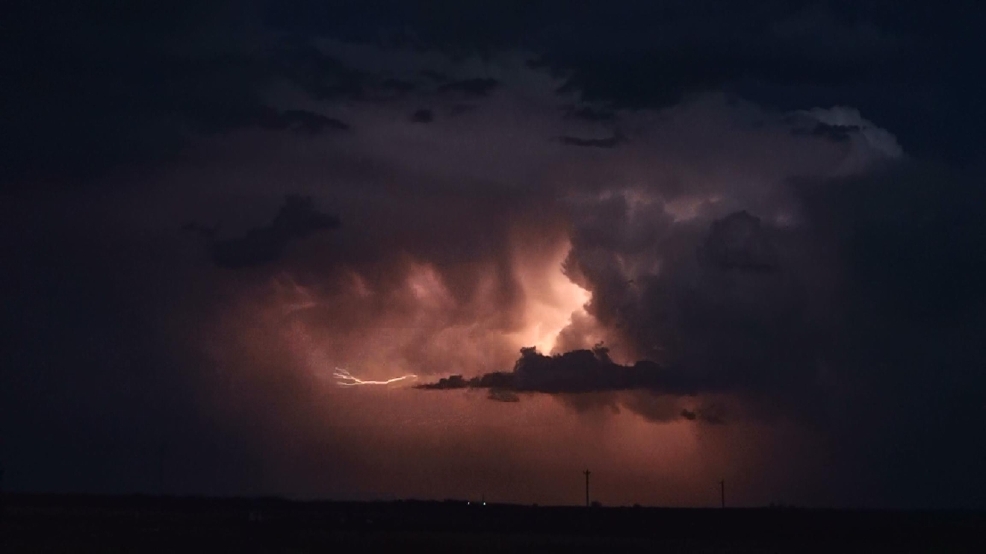
Distant lightning captured by FOX 25 Storm Tracker Bobby Hines from okcfox.com.
A rose by any other name would still smell sweet, however, so a lightning show by any other name will still be pretty! Just take care to watch these natural shows from the safety of a secure building.
Sarah Schulte, Summit Intern

26th Annual Seek the Peak Recap
26th Annual Seek the Peak Recap By Drew Bush Members of the "Peak Potential" team gather at Pinkham Notch before hiking Mount Washington for the 26th Annual Seek the Peak. View more images. We’ve had

Seek the Peak Spotlight: The Cloud Chasers
Seek the Peak Spotlight: The Cloud Chasers By MWOBS Staff Mike Bergeron and Desiree Bolton have been participating and volunteering for Seek the Peak for three years now. Together, they comprise Team Cloud Chasers
Celebrating 250 Years: The Declaration’s Legacy in the White Mountains
Celebrating 250 Years: The Declaration's Legacy in the White Mountains By Peter Crane We are now approaching July Fourth, Independence Day, the day when we celebrate the adoption of the Declaration of Independence in