
What is a Cloud?
2017-01-10 05:37:58.000 – Taylor Regan, Weather Observer
The summit of Mount Washington spends, on average, 60% of its time in the fog, sometimes meaning that the only cloud in the sky is hovering right at the summit. So, you could say we see our fair share of clouds, and maybe more. But what is a cloud? And how and why do they occur?
Clouds are made up of tiny droplets of water that condense around particles in the air, such as dust or pollen, and are small enough to stay suspended in the atmosphere. Because the droplets are so tiny, they are able to remain liquid down to very cold temperatures, as much as -22F below zero. In fact, only in the highest clouds do the water droplets turn to ice.
Water vapor is present to some degree in all air. When the air cools or expands to a certain degree, it allows the water vapor to condense into small droplets of liquid water. These droplets “stick” to small particles in the air, which is the start of a cloud. Eventually, bigger and bigger droplets form and the cloud begins to take a more pronounced shape.
For the water vapor to condense the air needs to be saturated, this means that it cannot hold any more water vapor. Air can become saturated by a few different means. Firstly, the amount of water vapor in the air could be increased. This could be through evaporation for example, from Earth’s surface. Another way for the air to become saturated is by cooling it to its dew point, which is the point at which condensation occurs.
Different types of clouds form as a result of different initiating factors and weather conditions. In 1803, Luke Howard published a book entitled “The Modifications of Clouds” in which he attempted to classify clouds based on common themes. The World Meteorological Organization adopted the system, and has since added to it, resulting in ten major cloud groups, called genera, divided into three levels (low, medium, and high) depending on their typical location in the atmosphere. Clouds are then further classified by species. Location and shape are two major features used to classify clouds.
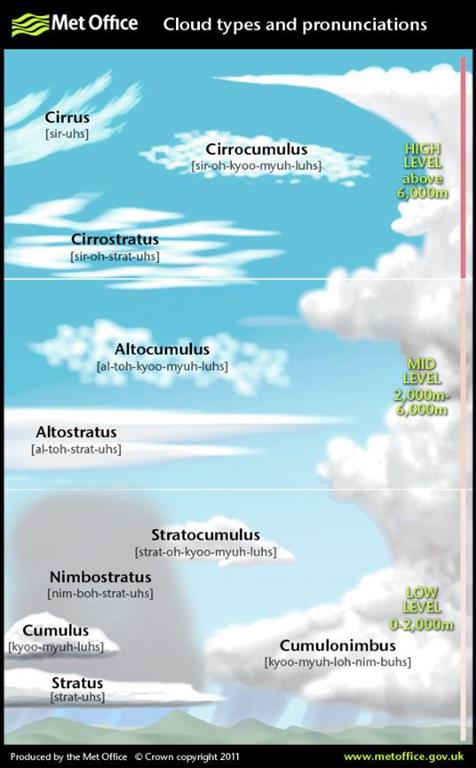 Depiction of cloud types with their associated heights
Taylor Regan, Weather Observer

Home Sweet Summit
Home Sweet Summit By Kathryn Hawkes Me enjoying the view of Mount Washington while skiing in the valley on my off week. Hi everyone! My name is Kathryn Hawkes and I’m the
Meet MWOBS/MWAC Intern Ryan Tanski
Meet MWOBS/MWAC Intern Ryan Tanski By Ryan Tanski Hello! I’m Ryan Tanski and I’m the joint USFS Mount Washington Avalanche Center and Mount Washington Observatory Intern this winter. I’m thrilled to get to work

Geologist Climbs Rock Pile, Looks Up
Geologist Climbs Rock Pile, Looks Up By Bailey Nordin Hello from the summit of Mount Washington! My name is Bailey Nordin, and I am the newest Weather Observer and Education Specialist joining the team