
All This Time
2011-12-14 21:58:30.000 – Mike Carmon, Weather Observer/Meteorologist
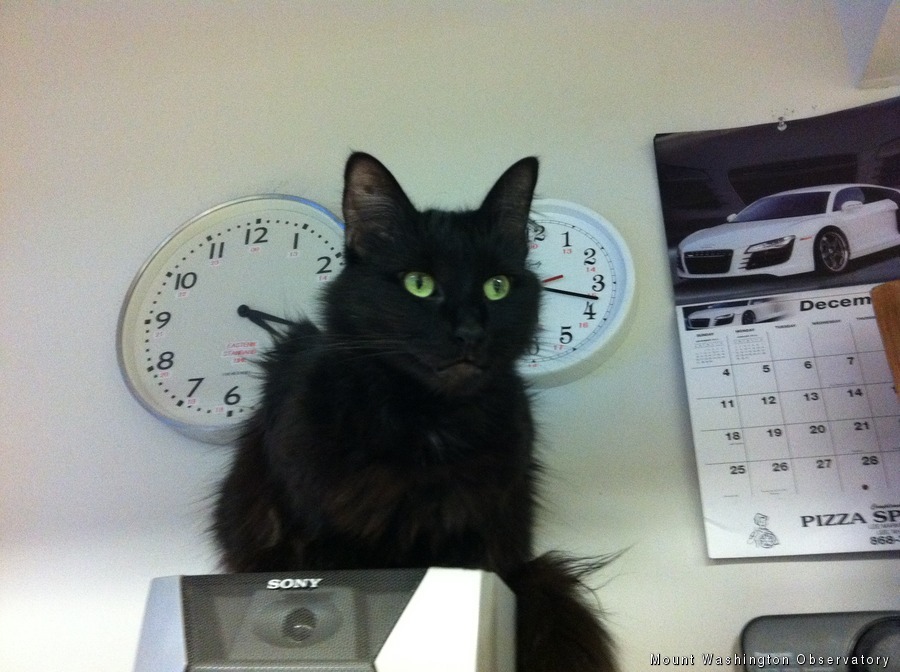

Marty splits the difference between EST and UTC
With regard to weather observations, according to the FMH-1 (Federal Meteorological Handbook-1):
‘The times that are disseminated as part of the observation shall be entered in UTC.’
This fact is confirmed by a header column of our station’s (KMWN’s) MF1M-10c, which is the form prescribed by the FMH-1 for taking surface weather observations.
As you may or may not be aware, all surface weather observations around the globe are taken according to UTC (Coordinated Universal Time), which is also known as Zulu (Z) or Greenwich Mean Time (GMT). The purpose of this is to ensure that all stations are taking observations at the same hour according to an identical clock, and a legitimate snap shot of current conditions can be formed by analyzing all concurrent weather observations. UTC does not change with the seasons as local time does with the daylight savings/standard swaps, so there is no confusion and no points of discontinuity in observation times. UTC is also a 24-hour clock, which eliminates the omnipresent AM/PM debacle.
For all of us east-coasters, UTC is local standard time (LST) plus 5 hours during the winter months, or local daylight time (LDT) plus 4 hours during the summer months. So when we perform an observation at 4:50AM EST and transmit to the National Weather Service, the time of the observation is officially reported as ‘0950Z’, which uses the brief symbol for zulu ‘Z.’ With the standardization of observation-taking time, one can then determine what was occurring at every other surface weather station at the same moment by referencing the 09XXZ observation for those stations.
Mike Carmon, Weather Observer/Meteorologist
White Mountains Almanac Explores How Elevation Shapes Weather, Climate and Ecosystems
FOR IMMEDIATE RELEASE December 1, 2026 White Mountains Almanac Explores How Elevation Shapes Weather, Climate and Ecosystems Second annual edition documents the changing landscape of New Hampshire's White Mountains WHITE MOUNTAINS, NH — The

Who Really Sees the Worst Weather: Mount Washington or the South Pole?
Who Really Sees the Worst Weather: Mount Washington or the South Pole? By Bailey Nordin When I stepped out of the snowcat on my first day as an observer last January into thick fog,

How to Not Lose Your Gear on Your First Day as a Weather Observer
How to Not Lose Your Gear on Your First Day as a Weather Observer By Misha Leyfer Within my first 24 hours as a weather observer at MWOBS, I managed to lose two important