
A little bit about the barographs at Mount Washington Observatory
2011-09-02 19:40:43.000 – Roger Pushor, Weather Observer/IT Specialist

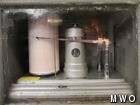
Barograph at Mount Washington Observartory
Invented in 1843 by the Frenchman Lucien Vidie, a barograph is a scientific instrument used in meteorology to measure and record atmospheric pressure over time.
The barographs at Mount Washington Observatory use aneroid cells acting through lever a train to drive a recording arm that has, at its extreme end a pen. A pen records on paper using ink, held in a knib. The recording chart is mounted on a cylindrical drum which is rotated slowly by clockwork. The clockwork on the barographs in the observatory rotates the drum once every four days. After four days the drum to which the graph is attached, is removed and at this point, the clockwork motor is wound.
Today, mechanical recording barographs for meteorological use have commonly been superseded by electronic weather instruments that use computer methods to record the barometric pressure. However, we continue to use the older mechanical recording barographs because of reliability, simplicity, consistency and accuracy. And since they’re spring wound they keep on recording, even during a power outage. Older mechanical barographs are highly prized by collectors as they make good display items, often being made of high quality woods and brass.
You’ll notice on the attached barograph chart, around mid-day on August 27th the barograph trace started to drop quickly. This is where hurricane Irene started to move through the area and the pressure started to fall quickly. By mid-day on the 28th,you’ll notice the pressure rapidly increasing as Irene departed the area. Ryan will have move detail on the weather observations around hurricane Irene on Monday after he finishes monthly check.
The characteristic of barometric tendency or the rising, steadiness or falling of the line traced by the pen is an indication of coming weather with falling pressure being an indication of a storm coming and rising pressure being an indication of clearing weather.
Roger Pushor, Weather Observer/IT Specialist
From One Mountain to the Next
From One Mountain to the Next By Ellie Derry Hi everyone! My name is Ellie Derry and I am one of the fall 2026 interns at the Observatory. I’m super excited to be here
Mountains and Meteorology: What More Could a Girl Need?
Mountains and Meteorology: What More Could a Girl Need? By Emily Grainger Hi everyone! My name is Emily Grainger, and I am one of this fall’s Summit Interns atop Mount Washington! I’m from Orlando,
My Fear of Weather Became a Love of Meteorology
My Fear of Weather Became a Love of Meteorology By Kaitlin Farrell Hello! My name is Kaitlin Farrell. I am one of the fall summit interns here at Mount Washington Observatory. I recently graduated