
Optical Phenomena Viewed From the Summit
2009-06-16 17:10:24.000 – Scott Wehrwein, Summit Intern

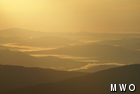
The recently risen sun tints the scenery gold.
Although we’ve been in the fog a lot, our time in the clear has presented a number of interesting optical phenomena. I’ve seen several so far, and curiousity led me to Wikipedia to find out a little bit about why they happen.
Sunrises and sunsets are one of the most common optical phenomena, happening most days when we’re not in the fog. When the sun is just rising or setting, its light passes through more of the atmosphere than during the day, and various types of scattering and refraction produce bright oranges and reds.
Sundogs are bright spots, often looking like little patches of rainbow, on either or both sides of a setting sun, caused by refraction from ice crystals in the atmosphere. Saturday evening I saw my first sundog, a single brighter spot among the clouds to the right of the sun with a slight hint of rainbow colors. Also on Saturday, I witnessed an example of cloud iridescence. This happens when the sun shines through thin clouds which diffract light in an orderly manner so that different colors appear in different regions of the cloud.
Crepuscular rays are the result of air that contains enough dust, moisture, and other particles to scatter the sunlight and appear brighter than the surrounding atmosphere. The visual effect is amplified by clouds that cast shadows, appearing to separate the glowing air into columns that stream through the clouds away from the sun.
In just two weeks on the summit, I’ve witnessed each of these, as well as a rainbow (no photo because I was giving a tour). It seems that our unique position at the highest point in the Northeast positions us favorably for observing the optical phenomena of the atmosphere, in addition to the weather.
Scott Wehrwein, Summit Intern
From One Mountain to the Next
From One Mountain to the Next By Ellie Derry Hi everyone! My name is Ellie Derry and I am one of the fall 2026 interns at the Observatory. I’m super excited to be here
Mountains and Meteorology: What More Could a Girl Need?
Mountains and Meteorology: What More Could a Girl Need? By Emily Grainger Hi everyone! My name is Emily Grainger, and I am one of this fall’s Summit Interns atop Mount Washington! I’m from Orlando,
My Fear of Weather Became a Love of Meteorology
My Fear of Weather Became a Love of Meteorology By Kaitlin Farrell Hello! My name is Kaitlin Farrell. I am one of the fall summit interns here at Mount Washington Observatory. I recently graduated