
Hiker Safety
By Fawn Langerman, Dave Fatula and Julie Saccardo
USFS Trailhead Steward volunteering season has begun, and hiker safety is on my mind. Truthfully, hiker safety is always on my mind, but more so when I am spending each Saturday morning trying to be helpful for safe decision making at some risky White Mountain National Forest (WMNF) trailheads.
Our group is present at five trailheads, and I regularly volunteer at three of them: Appalachia, Ammonoosuc Ravine, and Champney Falls. (The other two trailheads are Falling Waters / Old Bridal Path and Welch / Dickey.) We talk about the summit weather forecast vs. the valley weather forecast, the trail conditions, the Ten Essentials, the Hike Safe card, route selection, and Leave No Trace. At the Appalachia trailhead I talk to Presidential Traverse hikers about bailouts, water supply, and what to do if they need to abort their mission.
Everyone who does this type of volunteering has a “why,” and mine has to do with how sad I get every time I read a Search and Rescue report in which the person might have been helped if only they could have had a trailhead chat about these safety topics.
Any one of us could end up as a Search and Rescue report. These mountains are dangerous, and only somewhat predictable. As the Mount Washington Observatory says at the top of the Higher Summits Forecast, “Mountain weather is subject to rapid changes and extreme conditions.” And it is not just the weather. Whereas a water crossing might have been a “rock hop” yesterday, today might be a much different story. My gear, which was perfectly fine when I left home, might malfunction. My health, also perfectly fine when I left home, might deteriorate in a way entirely unrelated to the mountains. So many things can happen.
So, what do we do? I think that there are two critical strategies for hiker safety, when hiking year-round in the WMNF: planning, and a mindset that embraces turning around for safety, if needed. The planning is what sets us up for the best possible hiking day, and the mindset is what keeps up safe when (inevitably) things go awry.
First Critical Strategy: Planning
The first critical strategy is planning, and at the top of THAT list is, of course, the weather. Go ahead, admit it! If you are reading this then you know all about how vital and fantastic the MWOBS Higher Summits Forecast is and have used it to plan your hikes. And I bet you a dollar that you have sat in your house at 4:30am, with your backpack packed, drinking your coffee and hitting the refresh button to see just how early today’s forecast will be available! No? Am I the only one that does this?! I also use NOAA point forecasts for additional information when I am not hiking Mount Washington or the higher summits, and Mountain Forecast for the longer-range aspect and planning (wishing, hoping, dreaming) a few extra days in the future. I have programmed into my phone the MWOBS phone number (603-356-2137) and know to text “Weather” to get the current summit conditions!
In addition to the weather, it is the water crossings that are most concerning to me. Although there are USGS water level gages in the Saco River and the Ammonoosuc River, I just look at the East Branch Pemigewasset data. When I read someone’s trail report, or hike myself, I take note of the E Branch Pemi River discharge rate and then look at the actual conditions that I am seeing in person (or that another person saw and documented in their videos or photos). In that way I know what my upper limit is for crossing in a particular location. For example, I generally will not attempt to hike Owl’s head (with the Lincoln Brook crossings) if the E Branch Pemi River discharge rate is greater than 300 cuft/second. A lot of people use 500 cuft/second for this and it has a lot to do with how tall you are and how comfortable you are with water pushing on your feet and legs in a water crossing.
In addition to planning with data, I also plan with gear. I pack the “10 Essentials” and a bunch of extra things that I have noted to be helpful over time:
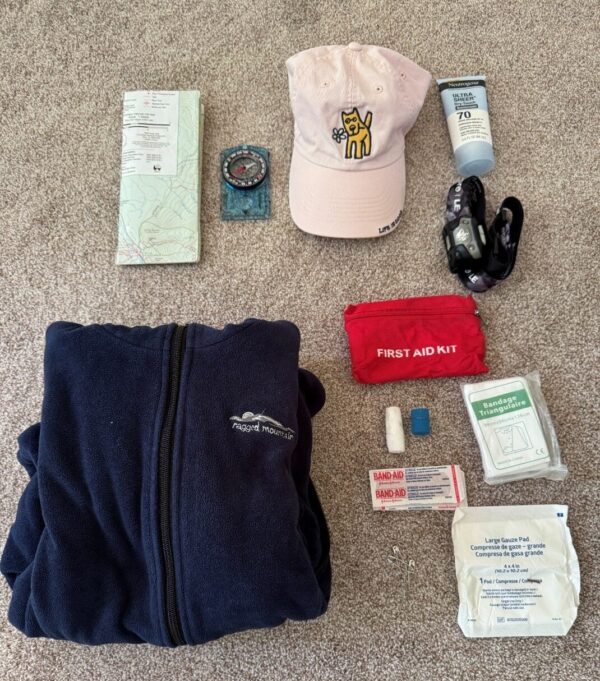
Ten Essentials
Paper map and real compass. I carry the map for the part of the WMNF that I am hiking in that day.
Sun protection (sunscreen and a hat).
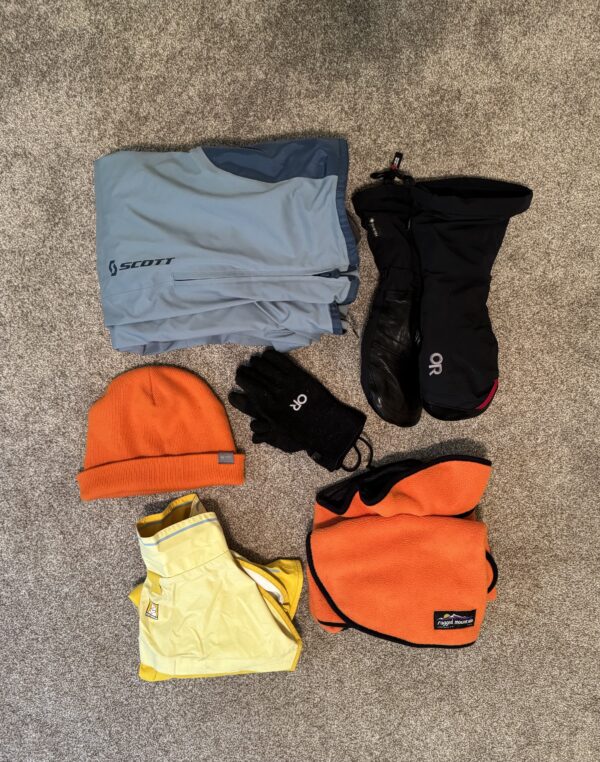
Insulation (extra clothing). In the summer, I carry my very heavy fleece jacket; many people use a puffy. In the winter I carry two pairs of gloves, a wool hat, and ski pants (second photo)! I carry multiple jackets for my dog, because she tends to get wet even when it is not raining. I have been in many debates about carrying a closed-cell foam sleeping pad instead of the ski pants, but here is my rationale. My ski pants are an insulation layer that I can sit on, and also that I can walk in. (A foam sleeping pad does not help me stay warmer while walking). I have now used my ski pants twice and in both cases, it was when I got to a point in a hike where things felt colder than the forecast and I was planning to turn around. In both cases I pulled on my ski pants and headed back down; the warmth was reassuring for me in those conditions.
Illumination. I use rechargeable headlamps. I always carry one, and 2-3 when backpacking or for sunrise hikes.
First Aid supplies. I am a physician and think a little bit differently about a First Aid kit than a lot of people do. I only bring with me items that I might need personally, and only give other people items that cannot possibly harm them even if I do not know their medical history. In short, I do not carry any oral medications. With medications you have to worry about their stability when exposed to temperature extremes, their expiration dates, and their onset of action. So I just carry items that would be helpful for wounds, including different types of bandages and gauze pads, a triangle bandage that can be used as a sling, and some bandage wraps. I also do not carry topical antibacterial ointment as it, just like oral medications, does not do well with temperature extremes!
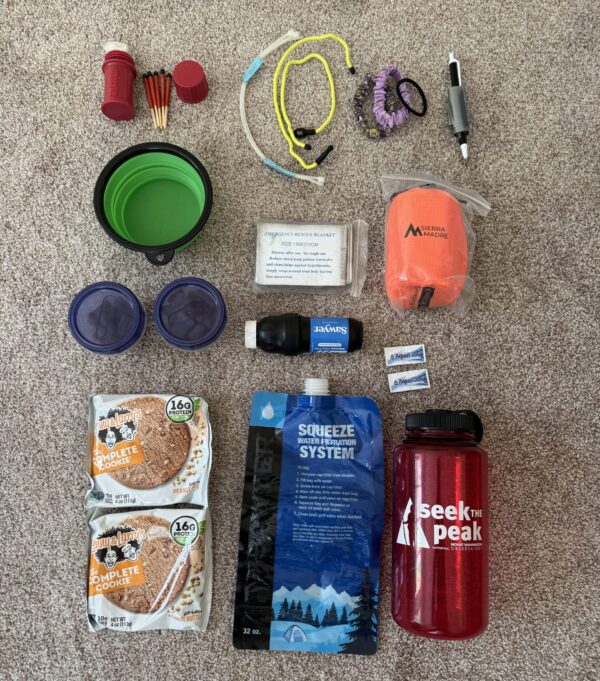
Fire starter. I carry waterproof matches that came in a tiny waterproof canister with some flammable fire-starting material, but I will be honest, I have a lot of trouble imagining a scenario in which I would personally light a fire. I carry this, however, because it weighs next to nothing and if the unimaginable occurred, this could make all of the difference. You never know.
Repair kit and tools. I carry a small multi-tool, zip ties with duct tape wrapped around them, a pen with more duct tape wrapped around it, some gear ties, and some hair bands. I hand out duct tape and zip ties to AT thru hikers frequently! And why do I carry the pen? Back when the Cabot Cabin had a register, I once found that the pen was dry and so I could not sign it. My sadness, about this, was entirely out of proportion to the typical consequences of a dried-up pen, and I vowed never to be that sad (about a pen) again. Thus, I now have a pen.
Emergency shelter. I carry a Sierra Madre Emergency Sleeping Bag, which really is a one-person, with one dog, shelter. It is 7’ x 3’, insulated and waterproof and I can fit me plus my dog in it, if needed. In addition, I carry an emergency rescue blanket, which could go over the top of both of us.
Extra food. I always have double what I think I will need for both me and for my dog.
Extra water. I carry water and salt tabs. I have never used the salt tabs because I do not like the way that the treated water tastes; in the winter I carry enough water for the hike and would only use the salt tabs in an emergency. When it is above freezing, I have my water filter.
Extra Items
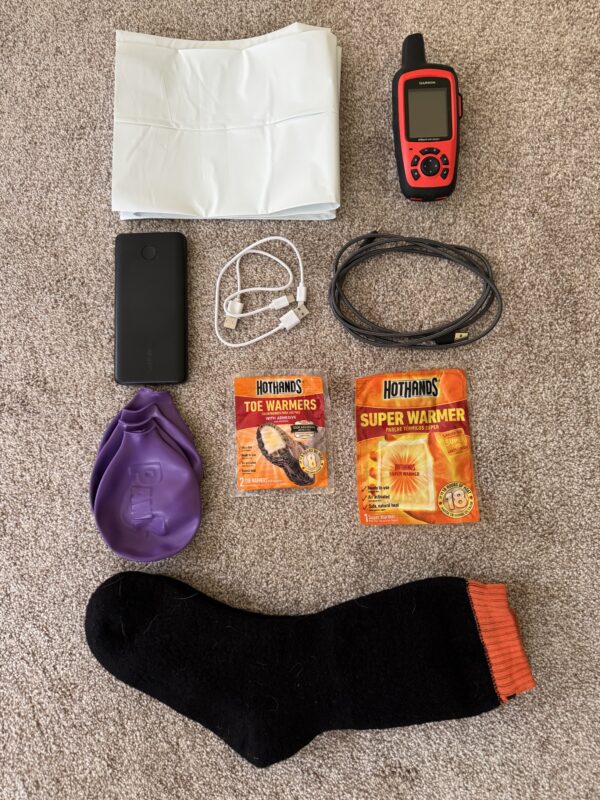
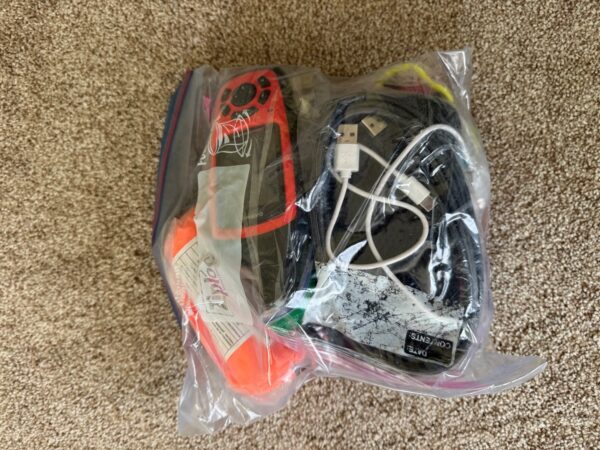
Garmin InReach Explorer Plus. I am a solo hiker and though there is a monthly subscription in addition to the purchase price for the device, I cannot tell you how much safer I feel having this. My InReach Plus sends my exact location to the satellite every 20 minutes (or more frequently, if I want it to). My loved ones can follow my journey on the internet, and know exactly where I am. The device also sends and receives text messages even without cell service. It is now 6 years old and there are smaller/lighter versions available but it works, and for now I do not mind the weight in exchange for the peace of mind.
Anker PowerCore 10k, which is a battery bank, and power cords for my cellphone, my InReach, and my headlamps. This is another heavy thing that I would not leave home without. The super long cord in the photo is for my cellphone; that allows me to have the battery bank in my pack and the cellphone in my pocket.
Hand and toe warmers. I carry these year-round as I ran across a really cold (injured) AT thru hiker on a summer day a few years ago and these were incredibly helpful.
Waterproof socks. These are my backup socks in the winter, in case something happens to my insulated boots, and they are ideal with trail runners in the summer, so as not to deal with that squish-squish-squish feeling after wading through a water crossing.
Two compacter trash bags. In the winter these can be combined with light traction to make wading gaiters; in the summer there is really any number of uses for these bags, so I have them in my pack year-round.
Pawz boots. These are like thick balloons and are dog boots to protect from snowballs in the pads. I carry them year-round just in case my pup gets a paw injury.
All together (without the food, water, water filter or compacter trash bags) this kit weighs 3.2 pounds. Everything is in individual, sealed plastic bags, and the whole thing is in a sealed plastic bag, and then it goes inside the compacter trash bags and lives in the bottom of my backpack.
Hiking with Dogs
In the WMNF, Search and Rescue groups only mobilize to assist humans, but the NH Paw Rescue (a Facebook and IG group) will assist with dogs. They write incredibly detailed reports, including an analysis of each incident with lessons learned. There were news reports, a few years ago, that the amazing North Conway pet store Four Your Paws Only had assembled emergency dog rescue kits and placed them at the AMC huts and at Pinkham Notch, so there might be help if you are with your dog in an area with an emergency kit. For me, I used to carry a dog rescue harness until my last dog, Willow, broke a bone in her paw when we were hiking in Evans Notch in 2022. We were about a mile from the trailhead and, though she was not doing any zoomies or running, she just suddenly started limping. I attempted to put her in the rescue harness on the back of me and my backpack on the front of me, but that did not work. I attempted the reverse (backpack on my back, her in the harness on the front of me), and that also did not work. So, then I put my backpack on the regular way and carried Willow over my shoulders with her belly on the back pack and her front paws on my left, back paws on my right. That worked perfectly. My error, by the way, was that I had tried out the harness in my backyard and it was fine, but I forgot that I would have a backpack with me! I think that a dog harness would be absolutely perfect if hiking with multiple humans, because then one person could carry the dog and others could carry the extra backpack. My dogs have always been a weight that I could carry myself (with lots of rest stops, of course), and I have not hiked with my dogs in the places that have the most dog paw problems (the Presidentials above Eisenhower, and Franconia Ridge).
Second Critical Strategy: Mindset
The second critical strategy for hiker safety, when hiking in the WMNF, is being absolutely ok with turning back before achieving your stated goal. This is hard. This is not just words. This might be more important than everything I have mentioned so far. In my opinion, if you do not absolutely own the idea that the parking lot is the goal, and the mountains really will be there the next time that you hike, then when something goes wrong you will not be in the right headspace to make the safest decision. If you hike enough, something will go wrong. The weather will be worse than the forecast, or will be exactly the forecast but feel a lot worse than you anticipated. The water crossing will be higher than the data said it should be. Your snowshoe binding will break. You will break a hiking pole. Your goggles will fog and it will be too cold to clear them. Your water filter will fail. You will open up your snacks and find out that everything is inedible. The trail will be muddier or snowier or icier than you were anticipating, so your hike is taking longer than you were planning to be out. You will land a footstep funny on the leg with your bad knee and will tweak it, and suddenly you are limping. I am not extrapolating possible future disasters; I am listing things that have happened to me personally. Sure, you can push through problems, and yes, we drag the 10 Essentials to address some of these problems, but one of the solutions, to any trail problem, really has to be turning back. I do not turn back for every problem, but I definitely think about it. Every. Single. Time.
I cannot count how many times I have turned back from a stated hiking goal, but I can tell you exactly how many times I have regretted turning back – zero. Honestly. I have no shame in stating that I turned back from something, and exactly why I turned back. I do not hide the fact that I turned back and applaud the social media posts where people talk about making this same decision.
I wish that there was not such a stigma around turning back, as if this were some sort of failure, rather than a completely awesome safety decision. Turning back is never, ever, ever the wrong decision. Really. I have heard “I drove all this way to do this,” and “I have to reach the summit for my list!” I feel you, hiking friends! I spent more than three decades driving to NH from OH (16+ hour drive each way) one to two times per year for hiking and camping, and never made it to the summit of Mount Washington in all of those years. I made five separate plans to see the top of our beloved rockpile, but every one of those times I turned back. The weather was not my friend, for those attempts. My first Mount Washington summit success was in the summer of 2020 (and it was worth the wait!).
I cannot overemphasize how important this ok-to-turn-back mindset is. Truthfully, all of the best and most detailed planning becomes entirely moot if the wrong decision is made on the trail. When I look closely at my decisions to turn back, I can separate them into two groupings. One grouping are the decisions that might have been different if I were not a solo hiker. When my water filter failed and I really did not want a hot summer ZBonds traverse with chemical-tasting water, I was by myself. If I had been with other people who also carried filters, it would have been a non-issue. Note that there are some problems that are not helped by hiking in groups, and those include catastrophic equipment failures, environmental issues (weather and water crossings), and medical problems.
Improving Hiker Safety: Hiking with Other People
Hiking with other people has a myriad of benefits. Conversations add an amazing dimension to the experience, as they can be uninterrupted. If you hike with other people, you are likely to notice a lot more of the world around you, as there are more eyes to see all of the amazing sights! Group hiking forges bonds that are unique and long-lasting. And, one of the really great things about hiking with other people is having people to talk through difficult decisions. I have always been a solo hiker so have ensured my own safety by having a really low threshold to turn back. But I am super impressed with the groups of hikers that are in the Hiking Buddies Facebook group, currently with over 29,000 members, as they have a keen eye on safety with the benefit of mutual hiker support. I talked with Julie Saccardo, one of several admins for the Hiking Buddies Facebook group, and she said this: “You will learn a great deal of skills hiking with others, things you may not be aware of just starting out. Conversations may include gear selection, trail knowledge, and past failures and what was learned from their experiences. Along with the comradery and support from others, there will be challenges where a collective decision must be made. It is sometimes easy to fall into letting others make critical conclusions and this is where your thoughts matter most and must be communicated. Your level of experience, available gear and comfort are central to your next move. Are the winds a tad higher than anticipated? Did I just see lightning in the distance? Is that pesky ankle injury acting up again, knowing that you have 5 miles to go?
“Hiking with a group does not solve every possible scenario of hazards. But what it will provide is support when things may go sideways. It will provide laughter through that tough climb, confidence when you need it, shared gear if yours fails, and a fellowship you can fall back on. Your communication with your group before, during, and after your hike is highly essential. And as always, be prepared to hike solo; carry your essentials, understand your route, and always have a backup plan tailored to you and your group.”
As Julie mentioned, one of the challenges of hiking with other hikers is that their experience level might be greater, lesser or the same as yours. Sometimes it is best to hike with an expert, and the ultimate way to increase safety while hiking is to find a knowledgeable and experienced guide. A great choice for a guide is Guineafowl Adventure Company. What I really like about this company is that they provide transportation and all of the gear that you need for your hike. As a new hiker, that would have taken a lot of the stress out of the hike for me! I talked with David Fatula, the Founder of Guineafowl Adventure Company, and he said this: “For people new to the WMNF, even with great hiking experience in other places, there really are no “easy” hikes here. It takes time and experience to get used to the rugged nature of the WMNF which often catches people by surprise, even if they’ve visited several national parks or hiked abroad. Not only do we safely guide our clients up and down the mountain(s), but we also ensure we take them on hikes appropriate for their experience level and abilities. All of our guides are trained in wilderness first aid and our goal is to remove any doubt or concern from our hikers’ minds before and during our trips, so they can simply experience the joy of being out in nature.”
Final Thoughts
In summary, hiker safety is definitely on my mind. There are two critical strategies for safety: planning, and a mindset that embraces turning around for safety, if needed. You can increase your safety by hiking with others, and there are some terrific options to do this. Be safe out there, hiker friends— I will see you at the trailheads, and out on these amazing White Mountain National Forest trails!
From One Mountain to the Next
From One Mountain to the Next By Ellie Derry Hi everyone! My name is Ellie Derry and I am one of the fall 2026 interns at the Observatory. I’m super excited to be here

Mountains and Meteorology: What More Could a Girl Need?
Mountains and Meteorology: What More Could a Girl Need? By Emily Grainger Hi everyone! My name is Emily Grainger, and I am one of this fall’s Summit Interns atop Mount Washington! I’m from Orlando,

My Fear of Weather Became a Love of Meteorology
My Fear of Weather Became a Love of Meteorology By Kaitlin Farrell Hello! My name is Kaitlin Farrell. I am one of the fall summit interns here at Mount Washington Observatory. I recently graduated