
Air Quality Impressions
2007-06-19 06:29:06.000 – Jon Cotton, Observer

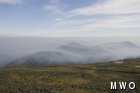
Haze Version of Thin Wave Stratus
Yesterday dawned with thin veils of cloud draping the Presidential range intertwining in arcing waves. The photos posted were taken at 4:30am. Here is the same scene photographed at 7am. Visibility here is 10 miles, reduced from 90 miles just two and a half hours earlier. Unfortunately haze like this is quite common in the summer months.
Some quick reasons for it – the Midwest pollutes, the mid-Atlantic does too, the summer jetstream rides south of its winter track to fall over the northern USA and warmer temperatures promote the secondary chemical reactions to produce the nitrates and sulfates of concern. Cool Canadian air is what provides such clear visibility common to the winter months. There is plenty of research, science, dialog and activism centered around pollution and rightly so. I am glossing over the hard facts because other folks are better suited to the discussion. UNH’s long-running AIRMAP project and our own staff scientists in Bartlett come to mind. Besides, I have a different point to make.
I have talked to a lot of people in several years working for the Observatory and neighboring AMC Huts. I overhear people all the time saying “What a beautiful day”, when my eyes look out the very same window and claw through a palpable brown quagmire to barely distinguish Bretton Woods. My impression of the scene is “Yuck, there is no way I’m going out in that; it’s disgusting”. We look at the same conditions and gut-react in opposite ways. What I’ve figured is that people just do not think of air quality. I am lucky in experiencing regular 130 mile visibility, seeing the green flash on the horizon and being surprised by a particular razor sharp quality to a tower 300 feet across the summit. I know what good, clean (old fashioned) air looks like. Noticing these things is my job and a person just can’t help but appreciate it. I absolutely understand how crystalline air simply isn’t a part of the daily life of the average American.
What I’ve figured is that people draw an equation from what they know. Good weather = sunny + warm. Air quality and the fact that the air you breathe could actually be sunburning your lungs just doesn’t factor in. When I step in to these overheard remarks with a disheartening “It’s extremely hazy today”, the response is, almost always, a nonchalant shrug as if I was referring to something else. Two examples – I once boarded a plane in Manchester, landed in Los Angeles and exclaimed at the haze entrenched against the mountains. My companions called it ‘low cloud’. My professional training and personal experience literally could not win this argument even though I championed the cause of truth. My last shift I overheard someone in the Observatory weather room say “oh it’s so nice out”. My boss responded without hesitation, “yeah but it’s really hazy”. This day was the first day of sickening summer haze in the White Mountains; it was May 24, 2007.
So today, wherever you are, take a moment to go outside. (Looking out a window doesn’t count. This is a hands on nature exercise and you have to be out beyond doors.) Look up and do your best to assess the quality of your oxygen source. You might not have a weather observer’s discernment, but if you pay attention you’ll know. And remember, knowing is half the battle.
(Also, when was the last time you looked at the sky and considered what goes on in the entire above-ground half of the world?)
Jon Cotton, Observer
From One Mountain to the Next
From One Mountain to the Next By Ellie Derry Hi everyone! My name is Ellie Derry and I am one of the fall 2026 interns at the Observatory. I’m super excited to be here
Mountains and Meteorology: What More Could a Girl Need?
Mountains and Meteorology: What More Could a Girl Need? By Emily Grainger Hi everyone! My name is Emily Grainger, and I am one of this fall’s Summit Interns atop Mount Washington! I’m from Orlando,
My Fear of Weather Became a Love of Meteorology
My Fear of Weather Became a Love of Meteorology By Kaitlin Farrell Hello! My name is Kaitlin Farrell. I am one of the fall summit interns here at Mount Washington Observatory. I recently graduated