
Cloud Iridescence
2013-01-03 19:43:34.000 – Ryan Knapp, Weather Observer/Meteorologist

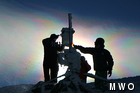
Deicing the 5300′ ARVP site w/ Cloud iridescence
As we ascended the mountain this morning, there was an overabundance of blue skies surrounding the summit. However, it wasn’t 100 percent clear as there was a small strip of Altocumulus Lenticularis hovering just to the east of the mountain. Lenticular clouds are always neat to see and watch as they morph into various shapes minute to minute like a natural atmospheric lava lamp. As we ascended the mountain for shift change day, I continued to keep an eye on these clouds, just in case anything caught my eye to photograph. As we started to ascend the 4-mile section of the Auto Road, the cloud started to glow in all sorts of colors. At first, I brushed it off as a corona around the sun but as we moved up the mountain, the waves of colors started to change and morphed in all sorts of directions and I knew we were seeing something rarely seen from the summit: cloud iridescence. So, I had the snow tractor stop at Cragway turn just in case this would be a short lived event.
After snapping some shots, we were off again. As we climbed, the colors were continuously changing. If I had my way, we would have been stopping every couple of feet. But I knew we had to relieve the down going crew, so I kept it to myself. However, we did stop one more time at the 5300 foot site for the Auto Road Vertical Profile and I was able to snap a few more images of this unique natural event.
So, what is an iridescent cloud? It is when a thin cloud is formed with similar sized droplets that diffract the light as it passes through and allows the cloud to shine with several bands of colors similar to that of a corona. In fact, the colors are being caused by corona fragmentation. However, a corona is formed when similar sized droplets cover a large area of the sky near the sun creating several bands of color that appear to radiate out from the sun. Cloud iridescence forms in localized areas and can form anywhere in the sky although typically it is somewhat in proximity to the sun. In the case of today’s event, the eastern lenticular cloud and our elevation gain allowed the colors to be spread unevenly across the thin edges of the lenticular cloud. It was a colorful sight and one I was glad we all got to witness.
Ryan Knapp, Weather Observer/Meteorologist
From One Mountain to the Next
From One Mountain to the Next By Ellie Derry Hi everyone! My name is Ellie Derry and I am one of the fall 2026 interns at the Observatory. I’m super excited to be here
Mountains and Meteorology: What More Could a Girl Need?
Mountains and Meteorology: What More Could a Girl Need? By Emily Grainger Hi everyone! My name is Emily Grainger, and I am one of this fall’s Summit Interns atop Mount Washington! I’m from Orlando,
My Fear of Weather Became a Love of Meteorology
My Fear of Weather Became a Love of Meteorology By Kaitlin Farrell Hello! My name is Kaitlin Farrell. I am one of the fall summit interns here at Mount Washington Observatory. I recently graduated