
Lightning Tidbit
2014-08-07 19:18:27.000 – Brett Rossio, Summit Intern

NULL
The day started with a quiet morning on the summit, but gave way to a busy start to the afternoon. A couple thunderstorms rolled through the summits, yielding some pea sized hail showers. Our shift leader, Mike Carmon posted some great pictures of the hail on our Facebook page! For meteorologists, this is what makes us jump out of our seats. Thunderstorms are truly a treat up here, but also very dangerous. Though the chances of getting struck by lightning are slim; standing on the summit completely exposed becomes exponentially more dangerous.
Imagine a large thunderstorm with very high cloud tops. Meteorologists like to call these clouds cumulus congestus or even cumulonimbus. Essentially when ice particles collide with very tiny water droplets in the cloud, electrons are being shaved off of the water and descend with these heavier ice particles. A strong positive charge develops at the top of the clouds with a strong negative charge at the base of the cloud. Eventually the electrons and protons are effectively separated between the bottom and top of the cloud respectively. In school we are always taught to never stand next to a tree in the vicinity of a thunderstorm. Not only is a positive charge building up in the top of the cloud, but also along the ground as well! The positive charge will surge to the highest point it may achieve which is where “cloud-to-ground” lightning occurs. When you are on the summit of Mount Washington, you are above tree-line and therefore become a high point for these protons. Electrons then descend toward the ground and reach for the highest point of contact with the protons to “balance” everything out. Once this is achieved, we see lightning. This is why being outside on the mountain can be extremely dangerous during a thunderstorm!
Brett Rossio, Summit Intern
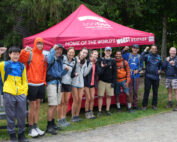
26th Annual Seek the Peak Recap
26th Annual Seek the Peak Recap By Drew Bush Members of the "Peak Potential" team gather at Pinkham Notch before hiking Mount Washington for the 26th Annual Seek the Peak. View more images. We’ve had
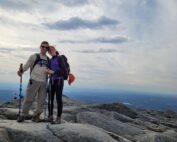
Seek the Peak Spotlight: The Cloud Chasers
Seek the Peak Spotlight: The Cloud Chasers By MWOBS Staff Mike Bergeron and Desiree Bolton have been participating and volunteering for Seek the Peak for three years now. Together, they comprise Team Cloud Chasers
Celebrating 250 Years: The Declaration’s Legacy in the White Mountains
Celebrating 250 Years: The Declaration's Legacy in the White Mountains By Peter Crane We are now approaching July Fourth, Independence Day, the day when we celebrate the adoption of the Declaration of Independence in