
Living the Night Life
By Madelynn Smith
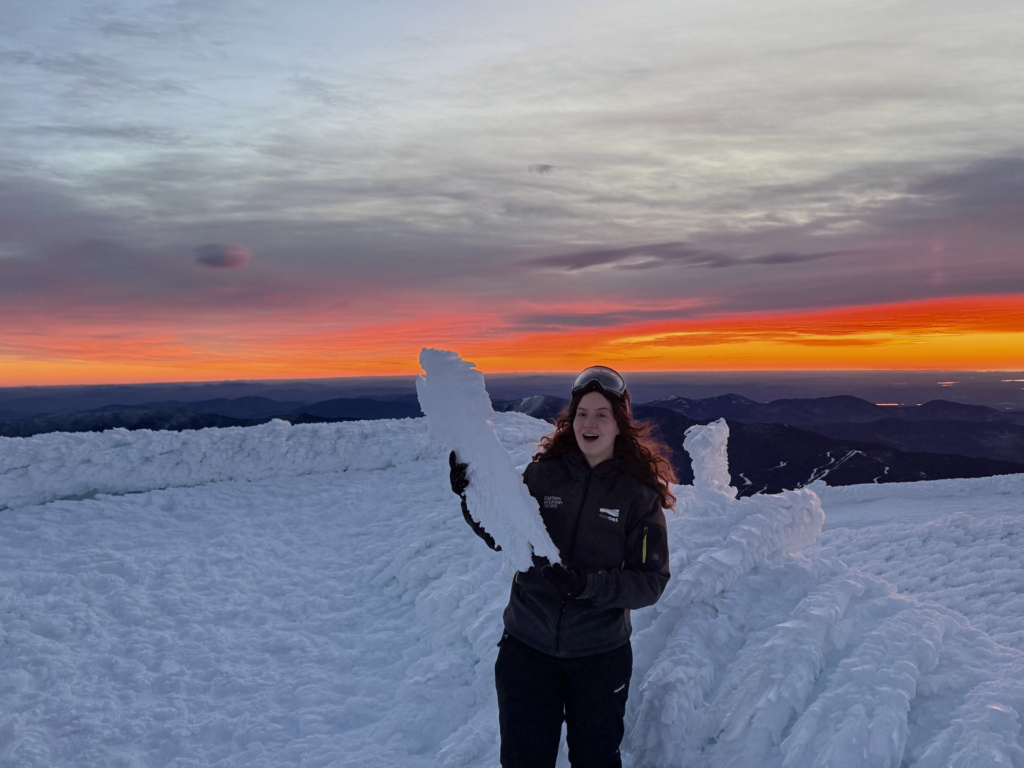
My alarm goes off in the bunkroom, with blackout curtains obscuring the sun’s rays as it begins to lower in the sky. My day starts in the afternoon – going about my “morning” routine as the day observers are finishing up their shift upstairs in the weather room. The smell of what our volunteers are cooking for dinner that evening signals the end of the workday for everyone else, but just the beginning for mine. Nimbus meows hello as I make my way up the tower stairs, caffeine in hand, readying for what the night may bring.
Having worked as a night observer with the Observatory only since November of 2025, the hours between dusk and dawn are still full of surprises. The day shift is fully loaded with people buzzing about on the summit: between the day observers, interns, and volunteers working inside the Observatory, to hikers and visitors making the journey up to the summit. Once the sun sets, the summit gets quieter (in some ways). As the sole person typically on duty overnight, I get to experience all that Mount Washington has to offer alone. That can result in a unique peace on the calmer nights, especially if we are clear of the ever-frequent fog. I would have to argue that these views are some of the best one could ask for in a workplace environment.
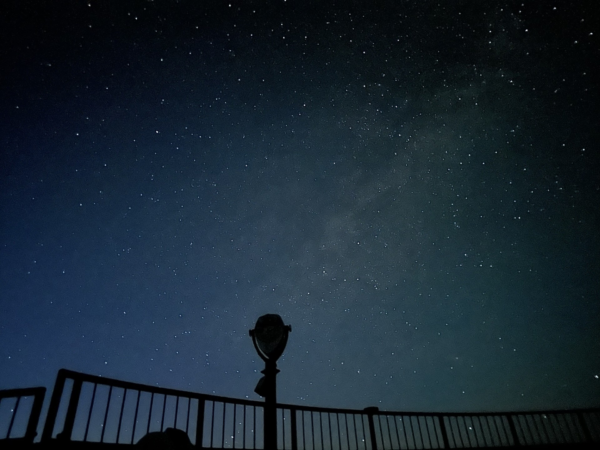
A rare clear night from the Observation Deck.
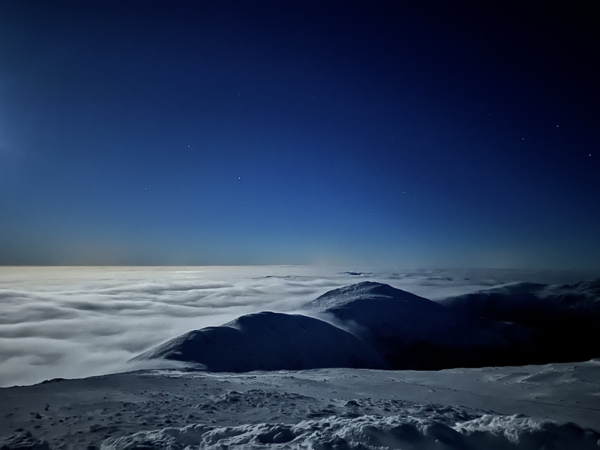
Another rare clear night from the Observation Deck.
With the unique nature of this job, I get a lot of questions about what it’s like working nights. Below are my answers to some frequently asked questions about being a night observer here at Mount Washington:
Q: What is the biggest difference between taking weather observations at night versus during the daytime?
Mainly in how we determine what our visibility is. During the day, observers will mainly utilize mountains visible across New Hampshire, Maine, Vermont, and even as far as New York to determine how far we can see from the summit. At night, it is usually quite a bit more difficult to see these same landmarks, especially the ones further away. So instead, we will use lights from various cities, airports, and even windmill farms to determine visibility. Otherwise, the procedures are pretty similar. While daytime observations are usually split between the 2 day observers (6 observations each during a 12 hour shift), I get to take all 12 observations as the sole observer on duty.
Q: How can you see what is going on outside if its dark outside? Do you wear a headlamp?
I do wear a headlamp, but I actually don’t use it much when taking observations. When you go outside at night, your eyes will eventually adjust to the dark in a few minutes. It is definitely easier when you have moonlight to amplify things, but even during a new moon, I just have to give myself extra time to allow my eyes to adjust. Having my headlamp light on actually makes things worse when conducting an observation- it makes things close to me too bright and makes it harder to see clouds above. I’ll usually only turn the light on when I’m reading the temperatures on the sling psychrometer, determining what precipitation is falling, or when I’m venturing out to get the precipitation can if I need it.
Q: Do you still have to go outside and collect the precipitation can at night?
Yes! We collect the precipitation can every 6 hours if there has been any, which for me means going out to collect it around dinnertime and again after midnight. The only times I wouldn’t venture out to the can is if winds are too high and it becomes too difficult to get the can safely. This is quite rare though and every observer has their own thresholds, but for me, I wouldn’t collect it if sustained winds are above 100 mph.
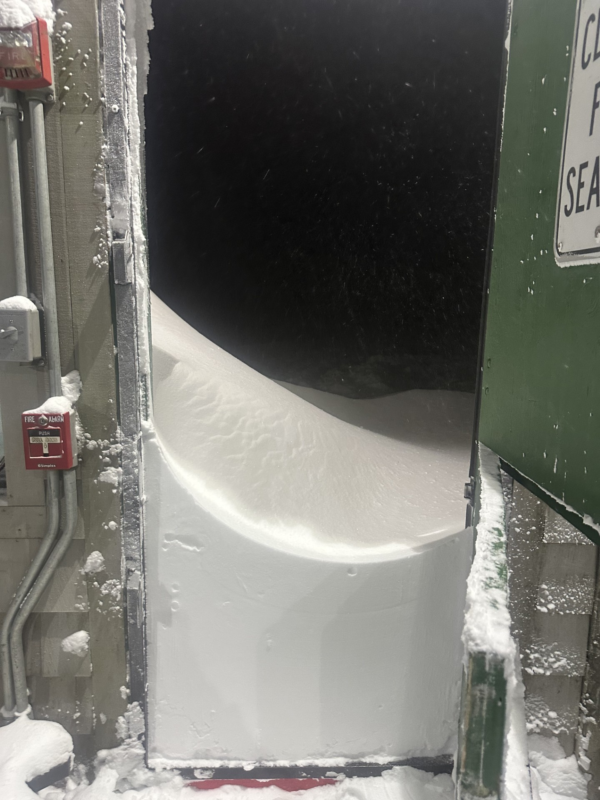
A large snow drift at the entrance of the State Park Building as I was going to get the precipitation can for the 00Z synoptic observation.
Q: Does Nimbus keep you company at night?
Sometimes! He is a fan of warmer weather, and doesn’t actually like to go up the tower into the weather room during winter because it gets too cold. He will opt to stay downstairs in the (warmer) living area and I’ll usually come see him a couple of times at night. During the warmer months however he will venture up the tower and keep me company at the computer while I’m doing the Higher Summits forecast or checking over all of our daily weather forms. He likes to conveniently sit right on top of the keyboard or whichever papers you’re working on.
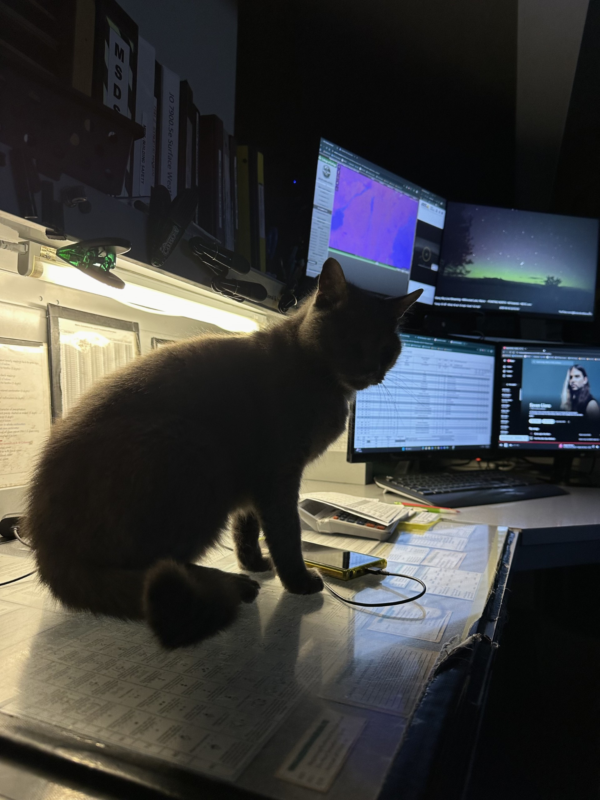
Nimbus helping out with night shift duties.
Q: Do you keep your night shift schedule even when you’re not working?
I try not to. While I do prefer working a night shift schedule and it’s one of my favorite parts about this job, during my off weeks I usually switch over to a slightly more “normal” schedule and try to be awake for most of the day. When I’m on-shift I usually wake up around 4:30 PM and stay awake until 9 AM-ish, but during my off weeks, I switch somewhat back and wake up sometime mid-morning and am up until after midnight. I am a natural night owl and always have been the most productive at night, which works great for this role.
Q: What’s the coolest thing you’ve experienced while working at night?
The most obvious answer for me is the northern lights. My first week working as an observer we were able to see them from the summit multiple times that shift, which is always the coolest thing to witness. When we’re not in the fog and we have a clear enough night to see them, I find it hard to believe that there is anything more amazing to see.
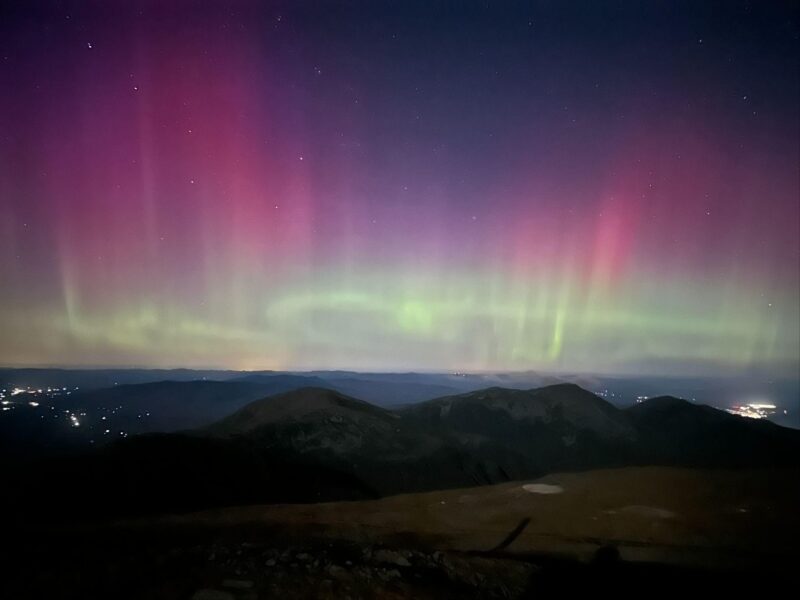
View of the Northern Lights over on September 30th, 2025.
In my previous role as a weather observer over at CLT airport in North Carolina, I always preferred 2nd or 3rd shift, which is either 4 PM-12 AM or 12 AM-8 AM. Not just because of my natural tendencies to enjoy staying awake late, but because it was always a neat feeling to be someone who kept things running while the majority of people were off the clock. It really teaches you how to be independent and truly builds a lot of self-confidence when you eventually face challenges at night and you are solely responsible for finding a solution. That has been something that has 100% carried over to being a night observer here, and I have definitely continued to grow in that sense since my first shift overnight on the summit. Mount Washington has taught me so much, and I’m sure it still has more in store.
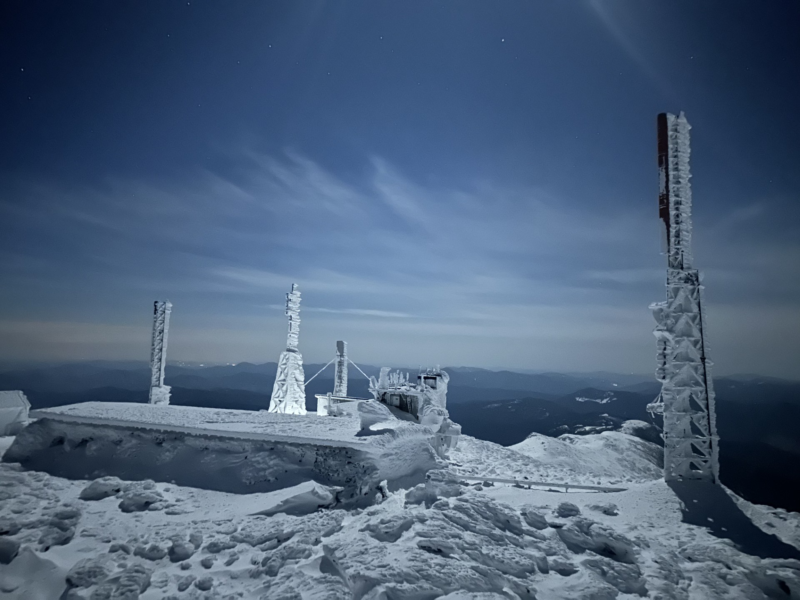
Looking south from the instrument tower one night in December.
From One Mountain to the Next
From One Mountain to the Next By Ellie Derry Hi everyone! My name is Ellie Derry and I am one of the fall 2026 interns at the Observatory. I’m super excited to be here
Mountains and Meteorology: What More Could a Girl Need?
Mountains and Meteorology: What More Could a Girl Need? By Emily Grainger Hi everyone! My name is Emily Grainger, and I am one of this fall’s Summit Interns atop Mount Washington! I’m from Orlando,
My Fear of Weather Became a Love of Meteorology
My Fear of Weather Became a Love of Meteorology By Kaitlin Farrell Hello! My name is Kaitlin Farrell. I am one of the fall summit interns here at Mount Washington Observatory. I recently graduated