
Lots of Digging, but Never Enough
By Ryan Tanski
Over the past four months, I had the privilege of working with the Mount Washington Avalanche Center and Mount Washington Observatory, deepening my understanding of mountain weather and the way that it shapes the surrounding backcountry terrain.
When I arrived in mid-January, I immediately got to see dynamic snow conditions following a historic November for snowfall and a December without the significant melts that have hampered early season development the past few years. Within the first week, I felt reactive wind slabs collapsing beneath my feet in a sheltered, low-angle portion of the Summer Lion’s Head trail. In the same week, I had the chance to test column stability near a crown line in the bowl, and separately feel isolated cracking while on my splitboard. My introduction to the avalanche center’s work was rapid and remarkable.
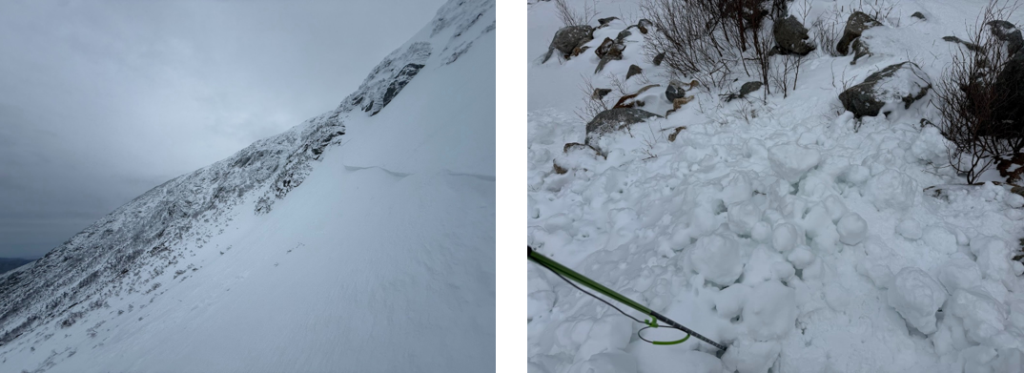
Wind slab avalanche crown in Chute and wet avalanche debris from Dodge’s.
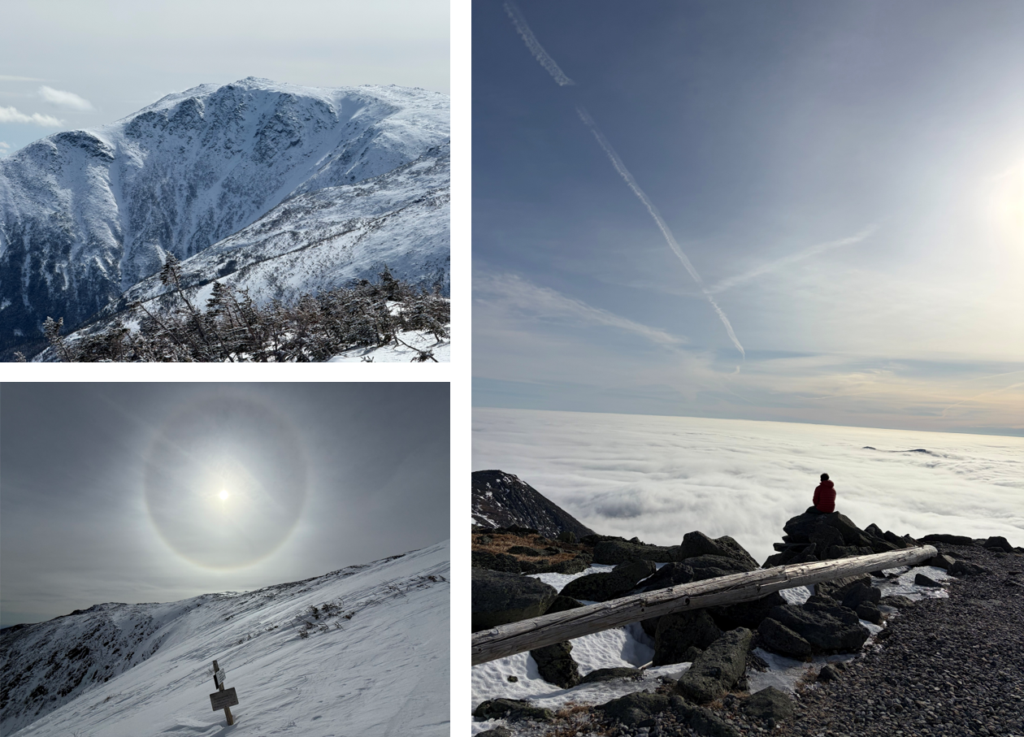
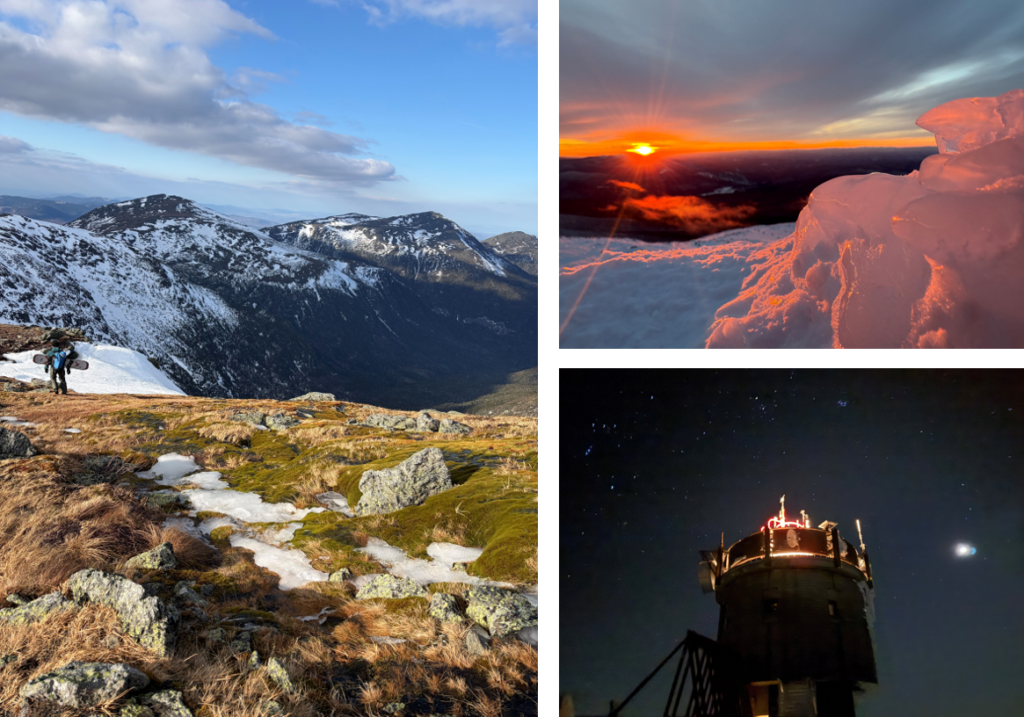
On the summit, I watched snow flow into the surrounding ravines and saw rime ice feathers extend from the instrument ring before being knocked off with a resounding mallet blow. I became intimately familiar with the disorienting nature of being in the fog for days on end which made the moments of clearing all the more jaw-dropping. I saw more sunrises and sunsets than any other winter, in spite of the frequent obstructions.
Between the mountain and the observers on my shift, I had wonderful instruction to deepen my understanding of meteorology. I quickly learned the intricacies of writing forecasts and became familiar with the common storm tracks as Alberta Clippers swung through and provide disappointing snowfall totals on a weekly basis. After using the Higher Summits page when planning my own trips to the White Mountains, it was both daunting and extremely rewarding to write many evening forecasts over the course of my time here.
Another benefit of being on the summit was the digging. As snow, rime, and ice accumulated and obstructed the observation objective, I got to bundle up for well below zero wind chills and shovel snow into piles or throw it into the wind and watch it swirl away toward the snowfields.
As part of the internship, I worked on a research project hoping to serve the interests of both the Observatory and the Avalanche center. I implemented physics-based snowpack modeling using meteorological data from the Hermit Lake mesonet station along with snow plot data. Through the comparison of model output to manual observations taken in Tuckerman Ravine, I observed the model’s ability to handle melt events and simple snow accumulation and its inadequacy in predicting the wind slab formation characteristic of the Mount Washington snowpack. In hoping to expand the available observations for future use, I had the chance to dig, a lot, in the cold, and I enjoyed every opportunity to check in on the constantly changing snowpack. Melt-freeze cycles and rain-on-snow events unfortunately made the snowpack largely impenetrable earlier than I hoped, robbing me of precious digging time.
In watching how forecasters at both the Observatory and Avalanche Center wrote to uncertainty, I saw the balance of forecasting accurately, helping visitors make sound risk management decisions, and the need to manage the trust of the public to ensure the forecast doesn’t fall on deaf ears. This delicate objective certainly encouraged the frequency of visiting the terrain for the Avalanche Center, and I often felt out-of-the-loop when returning from a week on the summit. When I was in the field, moving in avalanche terrain offered many lessons. As an essential part of my training, I had no choice but to splitboard while on the summit and apply this instruction. Although a few sunny snowfields runs ended in a “wow, that was the stickiest snow I’ve ever ridden”, I mostly successfully guided my fellow winter intern without major mishap.
I have so many people to thank for this experience. At the Avalanche Center, I’d like to thank Jeff, Charlotte, Pat, Elizabeth, and Liz for sharing their expertise and providing opportunities for me to engage with the forecasting process and improve my snow science skills. From my Observatory shift, I have to thank Alex, Ryan H., Ryan K., and Anna (I was actually the fourth Ryan between the two shifts this winter). I would not have learned nearly as much without their willingness to teach, and the hours not spent working were all the more enjoyable with their company. I would also like to thank Nimbus for sitting on my lap a few times, it was a brief honor.
From One Mountain to the Next
From One Mountain to the Next By Ellie Derry Hi everyone! My name is Ellie Derry and I am one of the fall 2026 interns at the Observatory. I’m super excited to be here
Mountains and Meteorology: What More Could a Girl Need?
Mountains and Meteorology: What More Could a Girl Need? By Emily Grainger Hi everyone! My name is Emily Grainger, and I am one of this fall’s Summit Interns atop Mount Washington! I’m from Orlando,
My Fear of Weather Became a Love of Meteorology
My Fear of Weather Became a Love of Meteorology By Kaitlin Farrell Hello! My name is Kaitlin Farrell. I am one of the fall summit interns here at Mount Washington Observatory. I recently graduated