
NULL
2006-10-19 08:37:40.000 – Neil Lareau, Observer

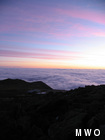
Morning undercast
Spending a good deal of time on the summit of Mount Washington allows one to begin to approach grandeur with a sense of familiarity instead of awe. It becomes possible to reflect upon scenes like the one that greeted my first observation of the morning:
We are joined in a world above the clouds this dawn by the summit of Mount Adams. Occasionally Jefferson and Madison poke their heads through the undercast, and for short intervals so to does our distant kin, Mount Lafayette; mostly though it is just us.
This is a drastically simplified landscape. Gone are the folds and clefts that define the peaks and notches of the white mountains. Gone is the coastal plane that flattens and slopes ever so gently toward the Atlantic. In place of the terrestrial landscape is instead the half fluid half gaseous ensemble of flat topped stratus stretching to the limits of sight on the horizon. In some places this layer features swells like those on the open ocean.
In the sky above are clouds of a radically different nature, ice crystals that trail away in fibrous nearly parallel strands from a point of coalescence. Rippling wave patterns are superposed throughout this layer suspended 30,000 feet above our heads.
On mornings like this I have thought, and continue to think, this is what New England must have looked like 15,000 years ago beneath a mile thick mantle of crevassed ice.
Neil Lareau, Observer
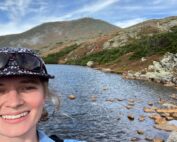
From One Mountain to the Next
From One Mountain to the Next By Ellie Derry Hi everyone! My name is Ellie Derry and I am one of the fall 2026 interns at the Observatory. I’m super excited to be here
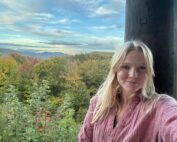
Mountains and Meteorology: What More Could a Girl Need?
Mountains and Meteorology: What More Could a Girl Need? By Emily Grainger Hi everyone! My name is Emily Grainger, and I am one of this fall’s Summit Interns atop Mount Washington! I’m from Orlando,
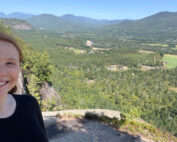
My Fear of Weather Became a Love of Meteorology
My Fear of Weather Became a Love of Meteorology By Kaitlin Farrell Hello! My name is Kaitlin Farrell. I am one of the fall summit interns here at Mount Washington Observatory. I recently graduated