
Oh the Pitot
2009-12-12 05:30:15.000 – Mike Carmon, Staff Meteorologist
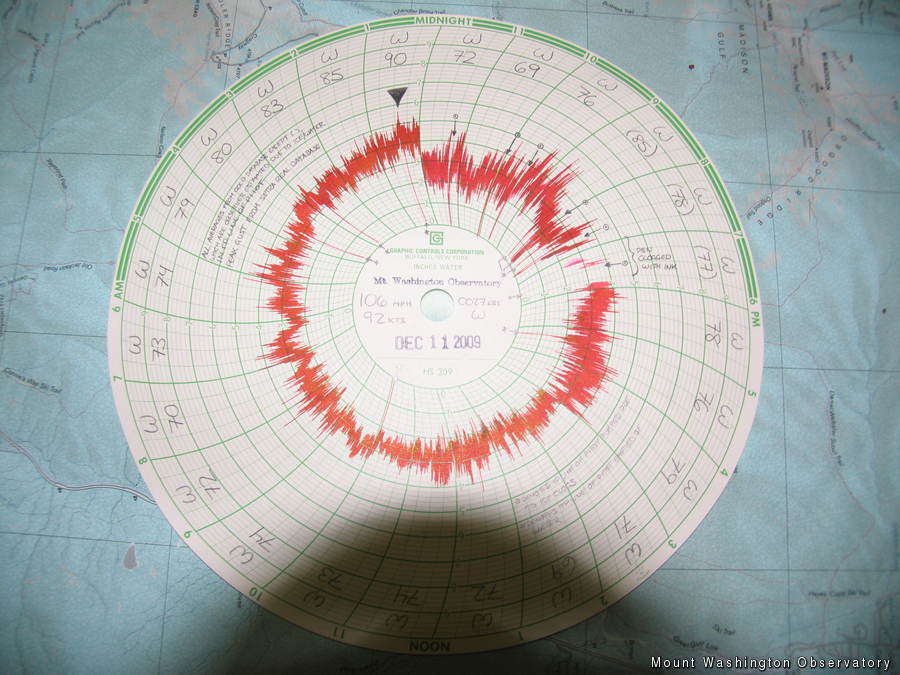
Ice Clogs Abound!
All jobs have their challenges. Working at the home of the world’s worst weather certainly presents some unique obstacles in daily operations.
Ice is one of those challenges that has kept me pretty busy all night. And I’m not talking about the hourly de-icing of our instruments atop the tower. On this night, I speak of ice within the guts of our instruments, namely the pitot-static anemometer.
Temperatures tonight have hovered around -10 degrees, and winds are regularly gusting near 100 mph. These bitterly cold conditions cause ice to form within one of the lines of the pitot tube system and clog the air flow. This undercuts the principle of differential pressure upon which the pitot operates, rendering it useless. In order to solve this problem, we disconnect and pump the icy line with a bit of methanol if a clog is suspected. This might sound pretty simple, but the trick is to know what certain wind velocities ‘sound like’ to determine whether or not the pitot is reading incorrectly. This can very often be quite challenging, and the only way this is possible is through experience. Another trick we use is to watch the barometric pressure readings, because our pressure instruments are connected to the pitot system as well. So, if we are expecting a trend of increasing pressure (for example today, an area of high pressure is building in to New England), and we start to notice an anomalous sharp drop in pressure, it probably means an ice clog is looming. As you might imagine, this requires a nearly continuous eye be kept on all of these instruments, which can make the lonely night shift a challenging one. If all goes well after pumping, the ice is long gone, and once the line is reconnected, the pitot functions as normal again.
Generally, most of our problems occur when temperatures are subzero and winds are strong. Tonight’s weather was a forecast for pitot problems, and unfortunately, it did not disappoint.
One of the side effects of ice clogs and disconnecting the pitot lines is an ugly looking 24 Hour Wind Speed History on our Current Summit Conditions page. Especially today, you will notice many sharp drops and rises (many reaching down to 0 mph). These are not authentic-they are the result of these pesky ice clogs. This also has a similar effect on our Hays Wind Chart (seen above).
This is one of the many reasons why the Mt. Washington Observatory will never be an automated weather station.
Mike Carmon, Staff Meteorologist

From One Mountain to the Next
From One Mountain to the Next By Ellie Derry Hi everyone! My name is Ellie Derry and I am one of the fall 2026 interns at the Observatory. I’m super excited to be here

Mountains and Meteorology: What More Could a Girl Need?
Mountains and Meteorology: What More Could a Girl Need? By Emily Grainger Hi everyone! My name is Emily Grainger, and I am one of this fall’s Summit Interns atop Mount Washington! I’m from Orlando,

My Fear of Weather Became a Love of Meteorology
My Fear of Weather Became a Love of Meteorology By Kaitlin Farrell Hello! My name is Kaitlin Farrell. I am one of the fall summit interns here at Mount Washington Observatory. I recently graduated