
Talking about Turbulence
2016-09-17 17:02:22.000 – Tom Padham, Weather Observer/Meteorologist
While talking with intern Taylor a bit about the weather today, she brought up a simple, yet very complex question: why do we see wind gusts? The short answer is turbulence, but what makes the air and our wind turbulent gets more complicated.
We live beneath an ocean of air that makes up our atmosphere, with all of this air constantly flowing over the terrain features that make up the surface. Mountains, lakes, forests, fields, etc. are all constantly altering the air immediately above by often slowing it down due to the greater friction at the surface. This leads to a general increase in wind speed with height.
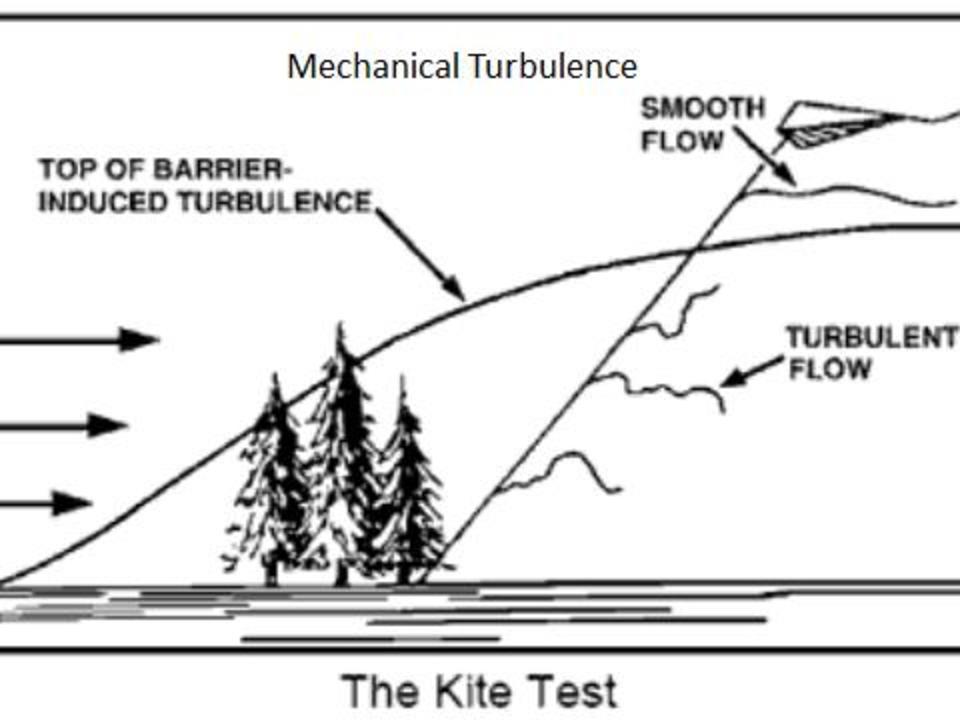 “The Kite Test” shows how turbulence from obstructions on the surface makes a kite fly erratically until a point where a more smooth flow takes over above the barrier. A good average height for this level is three times the height of the obstruction.
Turbulent, or chaotic motions of the air, are constantly occurring due to the air rising and sinking with the terrain (mechanical turbulence), and due to the ground being heated from the sun (convective turbulence). Since the atmosphere is almost transparent to incoming solar radiation, we heat pretty much from the ground up, but not equally! Different types of terrain and elevation differences lead to some areas like an open field or parking lot heating up more rapidly from the sun than say a lake or ice cap. This leads to thermals, or updrafts of relatively warmer air rising from the surface to higher elevations. What goes up must come down, and circulations of rising and sinking air (to varying degrees) form.
Bringing it all together, these rising and sinking air currents take what would otherwise be a steady flow of wind and mix everything up. Rising motions tend to lead to lulls in the wind speed at ground level, while sinking motions pull down the generally stronger winds seen aloft. When we see conditions that lead to very unstable air masses (during severe thunderstorms for example), very strong winds from several thousand feet up may be able to transfer momentum all the way to the surface resulting in very strong wind gusts. All of this chaotic mixing of the air makes meteorology a complex science; and forecasting the weather, especially on Mount Washington, no easy task!
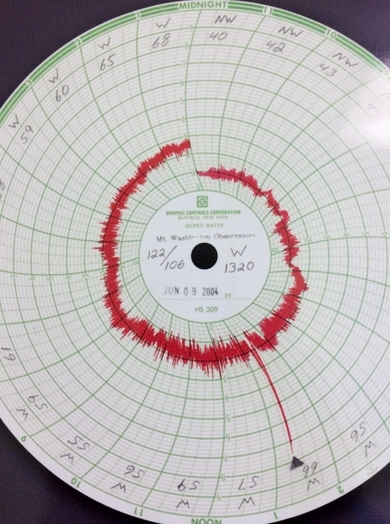
Hays Wind Chart June 9th, 2004 showing a 122 mph gust during a downburst event from a severe thunderstorm. That’s a lot of turbulence!
Tom Padham, Weather Observer/Meteorologist

From One Mountain to the Next
From One Mountain to the Next By Ellie Derry Hi everyone! My name is Ellie Derry and I am one of the fall 2026 interns at the Observatory. I’m super excited to be here

Mountains and Meteorology: What More Could a Girl Need?
Mountains and Meteorology: What More Could a Girl Need? By Emily Grainger Hi everyone! My name is Emily Grainger, and I am one of this fall’s Summit Interns atop Mount Washington! I’m from Orlando,

My Fear of Weather Became a Love of Meteorology
My Fear of Weather Became a Love of Meteorology By Kaitlin Farrell Hello! My name is Kaitlin Farrell. I am one of the fall summit interns here at Mount Washington Observatory. I recently graduated