
The Precip Can: Measuring Rain, Snow, and Everything Else on Mount Washington
By MWOBS Staff
Averaging 281 inches of snow per year, the Observatory is no stranger to measuring precipitation. While it might be easy to measure rain or snow at home, collecting official precipitation measurements at the Home of the World’s Worst Weather can be more difficult.
At the summit, the Observatory uses a precipitation can to collect the water falling from the sky. The precipitation can is a large metal bucket which rain, snow, and other precipitation types can fall into.
The can sits in an open spot, away from buildings, hills, and blockages which could skew the data. The Observatory has tested several spots to see which records the most accurate data, and the can currently sits between the summit and the back of the Sherman Adams building.
The top of the precipitation can measures 8 inches across, and it sits inside a yellow frame with a Nipher screen, which is the large funnel around the top of the can. When the winds are blowing rain or snow horizontally, the Nipher screen creates a vacuum, helping to pull precipitation into the can to record a more accurate measurement.
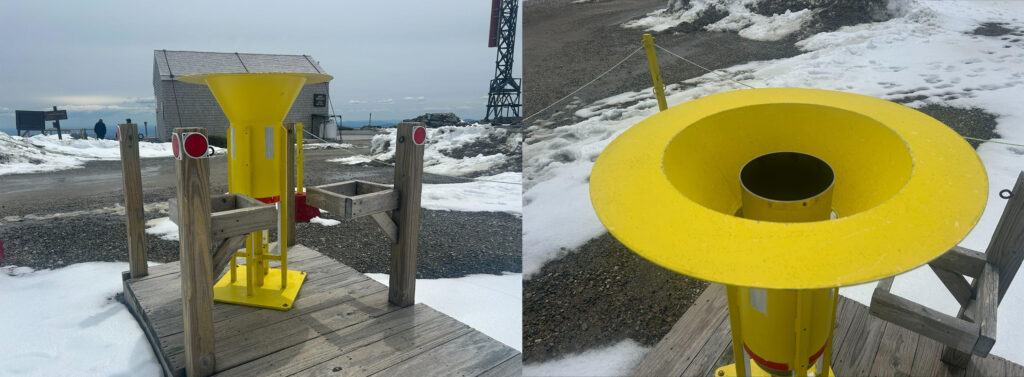
The silver precipitation can sits inside a yellow Nipher screen. The funnel shape doesn’t directly funnel more precipitation inside, but instead generates a vacuum. The funnel shape forces air to speed up over the top of the funnel, lowering pressure and vacuuming more precipitation inside.
Every six hours, an observer ventures outside to retrieve the can and measure how much precipitation has fallen. The process is different for rain versus snow.
Measuring Rain
Rain is the easiest precipitation type to measure. After bringing the can inside, observers use a funnel to pour the liquid into a smaller tube, and use a corresponding ruler to see how many inches of rain fell in the last six hours.
Measuring Snow
When snow falls, observers have to carefully carry the can inside to prevent any settling and record an accurate measurement. The walk inside is a couple minutes, and a full can is quite heavy.
Once inside, observers dip a textured ruler inside the can. The snow sticks to the ruler, so they pull the ruler out and measure the top edge of the snow. Just like snow drifts can pile up outside, there can be miniature snow drifts inside the can. They will take 10 measurements around the can, then average them together to more accurately determine how much snow fell.
After measuring the frozen snow, the observer submerges the outside of the can into a bucket of warm water. The water melts the snow inside, and they are able to determine the liquid equivalent of the snow. They pour the melted snow into the same funnel, then measure it just like rain.
They divide the snow total by the liquid total to determine a snow to liquid ratio. For example, if 10 inches of snow melted into the equivalent of 1 inch of rain, then the ratio would be 10:1. A rough “wet” snow ratio is 7:1, which is highly packable snow, perfect to build a snowman or have a snowball fight. A drier ratio could be 15:1, 20:1, or even higher. Dry, powdery snow is best for skiing, and crumples apart in your hands.
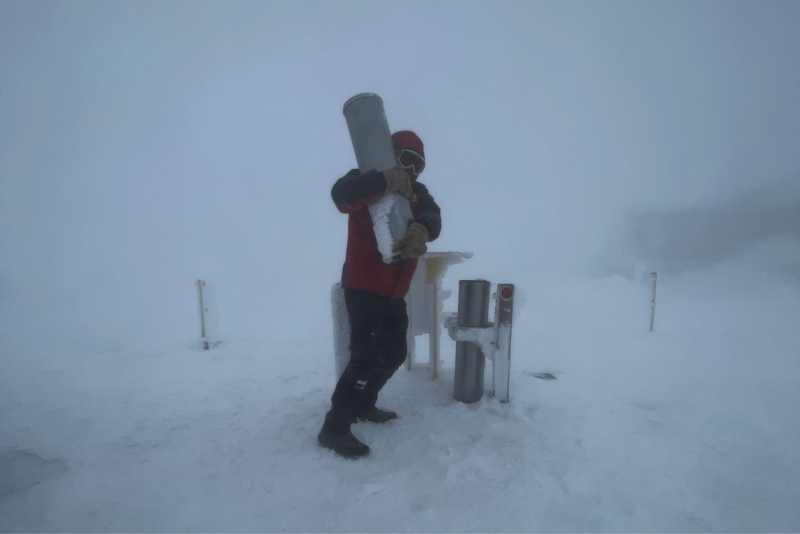
An observer retrieving the precipitation can in cold and windy conditions.
Besides lightning, observers go outside to retrieve the precipitation can regardless of the conditions. Holding on to the cold, slippery metal can in extreme winds can be difficult, especially when trying to keep the snow from settling.
More than just rain and snow can fall inside the can. Some days, there can be more than four or five types of precipitation in the can. Other types of precipitation include:
Sleet: raindrops that have frozen completely solid. Sleet bounces as it falls, and if you listen closely, you can hear the pitter-patter—sleet has a beat!
Freezing Rain: rain that falls as a liquid, immediately freezing on contact to create a glaze of ice on surfaces.
Graupel: a snowflake with drops of water that have frozen around the edges, which looks like a miniature hailstone.
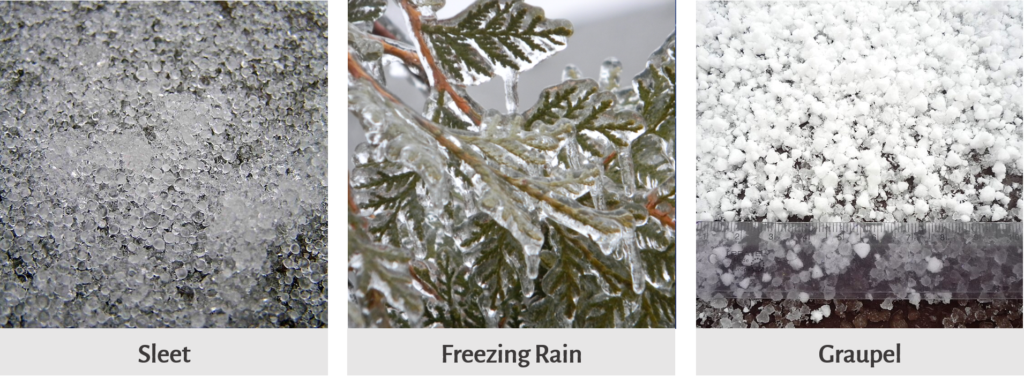
Sleet: Mike Epp (CC 2.0 https://commons.wikimedia.org/wiki/File:Sleet_on_the_ground.jpg)
Graupel: Logi Aer (CC BY-SA 4.0 https://commons.wikimedia.org/wiki/File:Graupel.jpg)
Freezing Rain: Laslovarga (CC BY-SA 3.0 https://commons.wikimedia.org/wiki/File:Freezing_Rain_in_Canada_2013_9.JPG)
Mount Washington can also see ice crystals, hail, and more. Weather observers watch the precipitation falling outside each hour, reporting the different types in their observation.
In extreme weather, measuring precipitation on Mount Washington can be difficult! The Observatory has maintained its precipitation record for more than 90 years. If you’re interested in supporting the Observatory and allowing these precipitation records to continue, please consider donating at mountwashington.org/donate.

From One Mountain to the Next
From One Mountain to the Next By Ellie Derry Hi everyone! My name is Ellie Derry and I am one of the fall 2026 interns at the Observatory. I’m super excited to be here

Mountains and Meteorology: What More Could a Girl Need?
Mountains and Meteorology: What More Could a Girl Need? By Emily Grainger Hi everyone! My name is Emily Grainger, and I am one of this fall’s Summit Interns atop Mount Washington! I’m from Orlando,
My Fear of Weather Became a Love of Meteorology
My Fear of Weather Became a Love of Meteorology By Kaitlin Farrell Hello! My name is Kaitlin Farrell. I am one of the fall summit interns here at Mount Washington Observatory. I recently graduated