
UFOs and such
2009-04-17 16:38:00.000 – Stacey Kawecki, Observer and Meteorologist

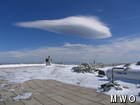
The mother-ship
Lenticular clouds are named so because they are shaped like lenses. They also suspiciously resemble over-sized Frisbees. Taking this one step further, one could say that lenticular clouds are shaped like flying saucers, also known as UFO’s. In this particular case, they are neither flying nor unidentifiable. But they sure do make a spectacle.
I’m convinced that some of the reported UFO’s are likely lenticular clouds. They cast huge, imposing shadows and can look quite other-worldly as the sun plays its tricks. In some instances, they might even look like a flying saucer that is glowing or on fire. Regardless of what these fantastic clouds might look like (besides clouds that is) they surrounded the summit today, in a rather invasive fashion. Every which direction there they were, waiting to attack. There were uncountable clouds. And, just to the east, there was the mother ship. The largest lenticular in the sky hovered directly over Wildcat, casting its unearthly shadow.
But what is a lenticular, besides a cool-looking cloud? It’s actually an interesting equilibrium. They are technically called standing lenticulars because they do not seem to move, though the process of forming such a cloud involves constant movement and phase change. When there is some turbulence, often caused by air rushing up and over mountains, the upward motion causes water vapor to condense into a cloud. As the air descends, the water droplets evaporate in the warmer or drier air. The cloud itself is in constant somewhat unchanging motion.
Stacey Kawecki, Observer and Meteorologist
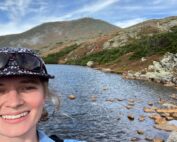
From One Mountain to the Next
From One Mountain to the Next By Ellie Derry Hi everyone! My name is Ellie Derry and I am one of the fall 2026 interns at the Observatory. I’m super excited to be here
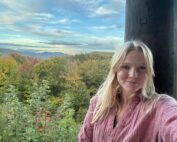
Mountains and Meteorology: What More Could a Girl Need?
Mountains and Meteorology: What More Could a Girl Need? By Emily Grainger Hi everyone! My name is Emily Grainger, and I am one of this fall’s Summit Interns atop Mount Washington! I’m from Orlando,
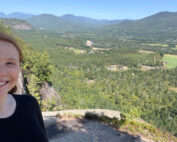
My Fear of Weather Became a Love of Meteorology
My Fear of Weather Became a Love of Meteorology By Kaitlin Farrell Hello! My name is Kaitlin Farrell. I am one of the fall summit interns here at Mount Washington Observatory. I recently graduated