
Winter Storm Tracks Across New Hampshire
By Alex Branton
As winter comes to a close, most of us are ready for the warmer temperatures and sunshine that come with Spring and Summer. Although we are looking forward to the summertime comfort, we can reflect fondly on Winter ‘25/’26. When I think about this past winter, I remember an intense start to the season in November, a couple big snowstorms, plenty of snow to sustain winter recreation, and near average temperatures. When we compare this winter to winter’s past, we may begin to wonder why this season in New Hampshire can be so variable. Some winters are cold and snowy, while others are warm and dry. We can also have the harsh combination of extreme cold and very little snow. So, what determines winter conditions in New Hampshire?
Geographically, New Hampshire is in a prime location for active winter weather. General weather patterns typically send winter storms right towards us, which can give us several storm cycles per week. The topography of the Northeast is also quite complex – with the mountains, a polar air mass to the north, the warm Gulf Stream to the east, and the Great Lakes to the west. All of these things interact with winter storms as they move across the region, impacting where the storm goes and how it will affect us. On a larger scale, climatic weather patterns like the North Atlantic Oscillation (NAO) and the El Nino Southern Oscillation (ENSO) also play a huge role in dictating storm tracks across New Hampshire. Although so many variables ensure that no winter storm is the same in New England, there are a few common winter storm tracks we can analyze further.
Nor’easter
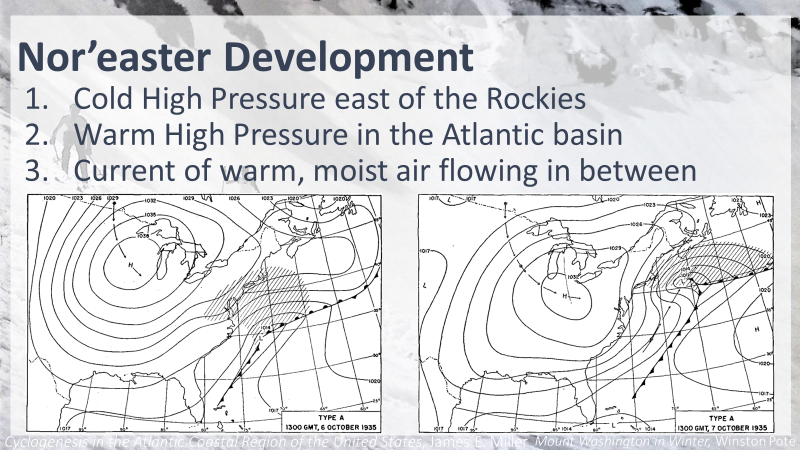
The Nor’easter is a type of winter storm that is unique to the Northeast United States, so called because winds over the coastal area are typically from the northeast (National Weather Service). Nor’easters typically develop with cold, high pressure east of the Rocky Mountains, warm high pressure in the Atlantic Basin, and a current of warm, moist air flowing between. The core of the storm develops somewhere offshore between coastal Georgia and Cape Cod, and moves northeast along the East Coast.
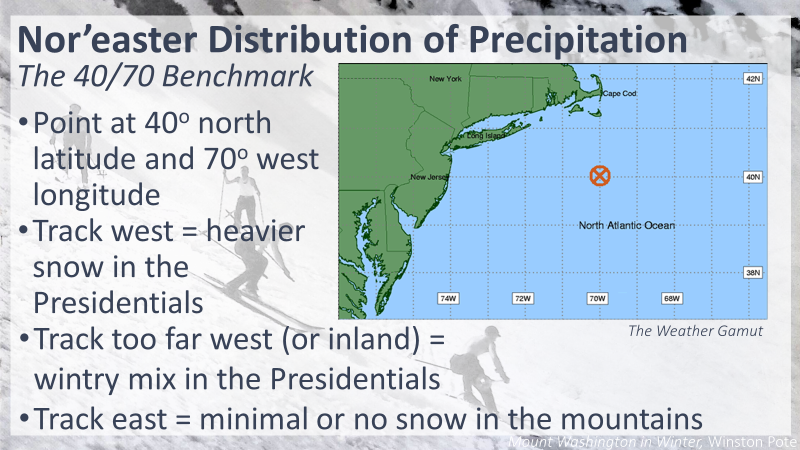
Precipitation type and extent are highly influenced by small variations in the Nor’easter track. Meteorologists use the 40/70 benchmark (40 degrees north latitude and 70 degrees west longitude) as a reference point to forecast precipitation and temperatures. If the center of the storm passes between this point and the New England coastline, we can expect cooler temperatures and heavier snow in the White Mountains. But, if the storm tracks too far west, we can expect warmer temperatures and a mix of precipitation in the White Mountains. A track east of the 40/70 benchmark may make for much colder temperatures but minimal precipitation in New Hampshire.
New England Coastal Cyclogenesis
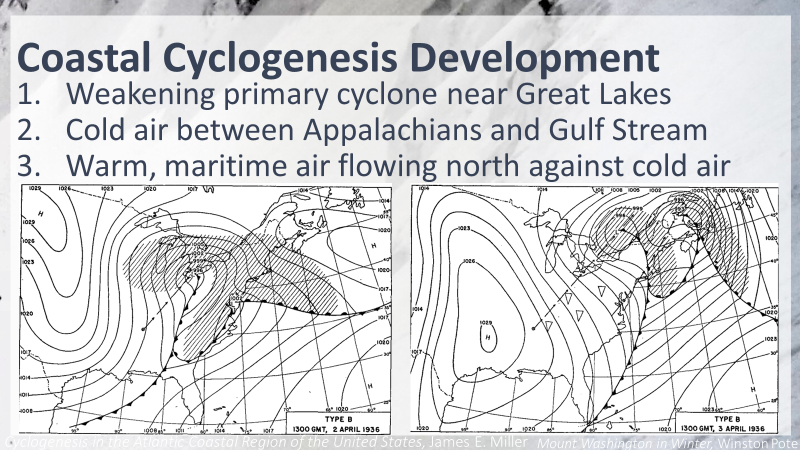
Coastal cyclogenesis is unique to the East Coast of the United States. It is the formation of a secondary cyclone along the coastline, with the primary cyclone being located in the Great Lakes Region. It occurs when we have a weakening primary cyclone near the Great Lakes, cold air between the Appalachians and the Gulf Stream, and warm maritime air flowing north against cold air. Coastal cyclogenesis occurs where there is a thermal contrast between the coastal landmass and the Gulf Stream. This thermal contrast reignites the decaying system’s energy, and spawns a new storm center offshore.
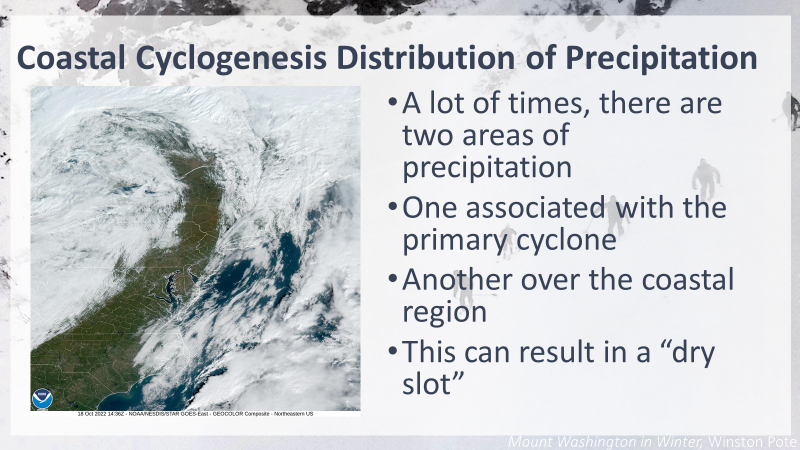
A lot of times, there are two areas of precipitation – one associated with the primary cyclone and another over the coastal region. Depending on where cyclogenesis occurs, this can result in a dry slot over New Hampshire; however, more often than not, these “double barrel lows” have the potential to drop a lot of snow across New Hampshire. In fact, the biggest snowstorm on record (records date back to 1932) at Mount Washington was a result of a storm of this type. This occurred in February of 1969 when the summit of Mount Washington received 97.8” of snow between February 22 and February 28, 1969.
Alberta Clipper
An Alberta Clipper is “a fast moving low pressure system that moves southeast our of the Canadian Province of Alberta through the Plains, Midwest, and Great Lakes Region.” The term clipper is derived from the movement of the storm, where the core of the low clips much of the northern tier of the United States. Another name for this type of storm is the “Saskatchewan Screamer,” derived from the fast pace of these systems. New Hampshire is located towards the end of these storms’ journeys, where the center of the low can either dive south towards Cape Cod or lift north towards the Canadian Maritimes. The former usually results in cooler temperatures and snow in New Hampshire, whereas the latter usually results in warmer temperatures and rain. Either way, the quick movement of these systems typically calls for light precipitation. The pattern this Winter (‘25/’26) sent lots of Alberta Clippers diving southeast across New England, contributing to the light, frequent snowfall and persistently cool temperatures felt this season.
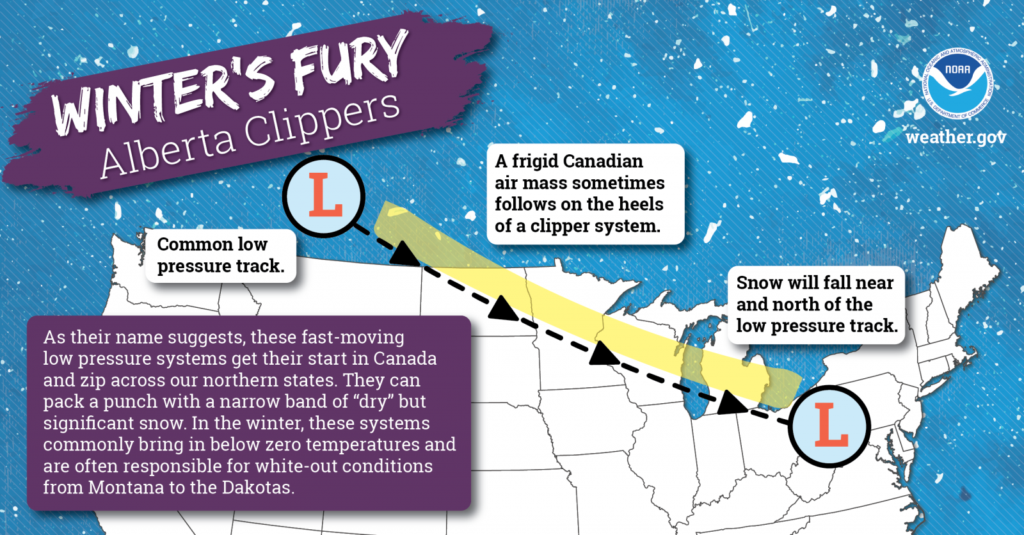
So, next time you’re reading the Higher Summits Forecast or listening to your local meteorologist, look out for these terms to better understand the character of the next Winter Storm!

From One Mountain to the Next
From One Mountain to the Next By Ellie Derry Hi everyone! My name is Ellie Derry and I am one of the fall 2026 interns at the Observatory. I’m super excited to be here

Mountains and Meteorology: What More Could a Girl Need?
Mountains and Meteorology: What More Could a Girl Need? By Emily Grainger Hi everyone! My name is Emily Grainger, and I am one of this fall’s Summit Interns atop Mount Washington! I’m from Orlando,
My Fear of Weather Became a Love of Meteorology
My Fear of Weather Became a Love of Meteorology By Kaitlin Farrell Hello! My name is Kaitlin Farrell. I am one of the fall summit interns here at Mount Washington Observatory. I recently graduated