
The Rock Pile Looms Large
2011-12-02 17:26:36.000 – Rick Giard, Weather Observer/Education Specialist

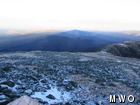
Casting a Long Shadow
In yesterday’s comment, Kevin discussed the refractive optical phenomenon known as the glory, produced dramatically over a thick undercast. Continuing with the general theme of atmospheric optics, this morning we observed an excellent demonstration of haze interfering with visibility. Additionally, the seasonal variation of solar angle and shadowing in mountainous terrain are becoming evident. The Rock Pile looms large over this region!
I snapped this photograph today shortly before 7:30 A.M., roughly a half-hour after summit sunrise. Notice the prominent shadow distinctly cast westward by Mount Washington, not only upon the surface but also on the hazy atmosphere above. The haze is essentially acting as if it were a cloud, substantial enough to reveal shadows. In this case, the low sun angle produces a shadow many miles beyond the mountain. All of the localities within this shadow experience a later sunrise than other nearby places. Incidentally, this feature was seen in virtually the same direction and time of day as the glory observed yesterday morning. This morning there were no clouds below the summit, thus the same sun angle created a different effect.
During its year-long orbit Earth’s orientation with respect to the Sun changes. From our perspective, it appears as if the sun is moving. In reality the position and movements of Earth create this illusion. It does produce very real effects on weather conditions and seasons. As we approach the Winter Solstice on December 22, the Sun reaches its declination (latitude point at which the Sun is directly overhead at Noon) farthest south – 23.5 degrees latitude below the Equator. This is the beginning of Winter in the Northern Hemisphere, the start of Summer in the Southern Hemisphere. During this period the sun is at its lowest elevation angle (distance above horizon at Noon), tracing a low arc across the southern horizon. This means short days, long nights, and generally the coldest temperatures of the year.
The good news is that, immediately following the Winter Solstice, the Sun begins to slowly move northward again. Consequently, the elevation angle gradually increases and the days slowly become longer. By mid-March the days and nights are equal (Spring equinox), and by mid-June (Summer solstice) we have the longest days and shortest nights. So, now that the Red Sox have finally hired a new manager, can spring training be very far away?
Rick Giard, Weather Observer/Education Specialist
My Fear of Weather Became a Love of Meteorology
My Fear of Weather Became a Love of Meteorology By Kaitlin Farrell Hello! My name is Kaitlin Farrell. I am one of the fall summit interns here at Mount Washington Observatory. I recently graduated
Ascending with High Winds
Ascending with High Winds By Alonso Lopez Hi! I am Alonso Lopez, one of four interns at Mount Washington Observatory from August to December, 2026. I was born and raised in the Dallas-Fort Worth

26th Annual Seek the Peak Recap
26th Annual Seek the Peak Recap By Drew Bush Members of the "Peak Potential" team gather at Pinkham Notch before hiking Mount Washington for the 26th Annual Seek the Peak. View more images. We’ve had