
Who Really Sees the Worst Weather: Mount Washington or the South Pole?
By Bailey Nordin
When I stepped out of the snowcat on my first day as an observer last January into thick fog, sub-zero wind chills, and swirling snow and ice pellets buoyed along by 80 mph wind gusts, I fancied myself more prepared than most to withstand Mount Washington’s extreme conditions. The worst weather in the world? We’ll see about that. I was able to be so foolhardy because I had an ace up my sleeve: I had already spent a year living and working at the Amundsen-Scott South Pole Station in Antarctica.
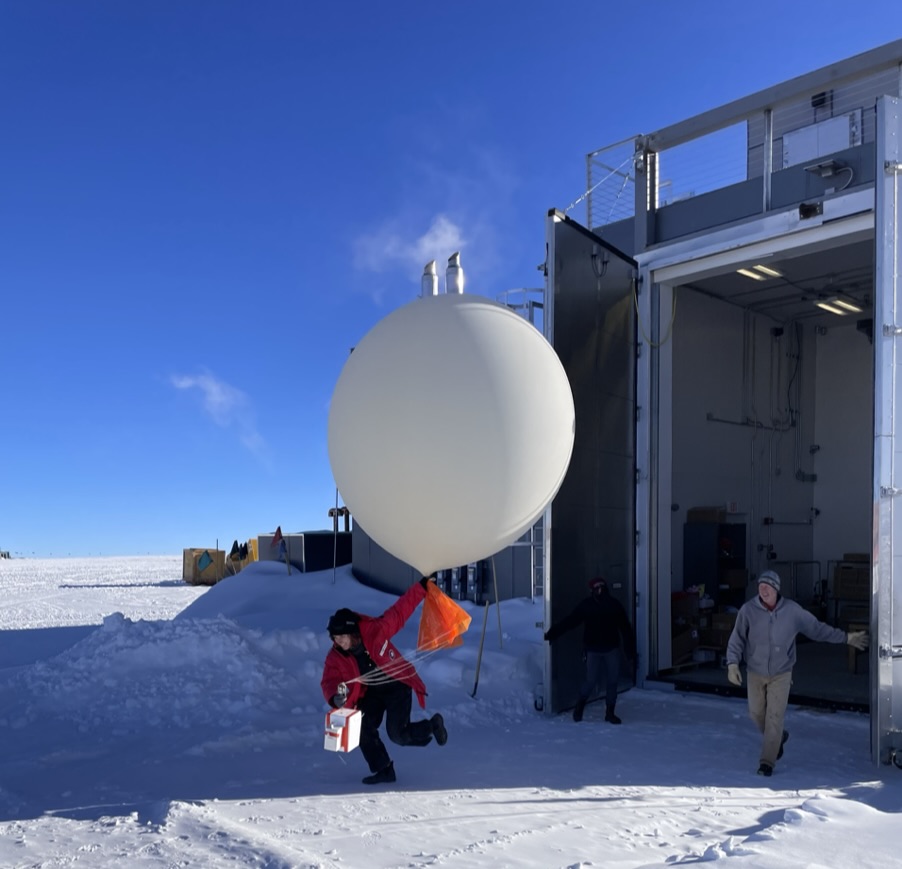
Bailey launches her first Ozonesonde balloon on her second day as an Atmospheric Science Technician at the South Pole, measuring the recovery of the hole in the Ozone layer over Antarctica.
In 2022, as a plucky, adventurous 24-year old, I was lucky enough to spend a year working for the National Oceanic and Atmospheric Administration (NOAA) at the U.S. Antarctic base located at the geographic south pole, the Amundsen-Scott South Pole Station. As an Atmospheric Science technician for NOAA, my day-to-day work revolved more around climate than weather, collecting air samples and maintaining a suite of instruments measuring greenhouse gases, atmospheric contaminants, and trace gases through the long, dark Antarctic winter. Antarctica, you may or may not already know, is actually the world’s largest desert. So while it may be colder than Mount Washington, it is also much, much drier. Especially up in the middle of the Antarctic plateau where the South Pole is located, hundreds of miles from any ocean, coastline, or visible topography, the flat expanse of ice stretching out in every direction could be confused for otherworldly dunes.
The question of whose weather is worse, however, is much more nuanced and subjective than just determining where it’s coldest and where it’s wettest. To try to take an even-handed approach to answering this question, I’ve broken down both the monthly statistics from the year I spent living in Antarctica (2022) and from this past year on Mount Washington, since I started as a Weather Observer in January 2026.
Temperature:
The cat’s already out of the bag with this one, unfortunately. The South Pole is quite a bit colder than Mount Washington. I’ve compiled a table with the average and minimum temperature for every month I spent in Antarctica during 2022, and every month of 2026 (so far) I’ve spent on Mount Washington. The day I stepped off the plane at the South Pole, the air temperature of -32 °F was already colder than any temperature Mount Washington has experienced so far this year (our record low so far this year is -31 °F, so close!). And from the day I landed in Antarctica, it only continued to get colder, since the seasons are reversed in the Southern Hemisphere.
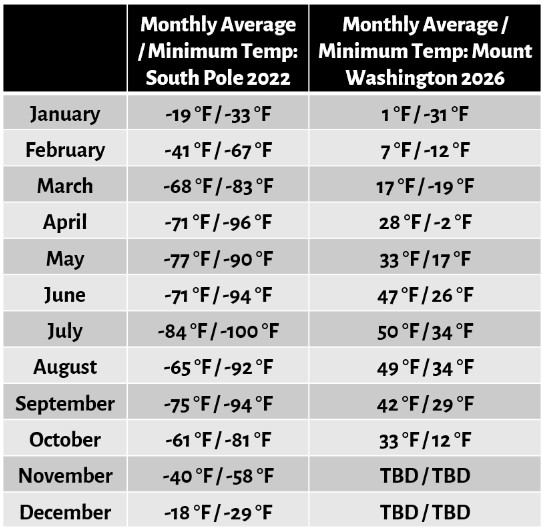
Average temperatures and minimum recorded temperatures for each month of the year, both for the year 2022, which I spent in Antarctica, and for the year 2026, which I’ve spent on the summit.
The year I spent at the South Pole, the average temperature was -57.1 °F, the warmest temperature recorded was 0.3 °F on January 22nd, and the coldest temperature recorded was -100.3 °F on July 15th. The coldest temperature ever recorded on Mount Washington, as many of you may know, was -47 °F (measured in 2023 by my co-observer Karl Philippoff). While temperatures like this are common even in the summer season in Antarctica, I can already hear the cries of “but what about wind chill?” off in the distance. While Mount Washington’s winds are certainly high enough to make temperatures feel much colder on exposed skin, this isn’t actually changing the temperature of the air, nor a person’s risk of developing frostbite. Even on the aforementioned -47 °F day in 2023, wind chills only dropped to -109 °F, compared to the -160 °F wind chill felt at the South Pole on several occasions in 2022. Comparing ambient air temperatures to wind chill values, like Mount Washington in winter, can become a slippery slope.
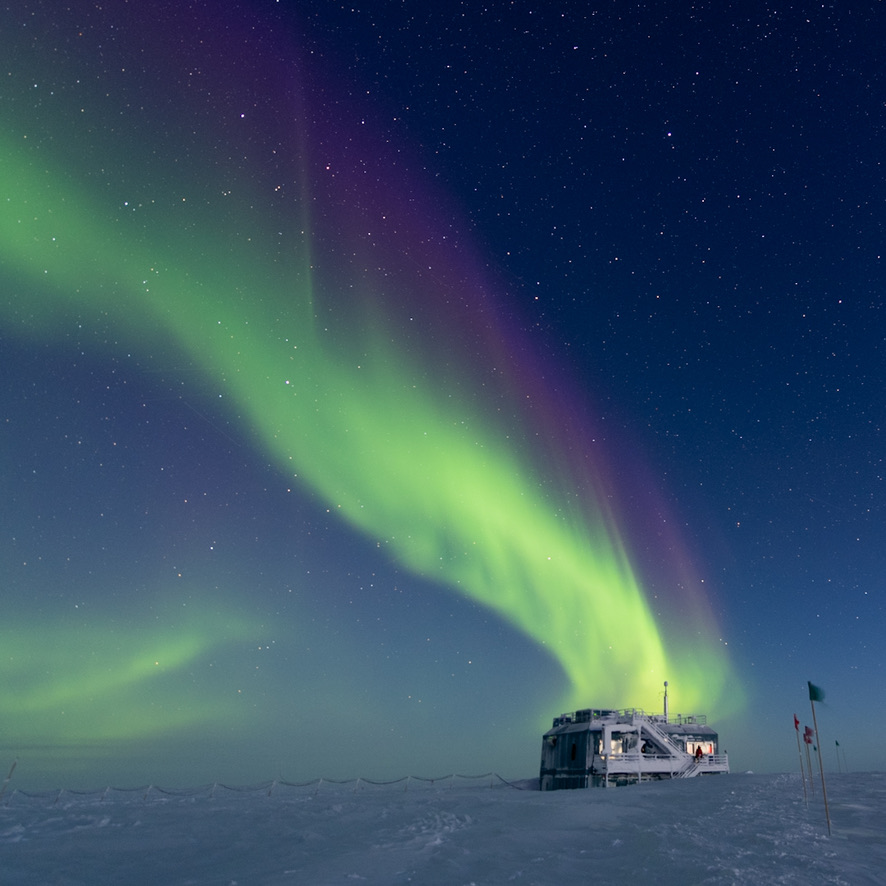
NOAA’s Atmospheric Research Observatory (ARO) outbuilding, located about a 10-minute walk from the geographic south pole and the Amundsen-Scott South Pole Station.
Wind:
While Mount Washington may not experience the bitingly cold temperatures Antarctica does, winds at the South Pole are actually exceptionally light, even on their gustiest days. The vast interior of the Antarctic plateau sees such light winds and so few storms because it is a broad, flat, elevated are dominated by persistent high pressure, with cold, dense air over the interior continually sinking. In fact, winds in 2022 were so light that the average monthly wind speeds on Mount Washington exceed even the peak gusts measured at the South Pole for every month of the year. And these higher winds pack a punch, as anyone who’s spent time on Mount Washington is bound to find out eventually. After a few minutes outside, exposed skin turns red and swollen, after half an hour, your ears begin to ring, and if you’re out for more than a few hours in high winds and any sort of precipitation, you’d better hope your Gore-Tex is genuinely waterproof.
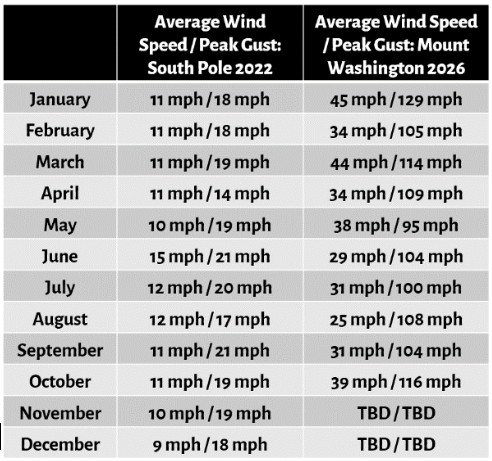
Average monthly wind speeds and peak recorded gusts for each month of the year, from 2022 at the South Pole and from 2026 on Mount Washington.
Fog, snow, and rain:
As I alluded to earlier on, another arena in which Mount Washington’s weather is routinely worse than Antarctica’s is that of moisture and storminess. The monthly precipitation totals in the table below really highlight this disparity – while Mount Washington is regularly getting inches of rain and feet of snow through the winter months, the South Pole scraped together less than half an inch of snow over the course of the entire year I was there. Rain and snow really make a difference, not only in terms of how hard it is to stay warm outside over periods of extended exposure, but also because of the thick, wet fog that frequently comes along with them in the mountains. Over the course of 2022, the South Pole saw a total of 20 days on which fog or blowing snow reduced visibility to ¼ mile or less. In 2026, Mount Washington has already seen a total of 283 such days (out of a possible 315 so far this year). As we spell out frequently in our Higher Summits forecasts, a rainy, foggy day with 70 mph winds can quickly become a lot more dangerous than a windy day with clear skies.
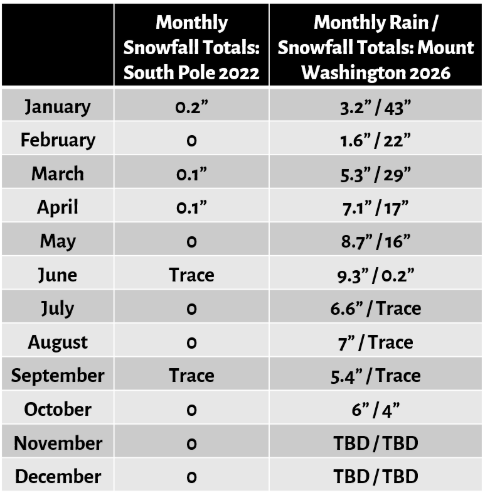
Monthly snowfall totals for each month of the year 2022 at the South Pole, and monthly liquid equivalent precipitation and snowfall totals for each month of year 2026 on Mount Washington.
So, whose weather is worse?
Anecdotally, I can report that there have been many more days in my tenure as a weather observer when it’s difficult or even impossible to be outside for more than a few minutes at a time than there were in Antarctica. Very cold temperatures, after all, can be abated by donning enough layers. When freezing rain being driven horizontally by hurricane force winds is building up on your goggles, mouth, and fingertips at a rate of centimeters a minute, there isn’t much you can wear to prepare yourself.
In terms of more dangerous weather conditions, Mount Washington’s weather has certainly claimed more lives, as well. 177 people have died on or ascending this mountain, compared to only 5 exposure deaths at the South Pole (not counting explosions, skydivers, and suspected murders). Of course, hundreds of thousands more people visit Mount Washington each year than visit the South Pole, so trying to draw any sort of robust statistical conclusions from these numbers is probably not going to drive my argument home here.
Though the South Pole may be colder, I think both the statistics I’ve compiled here and the collective experiences of weather observers on the summit points to something much more formidable about Mount Washington’s weather. Though “worse” may be subjective (one of our current summit interns, Alonso, uses his spare time on the summit to face directly into hurricane force winds for 20 minutes or so and see how well he can guess the speed of each gust), I’ve found that the conditions across the higher summits of the Northern Presidentials can take you by surprise much more quickly than can the extreme cold at the South Pole. Someone who minds the cold a bit more than I do might come to a different conclusion if handed these statistics, but for my part, I don’t feel prepared to strip the mountain of its claim to fame.
I should mention for the uninitiated that there are also certainly parts of Antarctica much windier and wetter than the South Pole, but you’ll have to stay tuned for future weather observers with increasingly outlandish backstories to get the exact play-by-play on those statistics. For now, it seems clear to me, at least, that spending more than a couple minutes outside troubleshooting a broken instrument in 80 mph sustained winds, sleet, and fog is a heck of a lot harder than doing the same thing in -80 °F and light winds. Until someone else wants to crunch some more numbers, I’m happy to let Mount Washington keep its title of “Home of the World’s Worst Weather.”
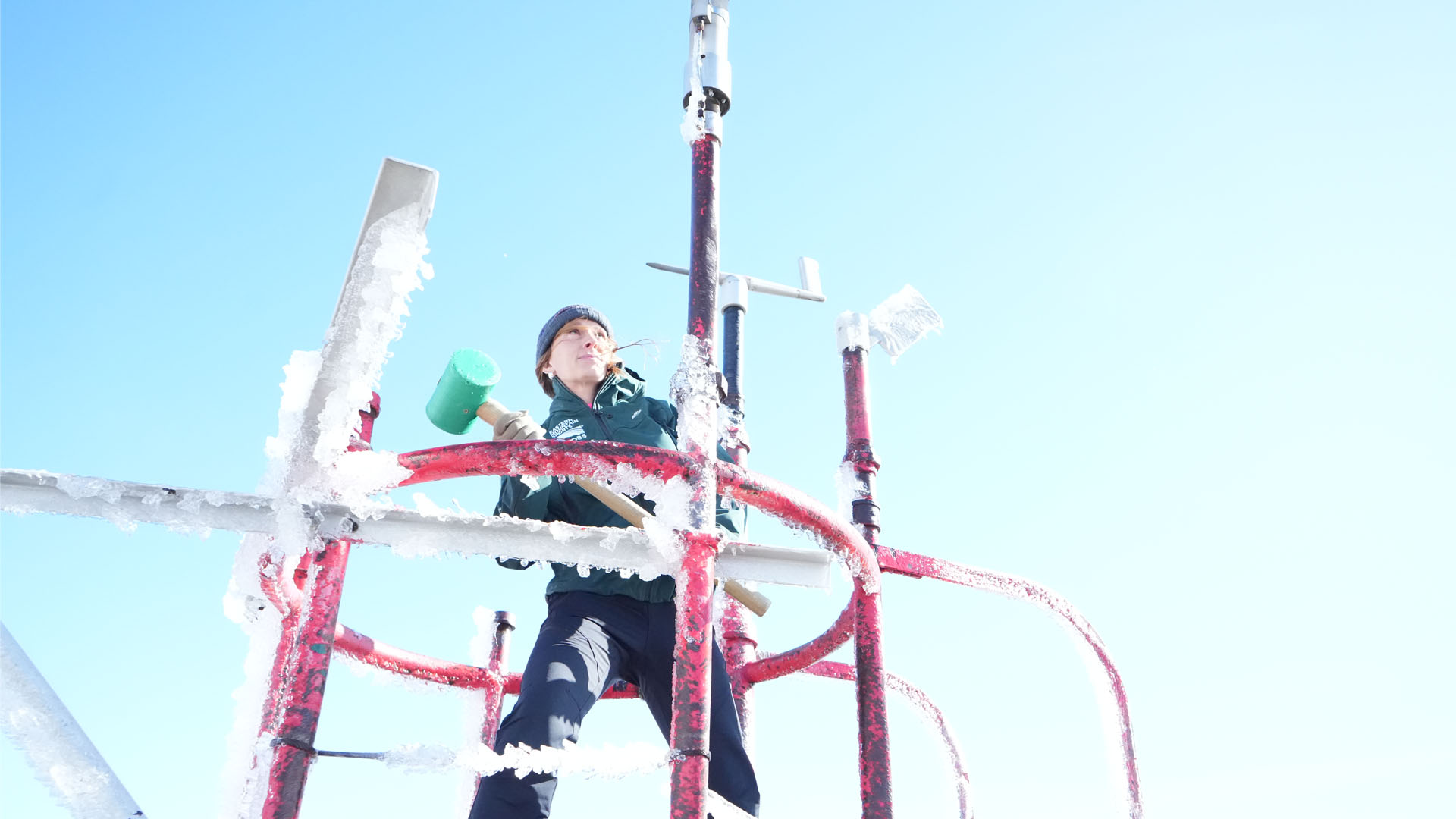
Bailey preparing to knock several inches of rime ice growth off of the Observatory’s anemometers on a cold, briefly clear day in late September.

Who Really Sees the Worst Weather: Mount Washington or the South Pole?
Who Really Sees the Worst Weather: Mount Washington or the South Pole? By Bailey Nordin When I stepped out of the snowcat on my first day as an observer last January into thick fog,

How to Not Lose Your Gear on Your First Day as a Weather Observer
How to Not Lose Your Gear on Your First Day as a Weather Observer By Misha Leyfer Within my first 24 hours as a weather observer at MWOBS, I managed to lose two important

From One Mountain to the Next
From One Mountain to the Next By Ellie Derry Hi everyone! My name is Ellie Derry and I am one of the fall 2026 interns at the Observatory. I’m super excited to be here