
How to Not Lose Your Gear on Your First Day as a Weather Observer
By Misha Leyfer
Within my first 24 hours as a weather observer at MWOBS, I managed to lose two important pieces of weather observing gear. It was a humbling reminder that everyone is equal in the eyes of Mount Washington, no matter their experience. Though I wouldn’t consider myself a mountaineer, I have a hiking history with the mountain, starting with formative childhood experiences that ultimately brought me to the job I work today.
I first hiked the Rock Pile as a teenager during a capstone trip at the Environmental Science Program, a summer camp based in my hometown of Newton, MA. I became the camp’s director for five years, which gave me an excuse to return to the mountain every year as a young adult. Through winter hikes and geology papers in college, my admiration for the mountain grew, and I was thrilled to become the Observatory’s Lead STEM Educator in January 2025.
After graciously enduring my endless weather questions and visit requests for almost two years, summit staff offered me a position as a weather observer that I started in mid-October. Even with over a decade of history, many overnight trips, and teaching experience pertaining to the very peak I would be living on, the mountain showed me that I am subject to the same physics as someone who had never set eyes on it. So, I thought I would use this blog to explain what gear I lost, how I lost it, and how to avoid that and other errors in the future.
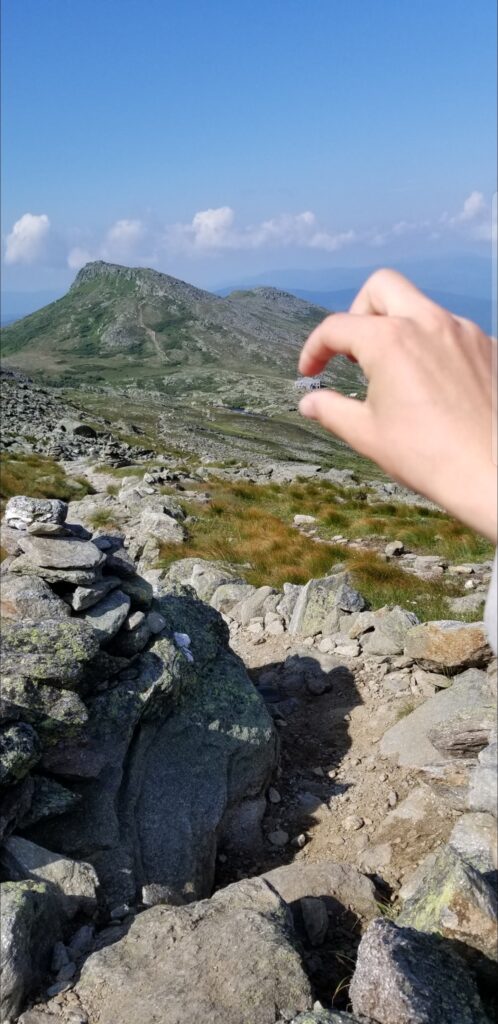
I don’t have many pictures of myself from my early hiking days on Mount Washington, but I did take an annual photo of the AMC Lakes of the Clouds Hut pinched in between my fingers. This one is from my fourth annual hike in 2019.
“Let’s frolic in the winds!” That was my rallying cry to interns and Mt. Washington State Park staff as northwesterly winds gusted into hurricane force on my first morning as a weather observer. And frolic we did – but I underestimated the influence of wind direction on perceived wind strength. While northwesterly winds tend to be less gusty on the summit (relatively flat topography to our northwest reduces turbulence), it’s much harder to seek cover in the lee of summit structures compared to wind coming from other directions.
The northwesterly flow made it particularly hard to return to the safety of the tower, as the winds accelerated when they got compressed right in front of it. While struggling to find shelter, I took off my hat. Whether to keep it from flying away or to hear better, it was a poor, absentminded decision. My hat was fine – the ski goggles that I forgot were attached to my hat, however, blew off my head while I not-so-elegantly slipped on some ice.
After struggling back inside, I grabbed a pair of loaner goggles. During a second go-around of the deck, I found my goggles slumped against the railing, and triumphantly returned indoors. But this fledgling weather observer, in his eternal wisdom, forgot that his glasses were underneath his goggles while they flew off. After a third circuit of the deck, I miraculously found them, too. They seemed blurry when I put them on in the weather station, and I quickly realized that a lens, of course, broke off. The melting rime ice, coupled with the still-elevated winds, made it impossible to find the lens during my fourth and final circuit, so I called it a day.
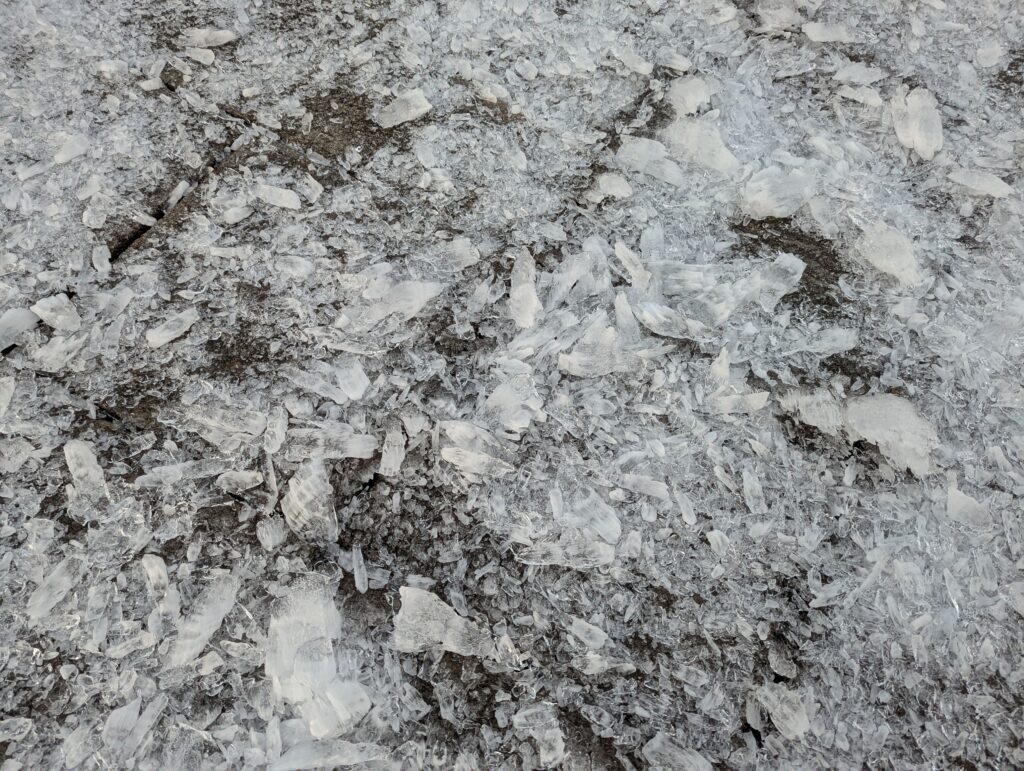
This is what the partially-melted rime ice looked like on the observation deck on my first day. If battling those winds was hard, battling them while looking for a loose lens in a deck full of this is near impossible!
Perhaps I removed my hat because I was distracted by a thought going through my head: “This is scary.” While feeling Mount Washington’s power has historically been a fun, thrilling experience, my inability to seek shelter as easily as I was used to triggered a response with which I was unfamiliar. My overconfidence in my experience and obliviousness of the conditions cost me my gear, but those lapses in judgment are not unique to me. Indeed, they are some of the most common and dangerous errors in the Whites. Their volatility is due to the fact that they are entirely subjective; a hiking guide could put you on the right trail and equip you with the best gear, but overconfidence is completely up to the individual. Therefore, accounting for such mistakes is also up to the individual, and the best way to account for them is to live through them. That way, the next time I think about removing my hat in hurricane-force winds, I can call upon the experience I had on my first day to temper that instinct.
Throughout my little ordeal, I was lucky: unlike most, I had access to the weather tower and could acquire that loaner pair of goggles. Losing this gear was my first mistake as a weather observer, and, unfortunately, it won’t be my last – but, armed with a fresh set of specs and an updated prescription, I have a clearer view of why those mistakes are important and how to prevent them going forward.
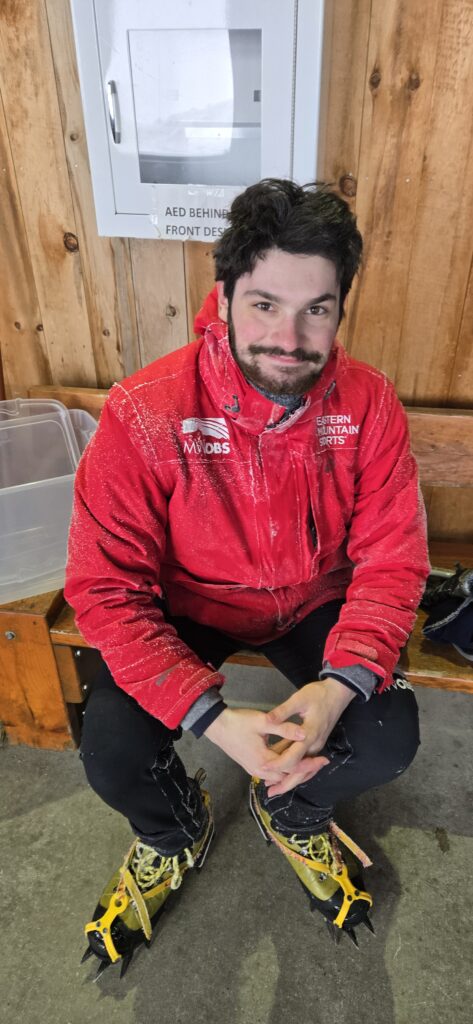
Me during my first trip to the summit as an MWOBS employee in February, 2025, returning from an outdoor excursion with excitement for the future and a fresh coat of rime.
How to Not Lose Your Gear on Your First Day as a Weather Observer
How to Not Lose Your Gear on Your First Day as a Weather Observer By Misha Leyfer Within my first 24 hours as a weather observer at MWOBS, I managed to lose two important
From One Mountain to the Next
From One Mountain to the Next By Ellie Derry Hi everyone! My name is Ellie Derry and I am one of the fall 2026 interns at the Observatory. I’m super excited to be here
Mountains and Meteorology: What More Could a Girl Need?
Mountains and Meteorology: What More Could a Girl Need? By Emily Grainger Hi everyone! My name is Emily Grainger, and I am one of this fall’s Summit Interns atop Mount Washington! I’m from Orlando,