
June 2025 By The Numbers
By Ryan Knapp
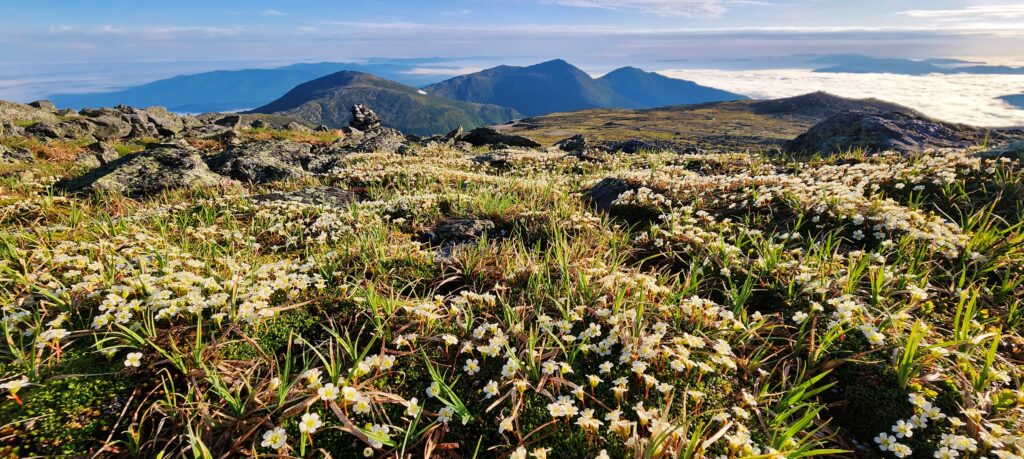
Diapensia in bloom in June. Photo taken 2025-06-19 by Ryan Knapp.
July has arrived, so it is a perfect time to look back and summarize June 2025 and the 2024/2025 snowfall season, which ended on June 30. If I were to use adjectives to summarize June 2025’s weather conditions on the summit, they would be warm, foggy, and windy. To find out why, let’s look back at some of the stats for June 2025:
Our average temperature for June 2025 was 47.1°F (9°C), which is 1.6°F above the 1991-2020 30-year normal for our station. Our warmest temperature recorded in June 2025 was 65°F (18.3°C) on June 23. Our coldest temperature recorded in June 2025 was 26°F (-3.3°C) on June 1.
In terms of winds, our average for June 2025 was 31.0 mph, which was 4.2 mph above the 1991-2020 30-year normal for our location. Our highest wind gust recorded for June 2025 was 124 mph from the northwest on June 20. The peak wind gust of 124 mph was the fourth highest June wind gust in our dataset). June 2025 had 8 days with gusts of 73 mph or greater.
As for our weather during June 2025, we averaged 28% of the possible sunshine. The summit had 0 days that were noted as clear or mostly clear, and there were 4 partly sunny days. The remaining 26 days were filed under mostly cloudy, cloudy, or obscured (fog). We had 28 days with at least some amount of fog recorded during a 24-hour period. We had 23 days with rain/drizzle and four days with snow/sleet.
In terms of total liquid-equivalent precipitation (which reflects the liquid collected from rain and by melting the freezing and frozen precipitation types collected after measuring their depth) during June 2025, the summit of Mt Washington received 6.34 inches, which was 2.25 inches below the 1991-2020 30-year normal for our location. The summit received 1.3 inches of snow/sleet, which was +/-0.0 inches for our location’s 1991-2020 30-year normal.
For Mt Washington, our precipitation/snowfall season went from July 1, 2024 until June 30, 2025. In terms of total liquid-equivalent precipitation (which, again, reflects the liquid collected from rain and by melting the freezing and frozen precipitation types collected after measuring their depth) during the 2024/25 season, the summit of Mt Washington received 89.07 inches, which was 2.16 inches below the 1991-2020 30-year normal for our location. During the 2024/25 season, the summit received 290.4 inches of snow/graupel/sleet/snow pellets/hail, 8.6 inches above our location’s 1991-2020 30-year normal.
If you are interested in additional weather data, please check out our F-6 page (updated nightly), our Normals, Means, and Extremes page, our Current Conditions page, and our 48-Hour Higher Summits Forecast. If you are interested in supporting the work we do at our weather station, please consider donating or becoming a member. Or, please consider donating to me and/or my Seek the Peak team, the Knights of Nimbus, during our largest annual fundraiser.

From One Mountain to the Next
From One Mountain to the Next By Ellie Derry Hi everyone! My name is Ellie Derry and I am one of the fall 2026 interns at the Observatory. I’m super excited to be here

Mountains and Meteorology: What More Could a Girl Need?
Mountains and Meteorology: What More Could a Girl Need? By Emily Grainger Hi everyone! My name is Emily Grainger, and I am one of this fall’s Summit Interns atop Mount Washington! I’m from Orlando,
My Fear of Weather Became a Love of Meteorology
My Fear of Weather Became a Love of Meteorology By Kaitlin Farrell Hello! My name is Kaitlin Farrell. I am one of the fall summit interns here at Mount Washington Observatory. I recently graduated