
Mount Washington Virtual Tour Takes Summit Access to New Levels
By Charlie Buterbaugh
Worcester Polytechnic Institute (WPI) students started working with the Observatory’s science education team in summer 2024 with an ambitious purpose: improve accessibility and the overall Mount Washington summit visitor experience.
Initially, WPI students discussed different areas of need with Mount Washington Observatory (MWOBS) staff, focusing on what would benefit MWOBS while also fitting into WPI’s goal of providing students with real projects with strong technological and sociological components.
“While many potential projects were identified within our active areas of scientific research, ultimately, the need to support our summit museum was selected due to the capacity limitations we have in that area,” said Brian Fitzgerald, MWOBS Deputy Director, who serves as the partnership’s primary sponsor. “MWOBS is active as a nonprofit in many areas such as weather operations, research, and education, so having additional capacity to support our education staff is key to helping us learn from visitors about how effective our current museum is operating, and what improvements we can make in the near and short term.”
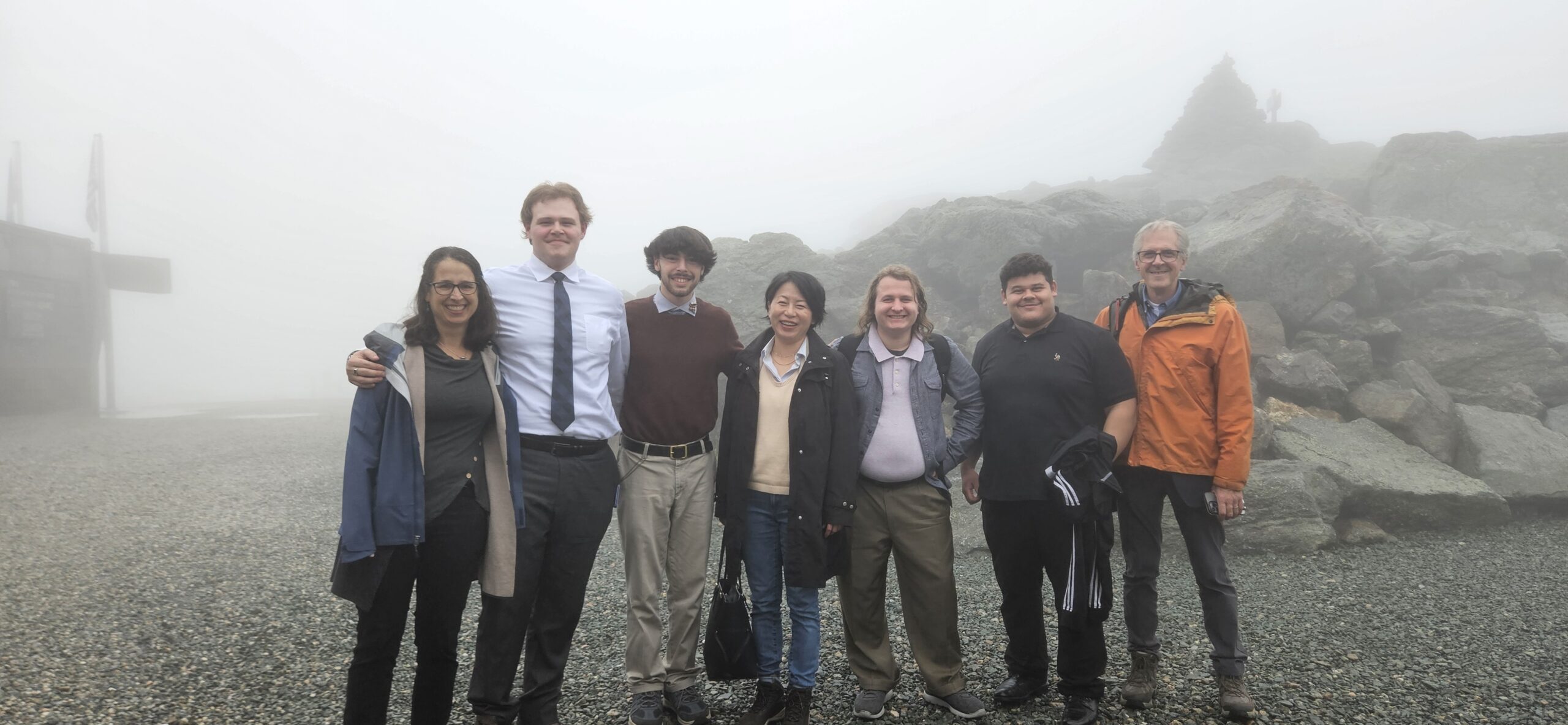
Corey Dehner, director of Worcester Polytechnic Institute’s (WPI) White Mountains Project Center, left, stands with project team members on Mount Washington’s summit, including E. Minot Wood, Evan Williams, WPI President Grace Wang, Nathan Craiglow, Jeffrey Ponce Lopez, and WPI project advisor Marc Trudeau.
A visitor survey and assessment of the summit museum was conducted in 2024, laying the groundwork for subsequent years. One piece that was of particular interest in the first year was a question of accessibility for visitors to the mountain, and for those who may never get the chance to visit.
“Very quickly, this motivated a new project in our second year as a sponsor, which was the creation of a 360-degree virtual tour,” Fitzgerald said. “This project not only resulted in a product that greatly improves accessibility opportunities for visitors, but also serves as an important opportunity to engage multiple stakeholders on Mount Washington to provide a comprehensive picture of the mountain that is otherwise very difficult to navigate both literally and figuratively at times.”
The WPI students recently launched the latest version of a 360-degree virtual tour of the summit of Mount Washington to immerse viewers from any location in the mountain’s history, recreation, partnerships, stunning panoramic visuals, and role in extreme weather science. Anyone can view the tour on MWOBS’s homepage at mountwashington.org/education/.
The project is part of WPI’s White Mountains Project Center and broader Global Projects Program, which places students in communities around the world to work on real-world problems. WPI has more than 50 project centers on six continents where students have the opportunity to spend a full term completing academic projects that are required for graduation.
The concept is based on the idea that students benefit greatly from putting the theory they learn in the classroom into practice. The White Mountains Project Center was established in 2022 as a pilot, and then formally in 2023, with student teams spending seven weeks each fall working on projects with community sponsors.
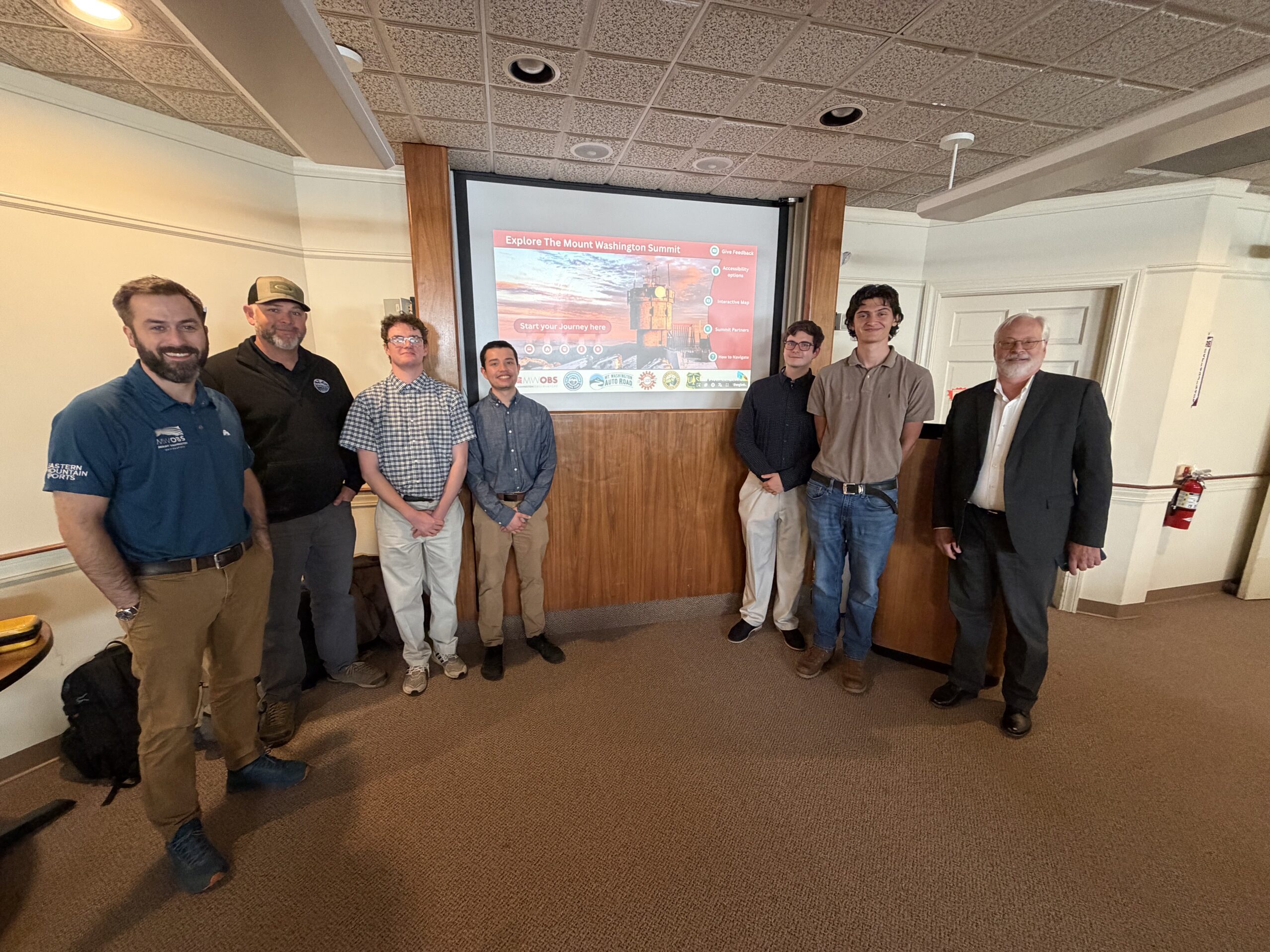
Project sponsor Brian Fitzgerald, MWOBS Deputy Director, left, and Mt. Washington Auto Road General Manager Tobey Reichert stand with WPI project team members and 2026 WPI project advisor Kent Rissmiller, right, after they shared the latest virtual tour in October 2026.
The students looked at different ways of executing virtual tours, analyzing the application at numerous museums and other sites. They also talked to many MWOBS staff and conducted several interviews with mountain partners, including the Mount Washington Cog Railway, Mt. Washington Auto Road, Mt. Washington State Park, Appalachian Mountain Club, and White Mountain National Forest.
Content for the virtual tour was developed over the course of two different project groups, with the initial student cohort beginning their work in earnest in late summer/early fall of 2025.
WPI students researched and identified a virtual tour platform, conducted research and interviews with tour experts, worked with MWOBS and mountain partners to identify learning objectives, and storyboarded key sites on the mountain to capture footage.
Over the span of a few weeks, they used 360-degree cameras and audio recording to capture images and videos of various parts of the top of Mount Washington, often times waiting for ideal weather conditions for outdoor footage.
“The student groups got to spend overnights on the summit with the weather observers. What an incredible experience for students to see the MWOBS important work in real time and experience the highest summit in the northeast with the most extreme weather, without any visitors ,” said Corey Dehner, director of the project center and an associate professor of teaching at WPI.
Dehner explained that “the best sponsors are those that are so passionate about what they do, that it’s contagious, and that’s MWOBS. They helped students gain an appreciation for observatory and weather research. It’s a perfect match and we look forward to the partnership continuing for a long time. They’re excellent educators and mentors for our students.”
As of early October 2026, visits to the virtual tour have exceeded 54,000, with multiple partners hosting the tour on their websites. Interest in the project has also resulted in the purchase of a MetaQuest VR headset that MWOBS is now beginning to use at a variety of outreach events across the region. Additionally, the Mount Washington Cog Railway and Mt. Washington Auto Road have now received and constructed touch screen exhibits featuring the virtual tour for visitors to their mountain base museums.
What are next steps for the project?
“Our latest cohort of highly capable WPI students has helped us to extend the tour from the summit of the mountain to the three primary pathways by which visitors come to top: hiking, the Auto Road, and the Cog Railway, “Fitzgerald said. “Our hope is to work with another cohort of students to build out a K-12 version of the virtual tour that motivates students to go on a learning journey either as a standalone activity, or as a learning opportunity helping prepare and/or reflect on a field trip program with MWOBS. Mt. Washington State Park has also expressed interest in further developing a virtual reality or related exhibit experience for visitors to the summit as well.”
###
Support work like this with a donation to our 2026 Year-End Campaign. If you give today, your gift will be matched from now until the end of the year. Give online HERE.
Who Really Sees the Worst Weather: Mount Washington or the South Pole?
Who Really Sees the Worst Weather: Mount Washington or the South Pole? By Bailey Nordin When I stepped out of the snowcat on my first day as an observer last January into thick fog,

How to Not Lose Your Gear on Your First Day as a Weather Observer
How to Not Lose Your Gear on Your First Day as a Weather Observer By Misha Leyfer Within my first 24 hours as a weather observer at MWOBS, I managed to lose two important
From One Mountain to the Next
From One Mountain to the Next By Ellie Derry Hi everyone! My name is Ellie Derry and I am one of the fall 2026 interns at the Observatory. I’m super excited to be here