
Ridgelines and Ravines: A Winter Exploring on Mount Washington
By Marin MacDonald
It’s been a cold and windy winter up here on the summit!
Since my last blog post, I’ve learned how to forecast both winter weather and avalanche hazards, collected snow observations, conducted new research, and joined the Subarctic Surf Club.
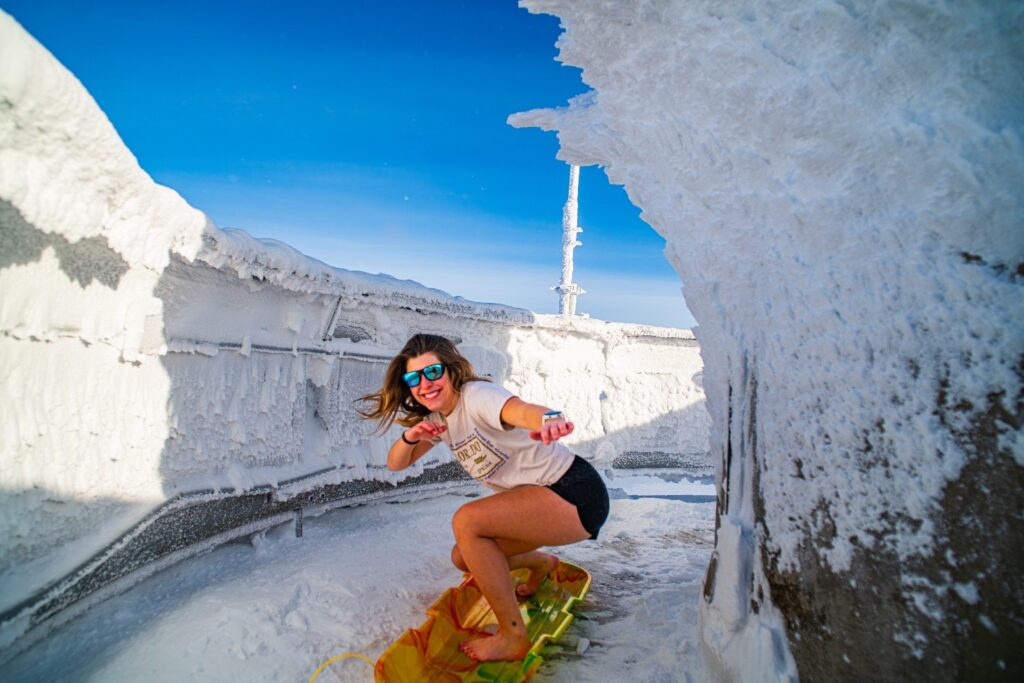
Never too cold for a summit surf!
Over the past few months on the summit, we’ve had stunning sunrises and sunsets, days on end in the fog, and everything in between. A few weeks ago, we even had two days of sustained 100 mph winds with gusts up to 138 mph! It was an entirely new experience being out in winds so strong, it slid you across the deck all on its own!
On the weeks I’m not on the summit, I’ve had the awesome opportunity to work with the Mount Washington Avalanche Center (MWAC)! This involves a lot of time in the field gathering observations on and around Mount Washington, and has allowed me to explore the mountains I grew up in from a new perspective. Since avalanche conditions can vary significantly depending on the aspect, elevation, and location of a slope, deciding where to go and which observations will be most valuable to the MWAC team and to the public can be a challenge. I have really enjoyed this aspect of working for the avalanche center because it has meant getting to explore and travel through all different kinds of terrain!
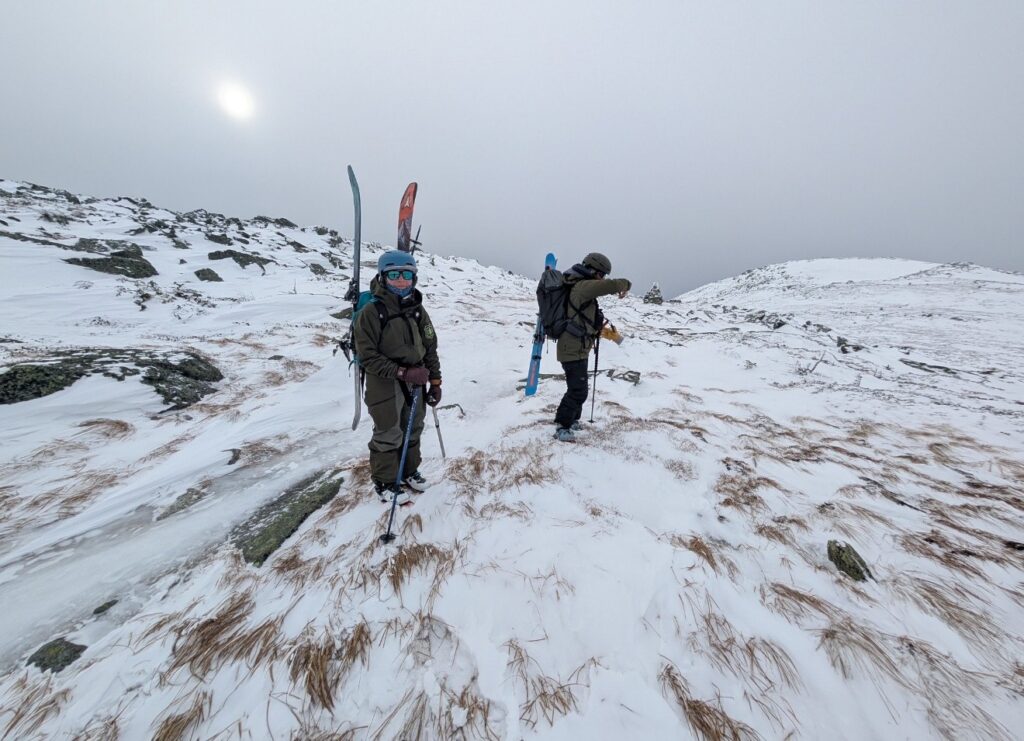
Traversing from the Summit cone to Gulf of Slides on the Davis Path (Marin pictured left in the blue helmet)
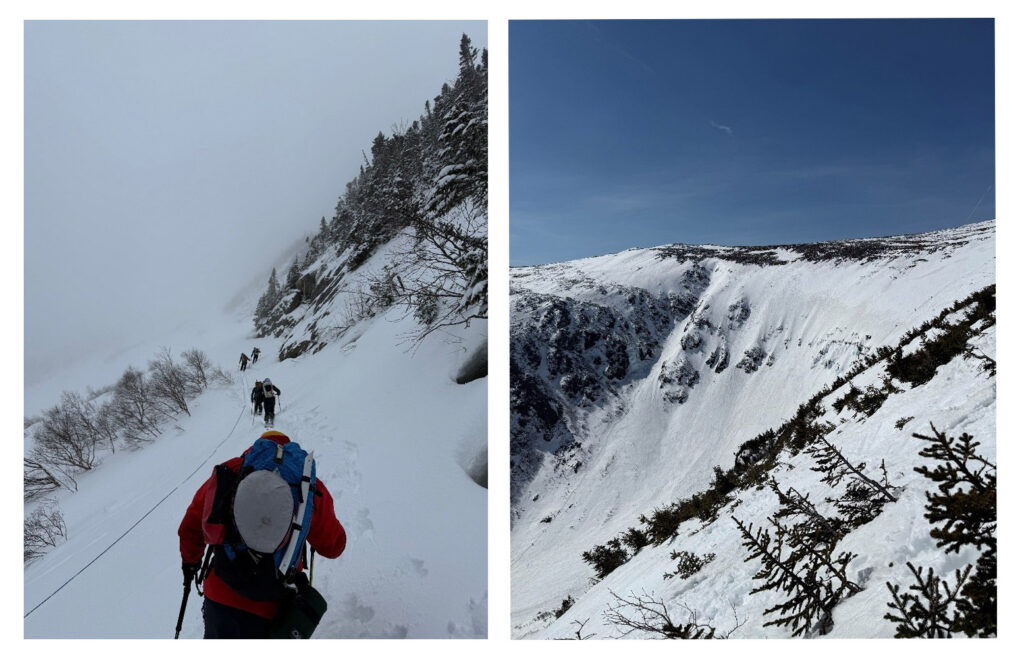
Practicing rescue drills under Empress (left), and view of Tuckerman Ravine from the top of Lobster Claw (right).
In addition to exploring the mountains and experiencing extreme weather, I have gotten to learn how to forecast! One of my favorite parts of being a scientist is getting to share the topics I’m passionate about with others, and this internship has allowed me to do that in a new context. With my background mainly in research, I did not have experience writing in the blended science communication/public safety messaging style required for forecasting. However, learning this skill has allowed me to share the things I’m passionate about- like snow- with people daily in a way that has an immediate impact, which is something that any scientist would be stoked on!
Although I was initially excited to learn how to forecast, I think it has become the part of my internship that I have grown to enjoy the most. The forecasts developed by both MWOBS and MWAC are essential to the outdoor community here, and I am really appreciative that I have gotten to be a small piece of that.
So, thanks for reading, and cheers to snow!
To learn more about Marin’s research on on Solid-to-Liquid Climatology on Mount Washington in collaboration with Mees Franssen, visit mountwashington.org/research/intern-research-projects/.
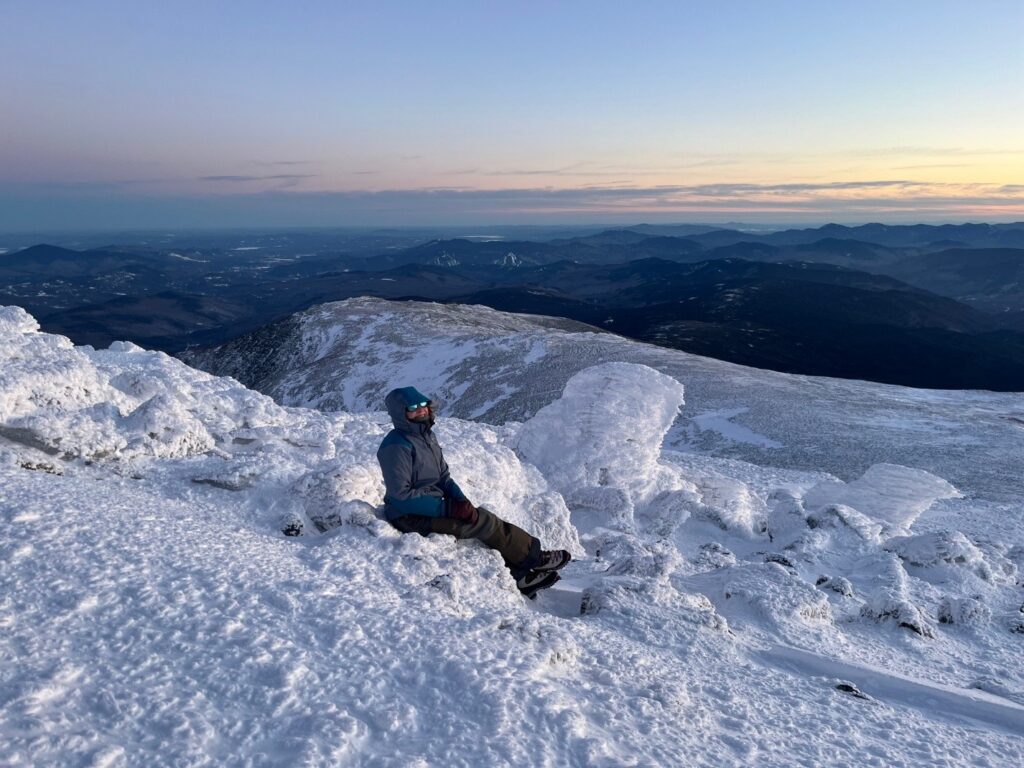
Enjoying sunset at Goofers Point.
From One Mountain to the Next
From One Mountain to the Next By Ellie Derry Hi everyone! My name is Ellie Derry and I am one of the fall 2026 interns at the Observatory. I’m super excited to be here
Mountains and Meteorology: What More Could a Girl Need?
Mountains and Meteorology: What More Could a Girl Need? By Emily Grainger Hi everyone! My name is Emily Grainger, and I am one of this fall’s Summit Interns atop Mount Washington! I’m from Orlando,
My Fear of Weather Became a Love of Meteorology
My Fear of Weather Became a Love of Meteorology By Kaitlin Farrell Hello! My name is Kaitlin Farrell. I am one of the fall summit interns here at Mount Washington Observatory. I recently graduated