
Temperature:      Wind Speed:      Gust:      Wind Chill:      Direction:    Switch to Metric

Temperature:

Wind Speed:      Gust:

Wind Chill:      Direction:
   Switch to Metric

Citizen Science Puts Weather Reporting in Your Hands
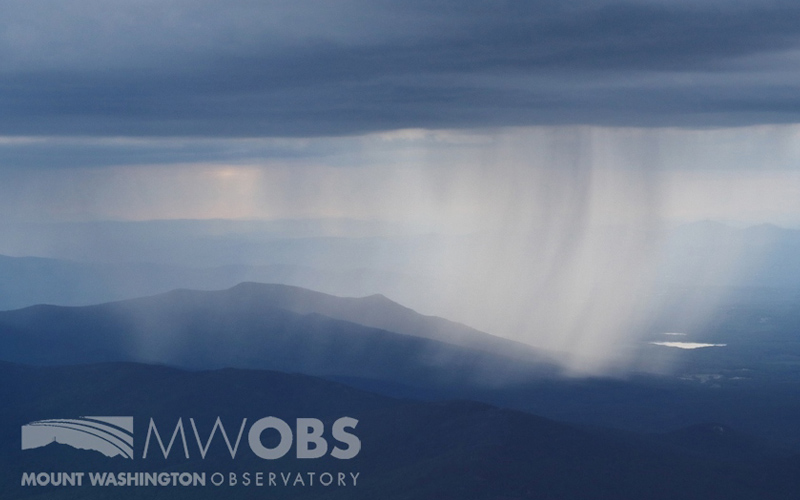
A distant shower falls over Mount Martha, NH (aka, Cherry Mountain). 
If you’re anything like me, you probably have an app or two dedicated to weather on your phone. Maybe you have a preferred app for weather forecasts, another for radar data, and yet another for satellite data. Or maybe instead of apps, you have several go-to websites bookmarked for various weather data.
Weather information keeps us informed so that we can prepare appropriately for the weather ahead, short-term or long-term. With colder weather in the forecast, we might pack a few extra layers or pull in a few more logs for the stove. Or, we might receive a warning about a severe storm heading your direction, and so we pack up, head indoors, and keep an eye on its progress.
While your favorite apps or websites might be providing you with weather data, did you know there are a few apps/sites that you can utilize and provide current weather data to aid in research as a citizen scientist?
Here are some apps that I have on my phone and might be of interest to you:
Mountain Rain or Snow
Remote sensing is improving and aiding in filling weather data gaps. However, precipitation phase changes can be difficult over mountainous terrain, and weather stations only provide information at a static location. That is where human observations aid in detailing how precipitation phase changes vary in time and space. Using these apps, with a few taps you can send observations of precipitation during storms at your location.
Forecasting
NOAA National Severe Storms Laboratory is collecting weather reports through the free app mPING. What’s “mPING?” It is an acronym for Meteorological Phenomena Identification Near the Ground. The data in turn help define the precipitation that is falling at your location and improve forecasts and radar techniques. That in turn filters down to improve those various other weather apps you might be using for forecasts and radar data.
Cloud Types and Sky Conditions 
GLOBE Observer Clouds can be used to observe clouds, mosquito habitats, land cover, and trees. With the cloud observation aspect, you can help document cloud cover, cloud types, cloud opacity, sky conditions, visibilities, and surface conditions along with photographic examples. It is a bit more involved than the prior reporting apps, but with a few taps and snaps, you can contribute your real-world observations for better understanding and interpretation of satellite data vs surface data.

Ryan Knapp, Weather Observer & Meteorologist

1712, 2010

NULL

December 17th, 2010|Categories: Historical Posts|

NULL 2010-12-17 23:14:58.000 - Stacey Kawecki,  Observer and Meteorologist NULL This week we have Charlie and Janine Kinney - long time veteran volunteers - on the rock pile with us. I had been preparing mentally for some time. I know their cooking style: decadent, delicious, and bountiful.

1612, 2010

Volunteer Blurb

December 16th, 2010|Categories: Historical Posts|

Volunteer Blurb 2010-12-16 16:26:42.000 - Sue And Mike Zlogar,  Summit Volunteers Undercast Another week finishes on the summit for Mike and me; as always Brian, Ryan, Mike and soon to be returning to Seattle the summit's awesome intern Erica, were fabulous crew mates to serve with on

1512, 2010

NULL

December 15th, 2010|Categories: Historical Posts|

NULL 2010-12-15 16:35:01.000 - Mike Carmon,  Staff Meteorologist Land Ho! Winter shift changes are almost always more eventful than summer ones. True, there are no tourist vehicles on the road. But the dangers of snow, wind, freezing fog, and mechanical failures are much more daunting than a

Share This Post

Support Us

Mount Washington Observatory is a nonprofit research and educational institution working to advance understanding of Earth’s weather and climate.

We cannot do this without your support!

Summer Heat?

September 6th, 2010|Comments Off on Summer Heat?

Summer Heat? 2010-09-06 22:25:38.000 - Ryan Knapp,  Staff Meteorologist Does our summers heat stack up like these clouds? In June, I predicted to my coworkers that this summer would break our stations all time high

Shoulder Seasons

September 5th, 2010|Comments Off on Shoulder Seasons

Shoulder Seasons 2010-09-05 20:15:54.000 - Mike Finnegan,  IT Observer For being 35F, foggy, and with the occasional rain shower, there sure were a lot of people up on the summit today. They came in all

In the wake of Earl

September 4th, 2010|Comments Off on In the wake of Earl

In the wake of Earl 2010-09-04 17:35:37.000 - Brian Clark,  Observer and Meteorologist NULL What is now Tropical Storm Earl has passed by and will soon become extratropical as it merges with a cold front

Find Older Posts

Go to Top