
Temperature:      Wind Speed:      Gust:      Wind Chill:      Direction:    Switch to Metric

Temperature:

Wind Speed:      Gust:

Wind Chill:      Direction:
   Switch to Metric

Citizen Science Puts Weather Reporting in Your Hands
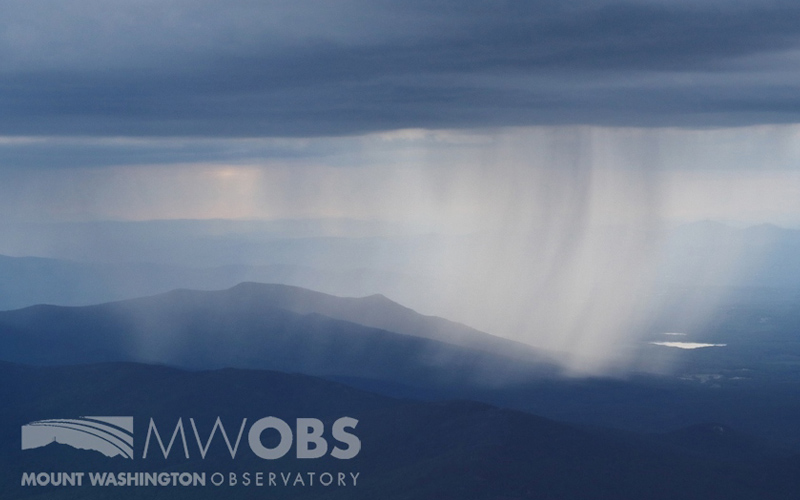
A distant shower falls over Mount Martha, NH (aka, Cherry Mountain). 
If you’re anything like me, you probably have an app or two dedicated to weather on your phone. Maybe you have a preferred app for weather forecasts, another for radar data, and yet another for satellite data. Or maybe instead of apps, you have several go-to websites bookmarked for various weather data.
Weather information keeps us informed so that we can prepare appropriately for the weather ahead, short-term or long-term. With colder weather in the forecast, we might pack a few extra layers or pull in a few more logs for the stove. Or, we might receive a warning about a severe storm heading your direction, and so we pack up, head indoors, and keep an eye on its progress.
While your favorite apps or websites might be providing you with weather data, did you know there are a few apps/sites that you can utilize and provide current weather data to aid in research as a citizen scientist?
Here are some apps that I have on my phone and might be of interest to you:
Mountain Rain or Snow
Remote sensing is improving and aiding in filling weather data gaps. However, precipitation phase changes can be difficult over mountainous terrain, and weather stations only provide information at a static location. That is where human observations aid in detailing how precipitation phase changes vary in time and space. Using these apps, with a few taps you can send observations of precipitation during storms at your location.
Forecasting
NOAA National Severe Storms Laboratory is collecting weather reports through the free app mPING. What’s “mPING?” It is an acronym for Meteorological Phenomena Identification Near the Ground. The data in turn help define the precipitation that is falling at your location and improve forecasts and radar techniques. That in turn filters down to improve those various other weather apps you might be using for forecasts and radar data.
Cloud Types and Sky Conditions 
GLOBE Observer Clouds can be used to observe clouds, mosquito habitats, land cover, and trees. With the cloud observation aspect, you can help document cloud cover, cloud types, cloud opacity, sky conditions, visibilities, and surface conditions along with photographic examples. It is a bit more involved than the prior reporting apps, but with a few taps and snaps, you can contribute your real-world observations for better understanding and interpretation of satellite data vs surface data.

Ryan Knapp, Weather Observer & Meteorologist

211, 2010

From Fog to Beauty

November 2nd, 2010|Categories: Historical Posts|

From Fog to Beauty 2010-11-02 14:14:03.000 - Mike Finnegan,  IT Observer Undercast Glory at Sunrise Finally...the sun has decided to show his face again! Although Thursday was a beautiful day, it has been since then that we have been in the fog. Nonetheless, I was still able

111, 2010

Looking back at October

November 1st, 2010|Categories: Historical Posts|

Looking back at October 2010-11-01 22:17:22.000 - Brian Clark,  Observer and Meteorologist NULL Well, October is officially in the books, both figuratively and literally. Well, almost literally.Ryan is in the process of finishing up monthly check, which is a process that our meteorological observers go through after

3110, 2010

Halloween

October 31st, 2010|Categories: Historical Posts|

Halloween 2010-10-31 18:15:59.000 - Ryan Knapp,  Staff Meteorologist Trick or Treat? Happy Halloween!At this moment, people are getting dressed up for trick or treating or various parties they have planned. Porch lights are coming on and bowls of candy are being prepared to hand out. And in

Share This Post

Support Us

Mount Washington Observatory is a nonprofit research and educational institution working to advance understanding of Earth’s weather and climate.

We cannot do this without your support!

Go time!

July 23rd, 2010|Comments Off on Go time!

Go time! 2010-07-23 10:13:51.000 - Brian Clark,  Observer and Meteorologist Seak the Peak 10, the biggest event in the history of the Observatory, is officially here! Executive Director Scot Henley, other valley staff, and a

STP!!

July 22nd, 2010|Comments Off on STP!!

STP!! 2010-07-22 15:32:57.000 - Brian Clark,  Observer and Meteorologist Yesterday was an eventful day. Not only was it the usual shift change day, which is always busy, but it was a busy weather day as

Volunteer notes

July 21st, 2010|Comments Off on Volunteer notes

Volunteer notes 2010-07-21 20:16:14.000 - Susan Freeborn and Rob Maier,  Summit Volunteers Tower views The summit of Mt. Washington has always had a special place in our hearts, although we've come from different directions to

Find Older Posts

Go to Top