
Temperature:      Wind Speed:      Gust:      Wind Chill:      Direction:    Switch to Metric

Temperature:

Wind Speed:      Gust:

Wind Chill:      Direction:
   Switch to Metric

Citizen Science Puts Weather Reporting in Your Hands
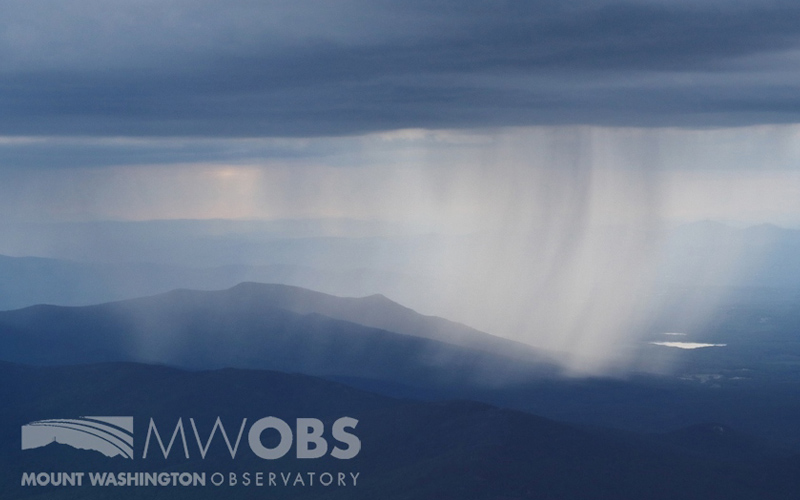
A distant shower falls over Mount Martha, NH (aka, Cherry Mountain). 
If you’re anything like me, you probably have an app or two dedicated to weather on your phone. Maybe you have a preferred app for weather forecasts, another for radar data, and yet another for satellite data. Or maybe instead of apps, you have several go-to websites bookmarked for various weather data.
Weather information keeps us informed so that we can prepare appropriately for the weather ahead, short-term or long-term. With colder weather in the forecast, we might pack a few extra layers or pull in a few more logs for the stove. Or, we might receive a warning about a severe storm heading your direction, and so we pack up, head indoors, and keep an eye on its progress.
While your favorite apps or websites might be providing you with weather data, did you know there are a few apps/sites that you can utilize and provide current weather data to aid in research as a citizen scientist?
Here are some apps that I have on my phone and might be of interest to you:
Mountain Rain or Snow
Remote sensing is improving and aiding in filling weather data gaps. However, precipitation phase changes can be difficult over mountainous terrain, and weather stations only provide information at a static location. That is where human observations aid in detailing how precipitation phase changes vary in time and space. Using these apps, with a few taps you can send observations of precipitation during storms at your location.
Forecasting
NOAA National Severe Storms Laboratory is collecting weather reports through the free app mPING. What’s “mPING?” It is an acronym for Meteorological Phenomena Identification Near the Ground. The data in turn help define the precipitation that is falling at your location and improve forecasts and radar techniques. That in turn filters down to improve those various other weather apps you might be using for forecasts and radar data.
Cloud Types and Sky Conditions 
GLOBE Observer Clouds can be used to observe clouds, mosquito habitats, land cover, and trees. With the cloud observation aspect, you can help document cloud cover, cloud types, cloud opacity, sky conditions, visibilities, and surface conditions along with photographic examples. It is a bit more involved than the prior reporting apps, but with a few taps and snaps, you can contribute your real-world observations for better understanding and interpretation of satellite data vs surface data.

Ryan Knapp, Weather Observer & Meteorologist

1901, 2008

Life on the summit for two weeks

January 19th, 2008|Categories: Historical Posts|

Life on the summit for two weeks 2008-01-19 20:38:55.000 - Lindsay Ventura,  Plymouth / Summit Intern My first undercast sunset Well I have been up here on the summit for eleven straight days now and it has been an incredible experience to say the least. The first

1901, 2008

Snowflakes

January 19th, 2008|Categories: Historical Posts|

Snowflakes 2008-01-19 00:40:57.000 - Ryan Knapp,  Staff Meteorologist NULL So, I will start this comment by saying thanks for everyone that left their feedback in the forums as to what to name the new cat. It seems that Marty will be the name of choice for the

1801, 2008

What is in a name.

January 18th, 2008|Categories: Historical Posts|

What is in a name. 2008-01-18 01:23:24.000 - Ryan Knapp,  Meteorologist Hello! My name is... As the proverb goes, “A rose will still smell the same, even if it called by another name.” This is certainly true, if a rose was called a bippity instead, it would

Share This Post

Support Us

Mount Washington Observatory is a nonprofit research and educational institution working to advance understanding of Earth’s weather and climate.

We cannot do this without your support!

August 2007 Progress Report

September 14th, 2007|Comments Off on August 2007 Progress Report

August 2007 Progress Report 2007-09-14 01:03:47.000 - Ryan Knapp,  Staff Meteorologist Summer is progressing nicely. August 2007 Progress ReportTo: Comment ReaderFrom: Mount Washington Observatory StaffDate: September 14, 2007Subject: Climatological StatiticsTime Frame: August 1 – 31,

Wednesday

September 12th, 2007|Comments Off on Wednesday

Wednesday 2007-09-12 20:17:09.000 - Stacey Kawecki,  Observer NULL Wednesday. For most people, Wednesday is considered to be the middle of the week, “hump day”. Once you get past that middle day, all you’ve got is

Things to talk about.

September 10th, 2007|Comments Off on Things to talk about.

Things to talk about. 2007-09-10 18:11:16.000 - Zach Allen,  Meteorologist A cloud sandwich! So I am the first one to write a comment on our “new” website. This feels like getting first tracks on an

Find Older Posts

Go to Top