
Temperature:      Wind Speed:      Gust:      Wind Chill:      Direction:    Switch to Metric

Temperature:

Wind Speed:      Gust:

Wind Chill:      Direction:
   Switch to Metric

Citizen Science Puts Weather Reporting in Your Hands
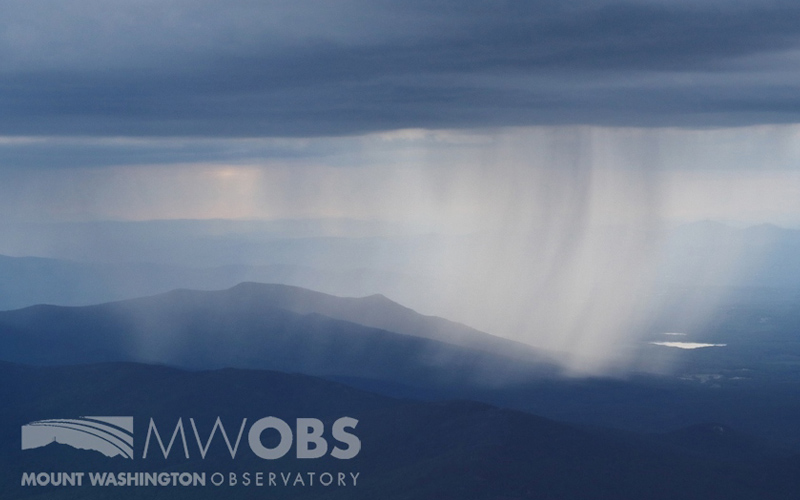
A distant shower falls over Mount Martha, NH (aka, Cherry Mountain). 
If you’re anything like me, you probably have an app or two dedicated to weather on your phone. Maybe you have a preferred app for weather forecasts, another for radar data, and yet another for satellite data. Or maybe instead of apps, you have several go-to websites bookmarked for various weather data.
Weather information keeps us informed so that we can prepare appropriately for the weather ahead, short-term or long-term. With colder weather in the forecast, we might pack a few extra layers or pull in a few more logs for the stove. Or, we might receive a warning about a severe storm heading your direction, and so we pack up, head indoors, and keep an eye on its progress.
While your favorite apps or websites might be providing you with weather data, did you know there are a few apps/sites that you can utilize and provide current weather data to aid in research as a citizen scientist?
Here are some apps that I have on my phone and might be of interest to you:
Mountain Rain or Snow
Remote sensing is improving and aiding in filling weather data gaps. However, precipitation phase changes can be difficult over mountainous terrain, and weather stations only provide information at a static location. That is where human observations aid in detailing how precipitation phase changes vary in time and space. Using these apps, with a few taps you can send observations of precipitation during storms at your location.
Forecasting
NOAA National Severe Storms Laboratory is collecting weather reports through the free app mPING. What’s “mPING?” It is an acronym for Meteorological Phenomena Identification Near the Ground. The data in turn help define the precipitation that is falling at your location and improve forecasts and radar techniques. That in turn filters down to improve those various other weather apps you might be using for forecasts and radar data.
Cloud Types and Sky Conditions 
GLOBE Observer Clouds can be used to observe clouds, mosquito habitats, land cover, and trees. With the cloud observation aspect, you can help document cloud cover, cloud types, cloud opacity, sky conditions, visibilities, and surface conditions along with photographic examples. It is a bit more involved than the prior reporting apps, but with a few taps and snaps, you can contribute your real-world observations for better understanding and interpretation of satellite data vs surface data.

Ryan Knapp, Weather Observer & Meteorologist

501, 2017

A Great Opportunity!

January 5th, 2017|Categories: Historical Posts|

A Great Opportunity! 2017-01-05 17:24:36.000 - Meghan Wells, PSU Research Intern   My name is Meghan and I am a junior meteorology major at Plymouth State University. I have the wonderful opportunity of interning at the Mount Washington Observatory in the middle of January. I believe it

101, 2017

Second Snowiest December on Record!

January 1st, 2017|Categories: Historical Posts|

Second Snowiest December on Record! 2017-01-01 21:19:13.000 - Caleb Meute, Weather Observer / Meteorologist   Well December 2016 was a bit snowier than December 2015 and just about every other December since our establishment in 1932 for that matter. 93.6 inches of snow fell on the summit

3012, 2016

The Heaviest Snow Missed Us :(

December 30th, 2016|Categories: Historical Posts|

The Heaviest Snow Missed Us :( 2016-12-30 09:08:08.000 - Adam Gill, Weather Observer/IT Specialist   Over the past few days it was looking likely that a strong coastal low was going to form near Boston and move almost directly north along the Maine and New Hampshire border.

Share This Post

Support Us

Mount Washington Observatory is a nonprofit research and educational institution working to advance understanding of Earth’s weather and climate.

We cannot do this without your support!

Why is It So Windy, Anyway?

June 13th, 2016|Comments Off on Why is It So Windy, Anyway?

Why is It So Windy, Anyway? 2016-06-13 16:37:59.000 - Tim Greene, Intern                        Mount Washington has already made national headlines a couple times this year on high wind days; this being because hurricane

Orographic Lifting

June 12th, 2016|Comments Off on Orographic Lifting

Orographic Lifting 2016-06-12 17:02:53.000 - Chris Hohman, Intern   My last post I had a large focus on learning new meteorological processes, and overall just getting my feet wet in this wonderful field. One thing

Warmer Days Ahead!

June 11th, 2016|Comments Off on Warmer Days Ahead!

Warmer Days Ahead! 2016-06-11 16:06:16.000 - Tom Padham, Weather Observer/Meteorologist   After a few chilly days on the summit with nearly 2 inches of snow, I find myself looking forward to much warmer conditions as

Find Older Posts

Go to Top