
Temperature:      Wind Speed:      Gust:      Wind Chill:      Direction:    Switch to Metric

Temperature:

Wind Speed:      Gust:

Wind Chill:      Direction:
   Switch to Metric

Citizen Science Puts Weather Reporting in Your Hands
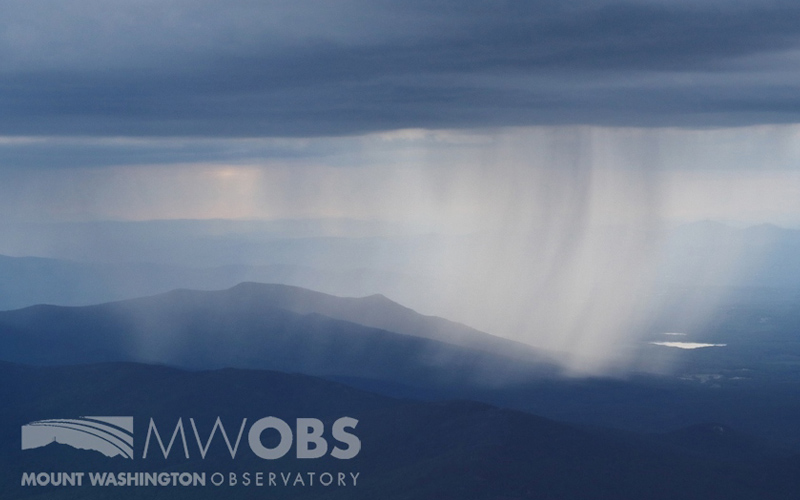
A distant shower falls over Mount Martha, NH (aka, Cherry Mountain). 
If you’re anything like me, you probably have an app or two dedicated to weather on your phone. Maybe you have a preferred app for weather forecasts, another for radar data, and yet another for satellite data. Or maybe instead of apps, you have several go-to websites bookmarked for various weather data.
Weather information keeps us informed so that we can prepare appropriately for the weather ahead, short-term or long-term. With colder weather in the forecast, we might pack a few extra layers or pull in a few more logs for the stove. Or, we might receive a warning about a severe storm heading your direction, and so we pack up, head indoors, and keep an eye on its progress.
While your favorite apps or websites might be providing you with weather data, did you know there are a few apps/sites that you can utilize and provide current weather data to aid in research as a citizen scientist?
Here are some apps that I have on my phone and might be of interest to you:
Mountain Rain or Snow
Remote sensing is improving and aiding in filling weather data gaps. However, precipitation phase changes can be difficult over mountainous terrain, and weather stations only provide information at a static location. That is where human observations aid in detailing how precipitation phase changes vary in time and space. Using these apps, with a few taps you can send observations of precipitation during storms at your location.
Forecasting
NOAA National Severe Storms Laboratory is collecting weather reports through the free app mPING. What’s “mPING?” It is an acronym for Meteorological Phenomena Identification Near the Ground. The data in turn help define the precipitation that is falling at your location and improve forecasts and radar techniques. That in turn filters down to improve those various other weather apps you might be using for forecasts and radar data.
Cloud Types and Sky Conditions 
GLOBE Observer Clouds can be used to observe clouds, mosquito habitats, land cover, and trees. With the cloud observation aspect, you can help document cloud cover, cloud types, cloud opacity, sky conditions, visibilities, and surface conditions along with photographic examples. It is a bit more involved than the prior reporting apps, but with a few taps and snaps, you can contribute your real-world observations for better understanding and interpretation of satellite data vs surface data.

Ryan Knapp, Weather Observer & Meteorologist

1003, 2015

Life On The Rock In March

March 10th, 2015|Categories: Historical Posts|

Life On The Rock In March 2015-03-10 16:53:01.000 - Dennis Rosolen, Summit Volunteer    A beautiful day for my first ride on the sno-cat, quite an experience I tell you. It seemed to be a long ride up with pushing snow and backing up, I wondered if

903, 2015

Did You Forget About This Kitty?

March 9th, 2015|Categories: Historical Posts|

Did You Forget About This Kitty? 2015-03-09 09:42:33.000 - Marty (Summit Cat), Translated by Mike Carmon   Haven't purred from me in a while, huh? There's a simple reason for that--I've been quite busy with my cat-naps and never-ending buffets of kitty treats (with a side of

803, 2015

A Dream Of Spring

March 8th, 2015|Categories: Historical Posts|

A Dream Of Spring 2015-03-08 17:02:10.000 - Tom Padham, Weather Observer/Meteorologist   With the bulk of a cold and snowy winter behind us, I find myself dreaming of the warmer and longer days of summer. This brought me to the question: when does Mount Washington typically see

Share This Post

Support Us

Mount Washington Observatory is a nonprofit research and educational institution working to advance understanding of Earth’s weather and climate.

We cannot do this without your support!

Rain, Then Snow on the Summit

November 24th, 2014|Comments Off on Rain, Then Snow on the Summit

Rain, Then Snow on the Summit 2014-11-24 16:53:46.000 - Michael Dorfman, Weather Observer/IT Specialist   While rain pushes through the area today (see above), we’re all on the edge of our seats monitoring the forecast

When Friends Become Family

November 23rd, 2014|Comments Off on When Friends Become Family

When Friends Become Family 2014-11-23 18:57:20.000 - Kaitlyn O'Brien, Weather Observer/Education Specialist   There’s hardly ever a dull moment on the summit. If we’re not forecasting, taking hourly observations, providing live interactive programs to students

Blowing Snow on the Summit

November 22nd, 2014|Comments Off on Blowing Snow on the Summit

Blowing Snow on the Summit 2014-11-22 17:42:36.000 - Michael Dorfman, Weather Observer/IT Specialist   Mount Washington is in the fog around 60 percent of the year, but fog isn’t the only thing that can reduce

Find Older Posts

Go to Top